


This summer, doctors in St Louis, Missouri, shaved away a small part of a person’s skull and replaced it with electrodes. The technology is intended to alleviate severe depression by sending tiny electric pulses to the brain.
Inner Cosmos, the start-up behind the surgery, is one of a growing cadre of tech companies working on implanted devices for the brain.
The trial, the first of its kind using implants in the bone of the skull to treat depression, represents a step forward for scientists’ efforts to treat mood disorders with hardware. It is also a sign of progress for implants that sit within the skull.
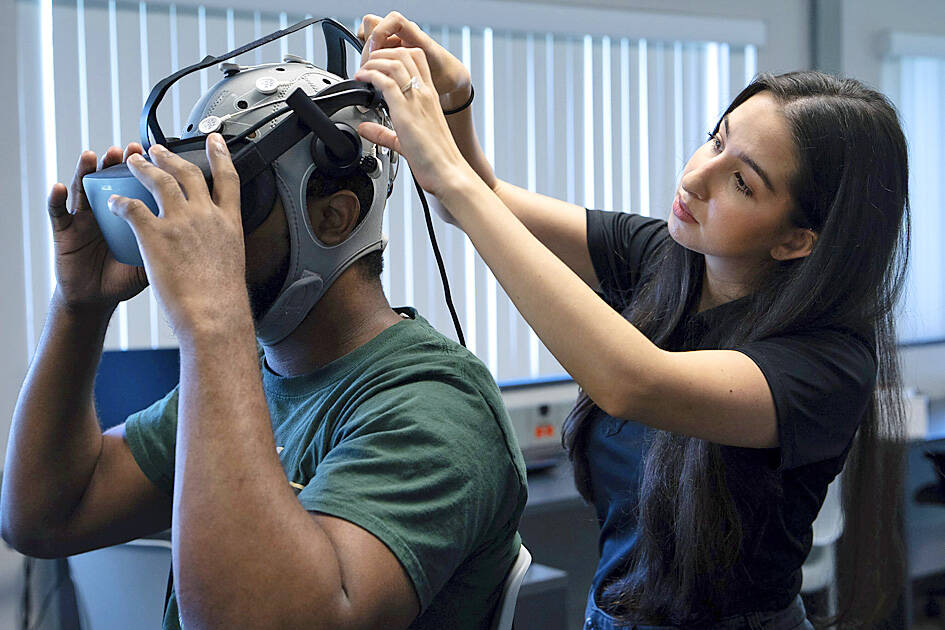
Photo: AP
“Any time you get a technology in a patient is a major milestone,” said Benjamin Rapoport, a New York-based brain surgeon who works with another company in the field.
Other high-profile brain-related start-ups are focused on helping people cope with paralysis. Elon Musk says his company, Neuralink Corp, has enabled monkeys to play video games with their minds. Synchron Inc recently started its first US human trial, which it hopes will let a person send e-mails and texts using only thoughts.
Unlike these companies, Inner Cosmos is focused on moods. It also uses a different type of surgery. It is less invasive than the technique planned by Neuralink, which has raised more than US$360 million, and aims to place electrodes deeper inside the brain.
The simpler the surgery, the more people are likely to be open to it, Inner Cosmos chief executive officer Meron Gribetz said.
That is helpful for the company’s goal of creating a new mass-market tool for treatment-resistant depression, which affects an estimated 2.8 million US adults.
As the technology around brain implants develops, more companies have pursued methods of embedding a device that do not require piercing the brain.
“Whether it penetrates brain tissue or not is a deep divide” when it comes to next-generation neuromodulation surgery, said Rapoport, who is cofounder of brain-computer interface company Precision Neuroscience Corp, which is focused on placing electrodes just inside the skull, on top of the brain.
In Los Angeles, Kernel has moved away from deeper brain implants and is building an electrode-studded helmet that accomplishes similar goals, but requires no surgery. New York-based Synchron, which has raised more than US$60 million, avoids brain surgery by sending electrodes to the brain through blood vessels, in a stent.
The overall idea is not new: Implanted electrodes have a years-long track record of treating epilepsy and Parkinson’s.
What is noteworthy about Inner Cosmos is its ability to capture what scientists call high-resolution local field potentials — localized electrical potential from the surface of the brain that overcome the randomness of individual neuron recordings — while not penetrating into the brain itself. If it works, the technique could eventually treat a much broader range of cognitive disorders.
Inner Cosmos said surgery went well for its first patient. Once a day for about 15 minutes, the implant sends pulses to the person’s left dorsalateral prefrontal cortex while measuring neuronal activity to gauge and adjust the correct amount of stimulation. The trial is to last for one year, and might add one or two more patients.
Neuroscientists have debated which part of the brain to target to achieve the best results in depression treatments. The area Inner Cosmos targets is similar to that of another technique, known as transcranial magnetic stimulation, which does not require surgery, but takes longer to implement than the Inner Cosmos device.
There are trade-offs for brain devices that do not go deeper into people’s heads.
Stanford University neurosurgeon Jaimie Henderson, a consultant to Neuralink, works with neuron-by-neuron data from deep within the brain, with his research enabling a paralyzed man to type using his thoughts.
By remaining within or outside of the skull, Henderson said, devices do not receive the same level of detailed data as they could by using more aggressive techniques that penetrate brain tissue.
“Rather than a fine-grained representation of what is happening at the individual neuron level, the information they capture is an average of the electrical activity within a certain brain area,” he said.
Inner Cosmos chief technology officer Jesse Wheeler said that might actually make the data more useful, as the broader sweep of information is less prone to distortions that might come from individual neurons.
Most scientists in the field say that because the brain affects so many health areas, there is room for a spectrum of strategies.
“There are definitely more companies trying to do less and less invasive things, because that always makes a product easier to adopt and the path to market shorter,” said Max Hodak, the former chief operating officer of Neuralink, who is now running his own optics-based brain-computer start-up, Science Inc. “But I think that long term, the most astonishing products will require an implant.”
PRICE HIKES: The war in the Middle East would not significantly disrupt supply in the short term, but semiconductor companies are facing price surges for materials Taiwan’s semiconductor companies are not facing imminent supply disruptions of essential chemicals or raw materials due to the war in the Middle East, but surges in material costs loom large, industry association SEMI Taiwan said yesterday. The association’s comments came amid growing concerns that supplies of helium and other key raw materials used in semiconductor production could become a choke point after Qatar shut down its liquefied natural gas (LNG) production and helium output earlier this month due to the conflict. Qatar is the second-largest LNG supplier in the world and accounts for about 33 percent of global helium output. Helium is
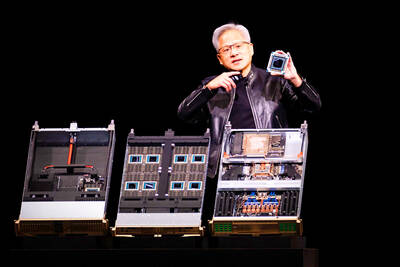
DOMESTIC COMPONENT: Huang identified several Taiwanese partners to be a key part of Nvidia’s Vera Rubin supply chain, including Asustek, Hon Hai and Wistron Nvidia Corp chief executive officer Jensen Huang (黃仁勳), addressing crowds at the company’s biggest annual event, unveiled a variety of new products while predicting that its flagship artificial intelligence (AI) processors would help generate US$1 trillion in sales through next year. During a two-and-a-half-hour keynote address, Huang announced plans to push deeper into central processing units (CPUs) — Intel Corp’s home turf — and introduced semiconductors made with technology acquired from start-up Groq Inc. The company even said it was developing chips for data centers in outer space. At the heart of Huang’s speech was the message that demand for computing power

OPTIMISTIC: Inflation still has a chance of remaining below the central bank’s 2 percent alert level, as Taiwan’s economy is resilient with healthy exports, the NDC minister said Taiwan’s inflation could exceed 2 percent this year if oil prices continue to surge amid escalating tensions in the Middle East, prompting the government to reassess its economic outlook, the Directorate-General of Budget, Accounting and Statistics (DGBAS) said yesterday. DGBAS Minister Chen Shu-tzu (陳淑姿) told lawmakers at a meeting of the legislature’s Finance Committee that the agency’s earlier growth forecast of 1.68 percent in the consumer price index (CPI) and 7.71 percent for GDP this year did not account for the ongoing Middle East conflict and would need revision, if tensions persist. The previous forecast assumed an average international crude price of

ELECTRIC DREAMS: Smart cities would use ‘virtual power plants,’ which integrate idle electricity use from households, businesses and factories, Asustek said Asustek Computer Inc (華碩) yesterday showcased key components of its artificial intelligence (AI)-driven smart city initiatives at a trade show in Taipei, eyeing new business opportunities as cities develop sovereign AI infrastructure. Advances in generative, multimodal and physical AI are driving cities toward a new phase of “sovereign AI,” Asustek cochief executive officer Samson Hu (胡書賓) told reporters on the sidelines of the Smart City Summit and Expo at Taipei Nangang Exhibition Center’s Hall 2. The company showcased its “AI City” framework, which comprises three layers — computing infrastructure centered on AI servers, AI models and a platform layer for data processing


 RSS
RSS