


A visit to the US by a Taiwanese delegation has opened the door to dialogue on cooperation between biotechnology companies, the Ministry of Economic Affairs said yesterday.
During the trip from Sept. 11 to Saturday, the delegation led by Deputy Minister of Economic Affairs Chen Chern-chyi (陳正祺) visited five prominent US companies to solicit investments in Taiwan, the ministry said in a statement.
Those visits created an opportunity for the potential start of discussions between biotechnology companies in the US and Taiwan on investments, under the contract development and manufacturing organization (CDMO) model, the ministry said.
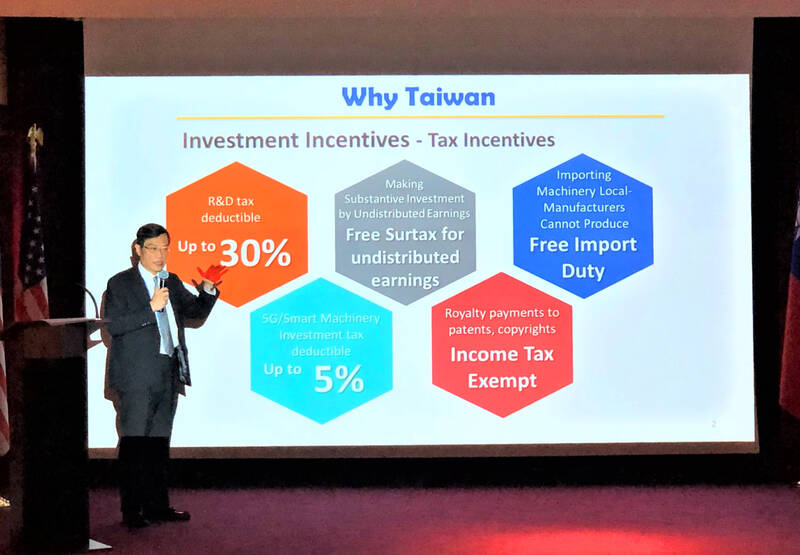
Photo courtesy of the Ministry of Economic Affairs’ Department of Investment Services
Under that model, pharmaceutical companies partner with others in the industry that are categorized as CDMOs to outsource drug development and manufacturing.
Potential cooperation between Taiwanese and US pharmaceutical companies could include the development and production of medical consumables and minimally invasive surgical instruments.
However, the ministry did not say when the discussions were expected to start or which US companies would be involved.
One of the Taiwanese delegates told the Central News Agency that two biotechnology firms in the US had expressed interest in starting discussions with Taiwanese companies, but the delegate did not name the firms.
In the push for US investments in Taiwan, Chen’s delegation also hosted a conference in New York which was attended by more than 50 representatives from prominent think tanks, investment advisory companies, private equity firms, industrial associations and other enterprises, the ministry said.
At the conference, Peter Chow (周鉅原), a Taiwanese professor at City University of New York, called on Washington to sign a bilateral trade agreement with Taipei, while some of the US participants said Washington should forge closer trade and investment ties with Taipei, the ministry said.
Chen and his delegation also visited SkySkopes, a geospatial data solutions company that specializes in aerial data acquisition through the use of advanced crewed and uncrewed aircraft equipped with cutting edge sensor solutions, it said.
At that company, the delegation met with its founder and partner Matt Dunlevy, who said he hoped to visit Taiwan to hold discussions with potential business partners, it added.

Cairo’s new monorail slices across the city skyline, running above the familiar chaos of blaring horns and aging buses’ exhaust fumes that mark rush hour below. The US$4.5 billion monorail, opened this month, is among Egypt’s most prominent new transport projects, part of a debt-funded infrastructure drive criticized for sapping state finances while bringing limited benefits to most of the country’s 109 million people. “It feels like you’re in a different country,” said Ramy Sayed, a restaurant manager, aboard a driverless Innovia 300 train. “No noise, no traffic, we’re not used to this.” The eastern line runs 56km from the bustling middle-class

Taiwanese firms have increased investment in the Philippines in recent years as Manila’s ties with Washington deepen and global supply chains continue to shift away from China, an expert at the Chung-Hua Institution for Economic Research (CIER, 中華經濟研究院) said yesterday. The Philippines had not been among Taiwanese investors’ top choices in Southeast Asia, CIER Taiwan ASEAN Studies Center director Kristy Hsu (徐遵慈) said at a seminar in Taipei. However, Taiwan’s investment in the country has grown significantly since the COVID-19 pandemic, reaching US $257 million last year, a high in recent years, she said. Although Taiwan’s total investment in the Philippines still lags

Starlux Airlines Co (星宇航空) today unveiled a long-haul network expansion plan at a shareholders’ meeting in Taipei, including direct flights to Barcelona, Spain, and Zurich, Switzerland, as well as a service connecting Taipei, Sydney and New Zealand. Starlux is to become the first Taiwanese carrier to offer non-stop services to the two European cities, while the inaugural oceanic route is expected to expand transit opportunities within the Australia-New Zealand market, Starlux said. Flight services to Chicago, Dallas, Washington and New York are under evaluation, the airline added. Prior to the shareholders’ meeting, the airline earlier this year announced that it would be

Intel Corp regards Taiwan Semiconductor Manufacturing Co (TSMC, 台積電) as a longstanding partner, as the US chipmaker would continue outsourcing production of advanced chips to TSMC, Intel chief executive officer Lip-Bu Tan (陳立武) said yesterday. “I don’t look at people as competitors. I look at the collaboration... Nvidia is also, you know, a good friend,” Tan told a news conference following his keynote speech at the Computex trade show in Taipei. “It’s a very trusted partnership for us... We are a big, top customer for them, and we’re going to continue doing that,” he said, referring to TSMC, the world’s largest foundry


 RSS
RSS