


EQUITIES
TAIEX drops 0.08 percent
The TAIEX yesterday closed marginally lower, entering a consolidation phase as investors remain concerned about an interest rate hike by the US Federal Reserve, after a mixed US jobs report released on Friday. The index failed to rebound after it came off a high, but contract chipmaker Taiwan Semiconductor Manufacturing Co (TSMC, 台積電) and some other large-cap semiconductor stocks showed resilience, preventing the broader market from falling further. The TAIEX closed down 11.94 points, or 0.08 percent, at 14,661.10. Turnover totaled NT$188.172 billion (US$6.13 billion), with foreign institutional investors selling a net NT$3.07 billion of shares, Taiwan Stock Exchange data showed. TSMC shares rose 0.21 percent, but the electronics sector lost 0.21 percent. The transportation sector fell 0.71 percent, but the financial sector was up 0.57 percent.
EQUITIES
Foreign sell-off continues
Foreign investors last week sold a net NT$88.02 billion of domestic shares after selling a net NT$37.02 billion the previous week, the Taiwan Stock Exchange said yesterday. As of Friday, foreign investors had sold a net NT$1.13 trillion of shares since the beginning of the year, the exchange said in a statement. The top three shares sold by foreign investors last week were Shin Kong Financial Holding Co (新光金控), CTBC Financial Holding Co (中信金控) and Cathay Financial Holding Co (國泰金控), while the top three shares that foreign investors bought were AUO Corp (友達光電), Innolux Corp (群創光電) and HTC Corp (宏達電子), it said. As of Friday, the market capitalization of shares held by foreign investors was NT$18.38 trillion, or 40.24 percent of total market capitalization, down NT$983.26 billion from a week earlier, the exchange said.
OPTICAL PRODUCTS
Largan revenue rises
Largan Precision Co (大立光), a leading supplier of handset camera lens modules, yesterday reported its highest monthly revenue of this year. Consolidated revenue last month rose 14 percent month-on-month and 11 percent year-on-year to NT$4.44 billion, the company said in a statement. Last month, 8-megapixel lenses accounted for 10 percent of total shipments, 10-megapixel lenses made up 40 to 50 percent, and lenses with a resolution of 20 megapixels or greater contributed 10 to 20 percent, Largan’s shipment breakdown showed. In the first eight months of this year, cumulative revenue totaled NT$28.14 billion, down 5 percent from the same period last year.
INSURANCE
Nan Shan net worth plunges
Nan Shan Life Insurance Co’s (南山人壽) net worth at the end of June plunged 82 percent year-on-year, or by NT$401 billion, to NT$83.62 billion because of unrealized investment losses, its financial report showed last week. The firm’s net worth ratio fell to 1.72 percent at the end of June, compared with 9.72 percent a year earlier and 10.09 percent at the end of last year, the report showed. It was also lower than the regulatory minimum of 3 percent. The insurer reported unrealized investment losses of NT$323 billion at the end of June, compared with unrealized gains of NT$128 billion a year earlier, as interest rate hikes and volatile financial markets negatively affected the value of stocks and bonds. The insurer’s holdings of local stocks fell 30 percent to NT$174 billion and those of foreign stocks shrank 40 percent to NT$145 billion, while its foreign bond positions fell 10 percent to NT$17 billion, the report showed.

Macronix International Co (旺宏), the world’s biggest NOR flash memory supplier, yesterday said it would spend NT$22 billion (US$699.1 million) on capacity expansion this year to increase its production of mid-to-low-density memory chips as the world’s major memorychip suppliers are phasing out the market. The company said its planned capital expenditures are about 11 times higher than the NT$1.8 billion it spent on new facilities and equipment last year. A majority of this year’s outlay would be allocated to step up capacity of multi-level cell (MLC) NAND flash memory chips, which are used in embedded multimedia cards (eMMC), a managed
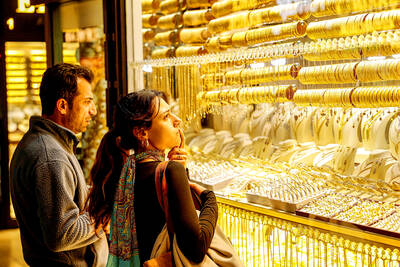
In Italy’s storied gold-making hubs, jewelers are reworking their designs to trim gold content as they race to blunt the effect of record prices and appeal to shoppers watching their budgets. Gold prices hit a record high on Thursday, surging near US$5,600 an ounce, more than double a year ago as geopolitical concerns and jitters over trade pushed investors toward the safe-haven asset. The rally is putting undue pressure on small artisans as they face mounting demands from customers, including international brands, to produce cheaper items, from signature pieces to wedding rings, according to interviews with four independent jewelers in Italy’s main

CULPRITS: Factors that affected the slip included falling global crude oil prices, wait-and-see consumer attitudes due to US tariffs and a different Lunar New Year holiday schedule Taiwan’s retail sales ended a nine-year growth streak last year, slipping 0.2 percent from a year earlier as uncertainty over US tariff policies affected demand for durable goods, data released on Friday by the Ministry of Economic Affairs showed. Last year’s retail sales totaled NT$4.84 trillion (US$153.27 billion), down about NT$9.5 billion, or 0.2 percent, from 2024. Despite the decline, the figure was still the second-highest annual sales total on record. Ministry statistics department deputy head Chen Yu-fang (陳玉芳) said sales of cars, motorcycles and related products, which accounted for 17.4 percent of total retail rales last year, fell NT$68.1 billion, or

In the wake of strong global demand for AI applications, Taiwan’s export-oriented economy accelerated with the composite index of economic indicators flashing the first “red” light in December for one year, indicating the economy is in booming mode, the National Development Council (NDC) said yesterday. Moreover, the index of leading indicators, which gauges the potential state of the economy over the next six months, also moved higher in December amid growing optimism over the outlook, the NDC said. In December, the index of economic indicators rose one point from a month earlier to 38, at the lower end of the “red” light.


 RSS
RSS