

Micron Technology Inc is considering to spend as much as US$160 billion on a new semiconductor factory in central Texas.
The company filed applications with the Texas Comptroller’s office to lock down property-tax breaks in exchange for a potential new facility near Lockhart, an exurb 48km south of Austin.
It would be built in eight phases with construction beginning in January next, the application showed.
There is no guarantee that Micron will make an investment of that magnitude, and a company spokeswoman declined to comment on the potential spending.
However, companies like Micron are rushing to file applications before a tax-break program known as Chapter 313 expires at the end of this year. That way they would have the incentives if they do decide to go ahead with the plans.
“We have not made any final decisions regarding the location, timing or scope of any expansion,” Micron spokeswoman Moira Whalen said in an e-mail. “Filing these applications now allows us to preserve options for potential future expansion needed to meet long-term memory demand.”
Texas has seen a record number of applications under Chapter 313 this year. South Korean chipmaker Samsung Electronics Co filed multiple applications for potential plants in Austin and Taylor, although the company said there were no specific plans to build at this time.
In its application, Micron said Texas’ high property taxes are a disincentive for developers and that the tax break would be a determining factor in its decision to locate the facility in the state.
“Thus, in the absence of a Chapter 313 value limitation agreement, the economic rate of return on this project would be greater in locations outside the state of Texas,” the application said.
Last year, Micron announced it would spend US$150 billion over the next decade on plants, as well as on research and development.
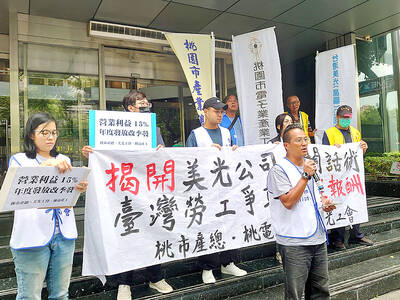
UNION DETERMINATION: Rejecting an offer for a one-time payout as an attempt to influence opinion, the union said a strike at the memory chip manufacturer is possible The Micron Taiwan workers’ union yesterday rejected a one-time payout unveiled by US-based Micron Technology Inc last week, saying it wants a long-term mechanism under which employees would share 15 percent of the company’s operating profits. While the union and the company are still in talks over the dispute, the reward package was proposed unilaterally by the employer without reaching an agreement with the union, union head Jerry Lin (林哲瑞) told reporters. Lin said he suspected the company was seeking to influence public opinion with the move. On Friday last week, Micron announced a reward package under which employees in Taiwan would receive

BUILDER’s RITES: The topping out ceremony is held when a project being built has its highest point laid out, a sure sign that TSMC’s European project is making solid progress A “topping out” ceremony was held on Monday at a plant under construction in Germany by Taiwan Semiconductor Manufacturing Co (TSMC, 台積電), indicating that the fab is progressing as planned and within budget, the head of a joint-venture company in charge of the project said. A topping out ceremony is the construction milestone of laying the final beam or structural piece at the highest point of a building, and it honors the construction crew, architects and engineers. European Semiconductor Manufacturing Co (ESMC) president Christian Koitzsch said that about 2,000 workers from 106 countries are working around the clock at the site in

APPEAL: Any agreement to produce advanced memory such as HBM or DRAM could run into opposition from Seoul as those technologies are sensitive, sources said South Korea’s SK Hynix Inc is in talks with Intel Corp about a deal that would see it manufacture memory chips on US soil for the first time, three people familiar with the discussions said. Under one potential scenario, SK Hynix would lease part of Intel’s long-planned chipmaking facility in Ohio, they said. Under another scenario, it could form a venture with Intel and major cloud firms that are keen to lock in memory supplies, two of the people said. A deal would relieve pressure on Intel, which has been struggling, and mark a big win for US President Donald
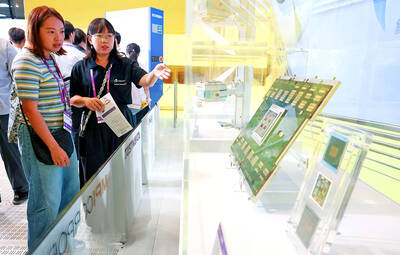
Prices of high-capacity NOR flash memory chips are projected to increase 90 to 110 percent in the second half of this year amid growing demand and slower capacity expansion, after jumping 100 to 120 percent on average in the first half, TrendForce Corp (集邦科技) said yesterday. “Emerging applications such as AI servers and aerospace communications are propelling demand in 2026, aside from existing applications such as advanced driver assistance, digital cockpit systems and industrial devices,” the Taipei-based research group said in a report. Demand from AI servers is exceptionally strong as each AI server requires three to five times more NOR flash


 RSS
RSS