


China has announced that it is investigating several executives at state-owned property companies over allegations of “serious violations of discipline and law.”
The probes are another blow to a key sector, which is already struggling with slowing sales, angry customers and heavily indebted developers.
Authorities said in separate notices on Tuesday that they were investigating Zhuang Yuekai (莊躍凱), chairman of C&D Real Estate Corp (建發房地產), and Shi Zhen (施震), chairman of C&D Urban Services Co (建發城服發展).
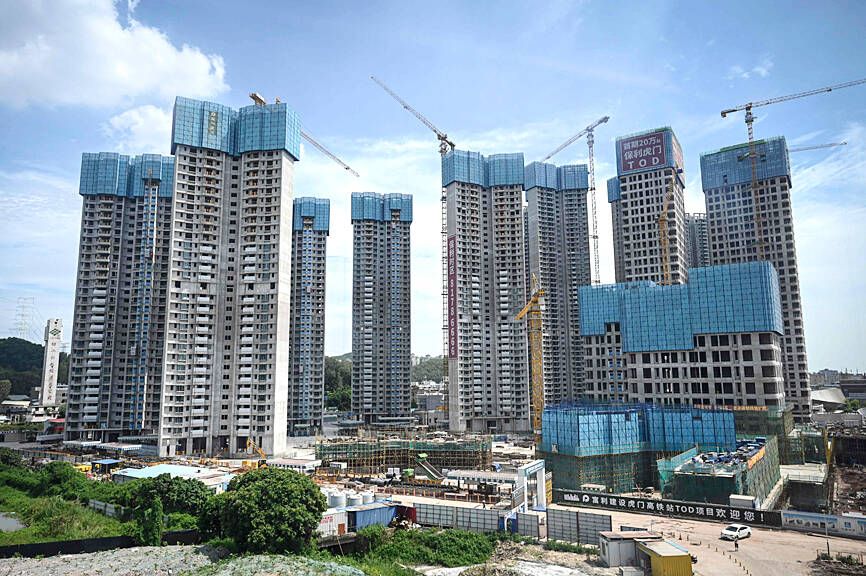
Photo: AFP
They are also looking into Liu Hui (劉暉), deputy general manager of Shenzhen Talents Housing Group (深圳市才安居集團), and Tang Yong (唐勇), a former chairman at China Resources Land Ltd (華潤置地).
All four were “suspected of serious violations of discipline and law,” the notices said, providing few details.
However, the language used in the announcements typically indicates impending graft charges.
These investigations might “deal a further blow to investor confidence and cause market worries about the internal governance of some state-owned enterprises,” Australia and New Zealand Banking Group Ltd analyst Ting Meng (孟婷) told Bloomberg News.
The investigations come ahead of the Chinese Communist Party’s 20th National Congress, at which Chinese President Xi Jinping (習近平) is widely expected to be anointed for an unprecedented third term.
Xi has championed an anti-corruption drive since coming to power, taking down big-name detractors, and observers expect him to use the months leading up to the meeting to cement his grip on power.
The probes follow a regulatory crackdown on some of China’s biggest tech firms.
Authorities have also in recent months announced investigations into figures in the semiconductor industry, including Chinese Minister of Industry and Information Technology Xiao Yaqing (肖亞慶).
Regulatory heads, insurance giants, security officials and financiers have faced censure or prosecution under the anti-corruption drive, but it is rare for a minister to be targeted while still in office.
The vast majority of people who have been investigated for corruption in China were eventually convicted.

Taichung reported the steepest fall in completed home prices among the six special municipalities in the first quarter of this year, data compiled by Taiwan Realty Co (台灣房屋) showed yesterday. From January through last month, the average transaction price for completed homes in Taichung fell 8 percent from a year earlier to NT$299,000 (US$9,483) per ping (3.3m²), said Taiwan Realty, which compiled the data based on the government’s price registration platform. The decline could be attributed to many home buyers choosing relatively affordable used homes to live in themselves, instead of newly built homes in the city’s prime property market, Taiwan Realty
The government yesterday approved applications by Alphabet Inc’s Google to invest NT$27.08 billion (US$859.98 million) in Taiwan, the Ministry of Economic Affairs said in a statement. The Department of Investment Review approved two investments proposed by Google, with much of the funds to be used for data processing and electronic information supply services, as well as inventory procurement businesses in the semiconductor field, the ministry said. It marks the second consecutive year that Google has applied to increase its investment in Taiwan. Google plans to infuse NT$25.34 billion into Charter Investments Ltd (特許投資顧問) through its Singapore-based subsidiary Fructan Holdings Singapore Pte Ltd, and

JET JUICE: The war on Iran’s secondary effects have seen fuel prices skyrocket, knocking flight schedules down to earth in return as airlines struggle with costs Airline passengers should brace for more irritation in the next few months as carriers worldwide cancel flights and ground planes to cope with stratospheric increases in jet-fuel prices. Dutch flag carrier KLM is the latest company to cut its schedule, saying on Thursday that it would scrap 80 return flights at Amsterdam’s Schiphol Airport in the coming month. That puts it in the same league as United Airlines Holdings Inc, Deutsche Lufthansa AG and Cathay Pacific Airways Ltd, which have all pruned itineraries to mitigate costs. Global capacity for next month has been reduced by about 3 percentage points, with all
Micron Technology Inc is a driving force pushing the US Congress to pass legislation that would put new export restrictions on equipment its Chinese competitors use to make their chips, according to people familiar with the matter. A US House of Representatives panel yesterday was to vote on the “MATCH Act,” a bill designed to close gaps in restrictions on chipmaking equipment. It would also pressure foreign companies that sell equipment to Chinese chipmaking facilities to align with export curbs on US companies like Lam Research Corp and Applied Materials Inc. The bill targets facilities operated by China’s ChangXin Memory Technologies Inc


 RSS
RSS