


The US dollar index on Friday reached a five-week high and was on track for its biggest weekly gain since April 2020 as investors adjusted for the likelihood that the US Federal Reserve would keep hiking rates to battle inflation.
The US central bank needs to keep raising borrowing costs to tame decades-high inflation, a string of US central bank officials said on Thursday, even as they debated how fast and how high to lift them.
“They still have their work cut out for them, and I don’t think the market was really positioned that way after the July FOMC [US Federal Open Market Committee],” said Bipan Rai, North American head of FX strategy at CIBC Capital Markets in Toronto.
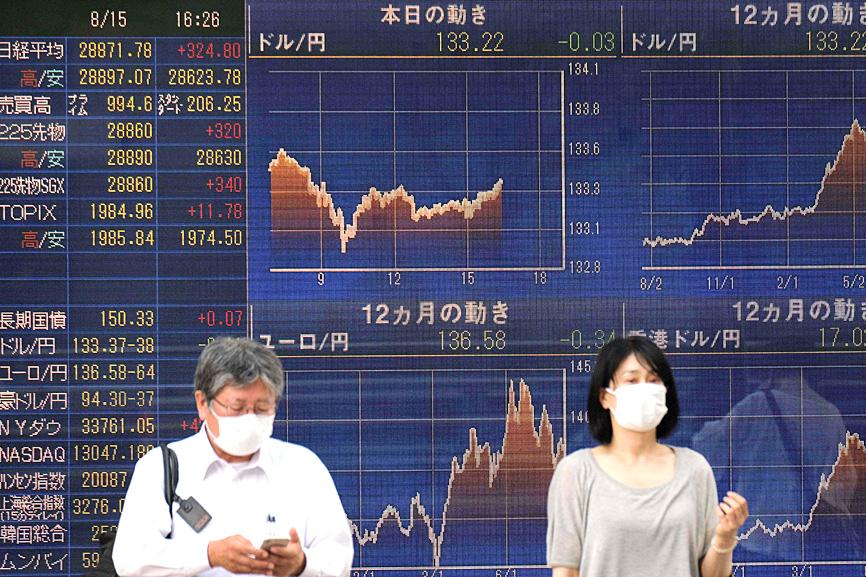
Photo: AFP
The New Taiwan dollar on Friday fell to its lowest point against the US dollar since June 2020, losing NT$0.029 to close at NT$30.020 against the greenback, down 0.17 percent from a week earlier.
The US dollar index rose 0.36 percent to 107.96, its highest since July 15, while the euro fell to 0.32 percent to US$1.0055, its lowest since the same date.
The US dollar gained 0.81 percent against the yen at ¥137, the strongest since July 27. The British pound tumbled 0.89 percent to US$1.1830 and was set for its biggest weekly drop against the dollar since September 2020.
The Fed is seen as having more room to hike rates than central banks of other large economies, which are more fragile. Fed funds futures traders are pricing in a 54 percent expectation that the Fed would hike rates by 50 basis points next month and a 46 percent probability of a 75 basis points increase.
Fed Chairman Jerome Powell is to update the market on his views at the annual Jackson Hole, Wyoming, symposium on Thursday through Saturday.
The US dollar has also benefited from safe haven demand, as weakening Chinese data and an energy crisis in Europe raise fears of further economic slowdown, said Jane Foley, head of foreign-exchange strategy at Rabobank in London.
The yuan slipped to its lowest since September 2020 at 6.8199 yuan per US dollar in onshore trading after the central bank set a much-weakened midpoint guidance, with traders expecting further downside.
In cryptocurrencies, bitcoin fell 7.3 percent to US$21,523, while ether was down 8.08 percent to US$1,699.
“Weakness has seeped into the crypto sphere as speculators retreated from highly risky assets,” Hargreaves Lansdown senior investment and markets analyst Susannah Streeter said.
Additional reporting by Staff writer, with CNA
Shares of contract chipmaker Taiwan Semiconductor Manufacturing Co (TSMC, 台積電) came under pressure yesterday after a report that Apple Inc is looking to shift some orders from the Taiwanese company to Intel Corp. TSMC shares fell NT$55, or 2.4 percent, to close at NT$2,235 on the local main board, Taiwan Stock Exchange data showed. Despite the losses, TSMC is expected to continue to benefit from sound fundamentals, as it maintains a lead over its peers in high-end process development, analysts said. “The selling was a knee-jerk reaction to an Intel-Apple report over the weekend,” Mega International Investment Services Corp (兆豐國際投顧) analyst Alex Huang
Taiwan Semiconductor Manufacturing Co (TSMC, 台積電) is expected to remain Apple Inc’s primary chip manufacturing partner despite reports that Apple could shift some orders to Intel Corp, industry experts said yesterday. The comments came after The Wall Street Journal reported on Friday that Apple and Intel had reached a preliminary agreement following more than a year of negotiations for Intel to manufacture some chips for Apple devices. Taiwan Institute of Economic Research (台灣經濟研究院) economist Arisa Liu (劉佩真) said TSMC’s advanced packaging technologies, including integrated fan-out and chip-on-wafer-on-substrate, remain critical to the performance of Apple’s A-series and M-series chips. She said Intel and Samsung
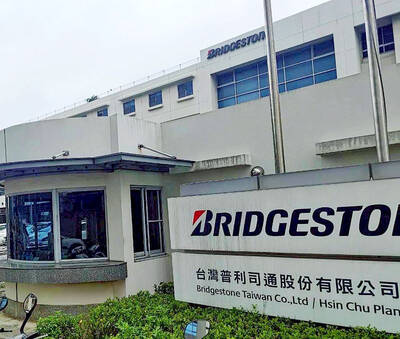
TRANSITION: With the closure, the company would reorganize its Taiwanese unit to a sales and service-focused model, Bridgestone said Bridgestone Corp yesterday announced it would cease manufacturing operations at its tire plant in Hsinchu County’s Hukou Township (湖口), affecting more than 500 workers. Bridgestone Taiwan Co (台灣普利司通) said in a statement that the decision was based on the Tokyo-based tire maker’s adjustments to its global operational strategy and long-term market development considerations. The Taiwanese unit would be reorganized as part of the closure, effective yesterday, and all related production activities would be concluded, the statement said. Under the plan, Bridgestone would continue to deepen its presence in the Taiwanese market, while transitioning to a sales and service-focused business model, it added. The Hsinchu
Taiwan Semiconductor Manufacturing Co (TSMC, 台積電) has approved a capital budget of US$31.28 billion for production expansion to meet long-term development needs during the artificial intelligence (AI) boom. The company’s board meeting yesterday approved the capital appropriation plan for purposes such as the installation of advanced technology capacity and fab construction, the world’s largest contract chipmaker said in a statement. At an earnings conference last month, TSMC forecast that its capital expenditure for this year would be at the higher end of the US$52 billion to US$56 billion range it forecast in January in response to robust demand for 5G, AI and


 RSS
RSS