


The US dollar rallied on Friday, but posted a weekly drop as traders weighed improving US inflation data against comments from US Federal Reserve officials who cautioned that the battle against rising prices was far from over.
US import prices last month declined for the first time in seven months on lower costs for fuel and non-fuel products, data showed on Friday, in the third report this week to hint that inflation might have topped out.
Another two key inflation measures, for consumer prices and producer prices, cooled last month, data showed on Wednesday and Thursday, prompting traders to pare back views that the Fed would raise interest rates by 75 basis points for a third consecutive time when it meets next month.

Photo: Reuters
After four straight down days, including a more than 1 percent drop on Wednesday, the US dollar rallied against its major rivals on Friday. The US dollar index was up 0.56 percent at 105.67, but posted a weekly loss of 0.89 percent.
“There’s a little bit of anxiety still out there, I believe, because we need to see more evidence that inflation is — I’m not going to say abating — but peaking,” Klarity FX director Amo Sahota said.
The greenback’s turnaround followed a steady drumbeat from Fed officials who made clear they would continue to tighten.
San Francisco Federal Reserve Bank President Mary Daly said on Thursday she was open to the possibility of another 75 basis point hike next month.
“The Fed is going to be inclined to push back against the notion of a premature policy pivot,” Convera senior market analyst Joe Manimbo said. “That would threaten to unravel all of the hard work they’ve done to bring down inflation.”
Traders were pricing in about a 42.5 percent chance of a 75 basis point Fed rate hike next month and a 57.5 percent chance of 50 basis point hike.
Kit Juckes, head of FX strategy at Societe Generale, said US dollar trading is likely to remain “choppy.”
“It’s not going to be going significantly weaker in a straight line because there’s still a danger that the market has to reprice terminal Fed funds higher, given there’s still plenty of inflation,” Juckes said.
The New Taiwan dollar on Friday declined against the US dollar, losing NT$0.028 to close at NT$29.970, down 0.07 percent from a week earlier.
The greenback was up 0.39 percent against the Japanese yen at ¥133.495.
The British pound fell 0.6 percent to US$1.2141 versus the US dollar.
Data showed UK GDP contracted by less than forecast in June, even though an extra public holiday had been expected to cause a big drag.
The euro was down 0.53 percent at US$1.02625.
French inflation was up 6.8 percent year-on-year last month, while for Spain it was 10.8 percent, the highest since 1984, data showed.
The euro has been weighed down by Europe’s struggles with the war in Ukraine, the hunt for non-Russian energy sources and a hit to the German economy from scant rainfall.
Commerzbank said in a note it had revised its euro-dollar forecast lower, as it expects a euro-area recession as a base scenario, having previously been a “risk scenario.”
The bank said it expects the euro to fall to US$0.98 in December and to not recover until later next year.
Additional reporting by CNA

Cairo’s new monorail slices across the city skyline, running above the familiar chaos of blaring horns and aging buses’ exhaust fumes that mark rush hour below. The US$4.5 billion monorail, opened this month, is among Egypt’s most prominent new transport projects, part of a debt-funded infrastructure drive criticized for sapping state finances while bringing limited benefits to most of the country’s 109 million people. “It feels like you’re in a different country,” said Ramy Sayed, a restaurant manager, aboard a driverless Innovia 300 train. “No noise, no traffic, we’re not used to this.” The eastern line runs 56km from the bustling middle-class
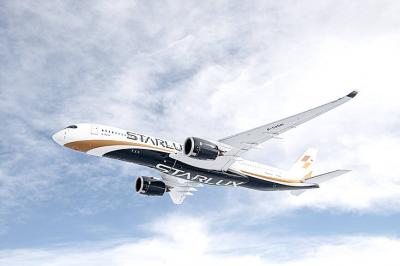
Starlux Airlines Co (星宇航空) today unveiled a long-haul network expansion plan at a shareholders’ meeting in Taipei, including direct flights to Barcelona, Spain, and Zurich, Switzerland, as well as a service connecting Taipei, Sydney and New Zealand. Starlux is to become the first Taiwanese carrier to offer non-stop services to the two European cities, while the inaugural oceanic route is expected to expand transit opportunities within the Australia-New Zealand market, Starlux said. Flight services to Chicago, Dallas, Washington and New York are under evaluation, the airline added. Prior to the shareholders’ meeting, the airline earlier this year announced that it would be

Netherlands-based semiconductor equipment supplier ASML Holding NV yesterday said that it is planning to hire an additional 1,000 people in Taiwan this year in response to growing demand from clients. ASML had previously planned to recruit 600 people this year, but that the plan has been adjusted upward, ASML vice president and ASML Taiwan general manager Grace Wang (汪佳慧) told reporters. ASML has a workforce of more than 4,500 in Taiwan, accounting for about 10 percent of its global total, Wang said. This year’s recruitment campaign would focus on adding people in the customer support, manufacturing and supply chain domains to assist ASML

Nvidia Corp yesterday announced that CEO Jensen Huang (黃仁勳) would attend an employee meeting in Taipei tomorrow to celebrate the launch of the company’s Taiwan headquarters project. Huang would attend a gathering at the site of Nvidia’s planned headquarters in Beitou Shilin Technology Park (北投士林科技園區), the company said in a statement. After arriving in Taiwan on Saturday last week, Huang told reporters that he plans to meet with Quanta Computer Inc (廣達) chairman Barry Lam (林百里) and Taiwan Semiconductor Manufacturing Co (TSMC, 台積電) chairman C.C. Wei (魏哲家), and would attend the groundbreaking ceremony for Nvidia’s Taiwan headquarters tomorrow. Nvidia has not yet applied


 RSS
RSS