


With just a look, Sosima Olivera knows when her cherished agave plants will be ready to make mezcal, tequila’s lesser-known Mexican cousin whose fast-growing popularity is raising fears of overexploitation.
The mezcal boom means a greater need for the land, water and firewood used to produce the smoky spirit, Olivera said.
“This excess demand from national and international markets has consequences. If more plants are needed, of course there’s more exploitation,” said the 50-year-old, who heads a producers’ collective.
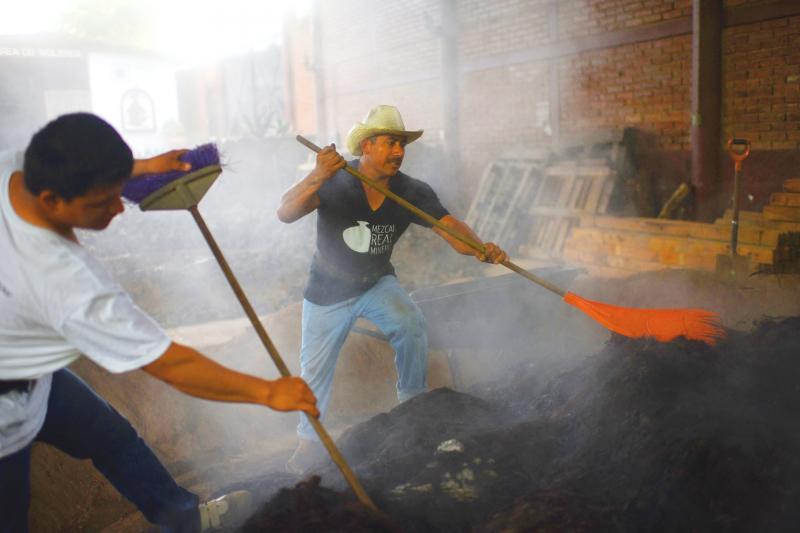
Photo: AFP
Craft distillers like Olivera, who has dedicated her life to the process, aim to safeguard mezcal’s future with measures including seed banks and efforts to showcase artisanal methods.
“A bottle sums up everything we’ve done for years,” she said, while touring a field in Mexico’s southern state of Oaxaca where magueys — a type of agave plant — grow slowly under the sun.
Once drunk only in small Mexican communities, mezcal has enjoyed a surge in demand, at home and abroad.
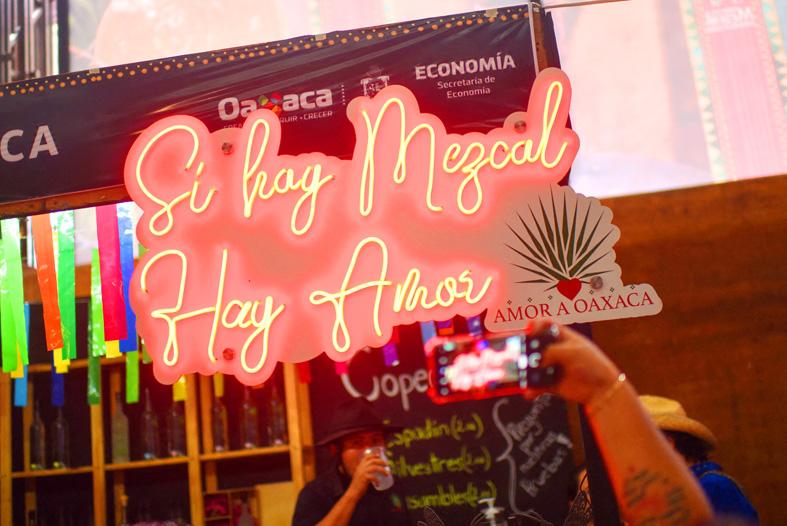
Photo: AFP
It is traditionally sipped neat, accompanied by slices of orange and salt mixed with dried chiles and ground agave worms.
Nowadays, it can also be found on the menu in fashionable cocktail bars from New York to Tokyo.
Celebrities who have jumped on the bandwagon include the costars of the hit television show Breaking Bad, Bryan Cranston and Aaron Paul, who founded the drinks company Dos Hombres.
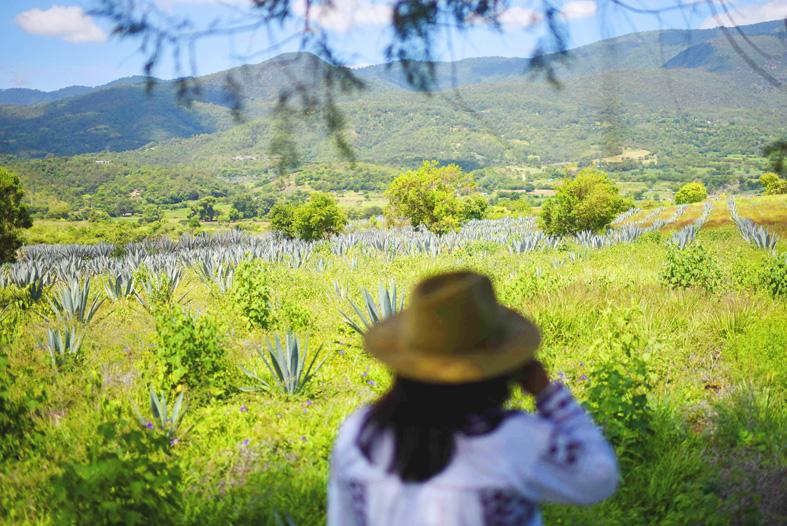
Photo: AFP
The value of Mexico’s mezcal exports skyrocketed from nearly US$20 million in 2015 to about US$63 million in 2020, official figures showed.
The US, Canada, Spain, France and Germany are among the top consumers of the drink, which is produced in several Mexican states, but above all in Oaxaca.
Although mezcal and tequila have similar production methods, some important differences set them apart.
Tequila is made with blue agave in the western state of Jalisco.
Mezcal uses other types — including highly prized wild magueys — some of which take 15 years or longer to mature.
For that reason, producers such as Graciela Angeles believe it is crucial to preserve the plants for future generations.
“What will happen to biological diversity? There are very few efforts to conserve these species,” said the 43-year-old creator of the Real Minero brand.
“Without magueys there’s no mezcal,” added Angeles, who keeps seeds to ensure the plants would exist for her children to harvest one day.
The complex process of mezcal production hinges largely on the distiller’s talent and sense of smell.
With the arrival of deep-pocketed corporations, high-volume producers have become little more than “assembly plants” blending mezcal from different communities, Angeles said.
On average, a 750 milliliter bottle costs about US$40 in Oaxaca, but the most exclusive varieties have a price tag of more than US$100.
In the US, a limited edition bottle of Dos Hombres mezcal made from tobala agave sells for more than US$300.
The mezcal produced by Olivera and Angeles is the result of a painstaking process dating back several generations — something they are determined will live on.
“Small producers will always exist ... who know that we have to plant a certain amount of plants, distill a certain amount. There’s a balance in life,” Olivera said.
Both women organize tastings to showcase the flavors and aromas of their products.
In the city of Oaxaca, mezcal tasting has become a must-do for many tourists.
Australian visitor Christopher Govers said he had learned all about the spirit “after falling in love with the taste and the effect.”
“The history and culture behind it is connected with the taste,” he said at a bustling trade fair, where an illuminated sign read “Make Mezcal, Not War.”

Apple Inc increased iPhone production in India by about 53 percent last year and now makes a quarter of its marquee devices there, reflecting the US company’s efforts to avoid tariffs on China. The company assembled about 55 million iPhones in India last year, up from 36 million a year earlier, people familiar with the matter said, asking not to be named because the numbers aren’t public. Apple makes about 220 million to 230 million iPhones a year globally, with India’s share of the total increasing rapidly. Apple has accelerated its expansion in the world’s most populous country in recent years, bolstered

HEADWINDS: The company said it expects its computer business, as well as consumer electronics and communications segments to see revenue declines due to seasonality Pegatron Corp (和碩) yesterday said it aims to grow its artificial intelligence (AI) server revenue more than 10-fold this year from last year, driven by orders from neocloud solutions clients and large cloud service providers. The electronics manufacturing service provider said AI server revenue growth would be driven primarily by the Nvidia Corp GB300 server platform. Server shipments are expected to increase each quarter this year, with the second half likely to outperform the first half, it said. The AI server market is expected to broaden this year as more inference applications emerge, which would drive demand for system-on-chip, application-specific integrated circuits

At a massive shipyard in North Vancouver, Canadian workers grind metal beams for a powerful new icebreaker crucial to cementing the country’s presence in the increasingly contested arctic. Icebreakers are specialized, expensive vessels able to navigate in the frozen far north. And “this is the crown jewel,” said Eddie Schehr, vice president of production at the Seaspan shipyard. For Canadian Prime Minister Mark Carney, who heads to Norway next Friday to observe arctic defense drills involving troops from 14 NATO states, Canada’s extreme north has emerged as a strategic priority. “Canada is and forever will be an Arctic nation,” he said ahead of

Chinese entrepreneur Frank Gao used to spend long hours running his social media accounts but now outsources the chore to artificial intelligence (AI) agent tool OpenClaw, which is taking China by storm despite official warnings over cybersecurity. OpenClaw, created in November by an Austrian coder, differs from bots such as ChatGPT because it can execute real-life tasks such as sending e-mails, organizing files or even booking flight tickets. “Since January, I’ve spent hours on the lobster every day,” Gao said in an interview, referring to OpenClaw’s red crustacean mascot. “We’re family.” After downloading OpenClaw, users connect it to artificial intelligence models of their


 RSS
RSS