


France’s National Assembly rejected a tax on windfall profits on Saturday in a close vote, as pressure mounts to tax energy and transport companies that have benefited from rising prices.
As they were discussing an update of the finance bill for this year, 114 members of the lower house rejected amendments that would have set up an exceptional tax on so-called “superprofits” from companies such as TotalEnergies SE, Engie SA and shipper CMA CGM SA. The tax was proposed by the left, and backed by 96 members of parliament, including one who belongs to French President Emmanuel Macron’s coalition. Some deputies from Macron’s party have advocated for such a tax, but abstained during the vote.
On Friday, Total and CMA CGM said they would grant fuel and freight-rate rebates in France, bowing to political pressure for measures to soften the impact of inflation and counter the call for a windfall tax.
While the government did not back the tax, French Finance Minister Bruno Le Maire had asked both firms to make a bigger effort to help consumers and welcomed the firms’ announcements, saying pressure on the companies has been “efficient.”
Since he lost his outright majority in the lower house of parliament last month, Macron has been forced to seek ad hoc coalitions to pass legislation. He passed his first test earlier last week, with the adoption of measures aimed at sheltering households from surging inflation, passed thanks to the support of Marine Le Pen’s National Rally party and the conservative Les Republicains.
On Saturday, lawmakers also agreed to scrap the TV license fee and to fund media such as France 24 TV channel or France Inter via the value-added tax. Other measures on the agenda of the National Assembly include the funding of the full nationalization of energy company Electricite de France SA as well as cuts on fuel prices and subsidies for energy.
Debates were to continue over the weekend, and legislation still needs to be approved by the Senate.
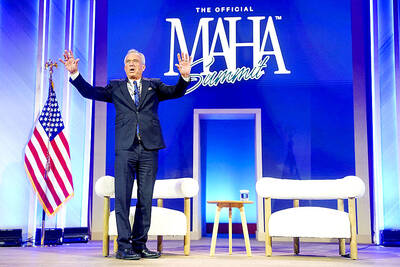
Sweeping policy changes under US Secretary of Health and Human Services Robert F. Kennedy Jr are having a chilling effect on vaccine makers as anti-vaccine rhetoric has turned into concrete changes in inoculation schedules and recommendations, investors and executives said. The administration of US President Donald Trump has in the past year upended vaccine recommendations, with the country last month ending its longstanding guidance that all children receive inoculations against flu, hepatitis A and other diseases. The unprecedented changes have led to diminished vaccine usage, hurt the investment case for some biotechs, and created a drag that would likely dent revenues and
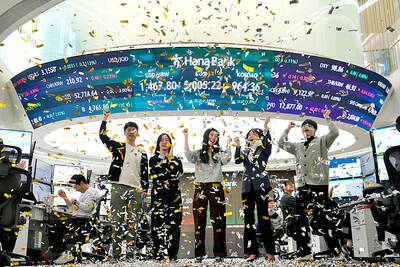
Global semiconductor stocks advanced yesterday, as comments by Nvidia Corp chief executive officer Jensen Huang (黃仁勳) at Davos, Switzerland, helped reinforce investor enthusiasm for artificial intelligence (AI). Samsung Electronics Co gained as much as 5 percent to an all-time high, helping drive South Korea’s benchmark KOSPI above 5,000 for the first time. That came after the Philadelphia Semiconductor Index rose more than 3 percent to a fresh record on Wednesday, with a boost from Nvidia. The gains came amid broad risk-on trade after US President Donald Trump withdrew his threat of tariffs on some European nations over backing for Greenland. Huang further

CULPRITS: Factors that affected the slip included falling global crude oil prices, wait-and-see consumer attitudes due to US tariffs and a different Lunar New Year holiday schedule Taiwan’s retail sales ended a nine-year growth streak last year, slipping 0.2 percent from a year earlier as uncertainty over US tariff policies affected demand for durable goods, data released on Friday by the Ministry of Economic Affairs showed. Last year’s retail sales totaled NT$4.84 trillion (US$153.27 billion), down about NT$9.5 billion, or 0.2 percent, from 2024. Despite the decline, the figure was still the second-highest annual sales total on record. Ministry statistics department deputy head Chen Yu-fang (陳玉芳) said sales of cars, motorcycles and related products, which accounted for 17.4 percent of total retail rales last year, fell NT$68.1 billion, or

Macronix International Co (旺宏), the world’s biggest NOR flash memory supplier, yesterday said it would spend NT$22 billion (US$699.1 million) on capacity expansion this year to increase its production of mid-to-low-density memory chips as the world’s major memorychip suppliers are phasing out the market. The company said its planned capital expenditures are about 11 times higher than the NT$1.8 billion it spent on new facilities and equipment last year. A majority of this year’s outlay would be allocated to step up capacity of multi-level cell (MLC) NAND flash memory chips, which are used in embedded multimedia cards (eMMC), a managed


 RSS
RSS