


Facebook owner Meta Platforms Inc has cut plans to hire engineers by at least 30 percent this year, CEO Mark Zuckerberg told employees on Thursday, as he warned them to brace for a deep economic downturn.
“If I had to bet, I’d say that this might be one of the worst downturns that we’ve seen in recent history,” Zuckerberg told workers in a weekly employee question-and-answer session (Q&A), as Reuters heard in an audio.
Meta has reduced its target for hiring engineers this year to about 6,000 to 7,000, down from an initial plan to hire about 10,000 new engineers, Zuckerberg said.
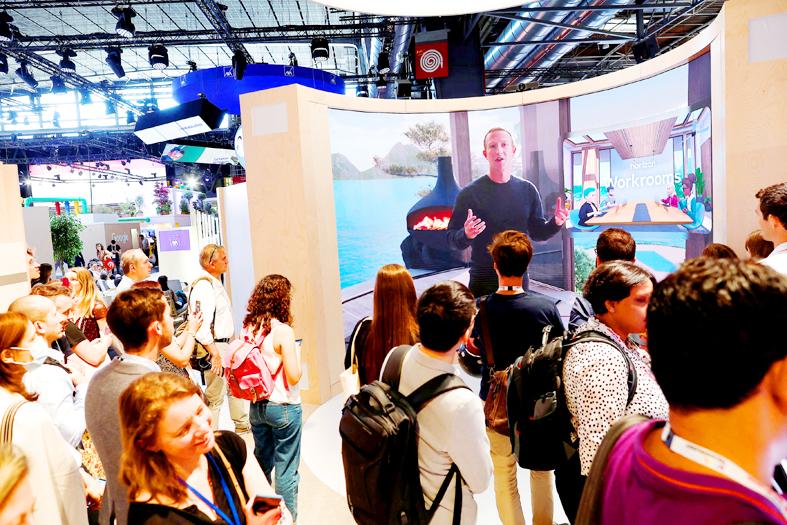
Photo: Reuters
Meta confirmed hiring pauses in broad terms last month, but exact figures have not previously been reported.
In addition to reducing hiring, the company was leaving certain positions unfilled in response to attrition and “turning up the heat” on performance management to weed out staffers unable to meet more aggressive goals, Zuckerberg said.
“Realistically, there are probably a bunch of people at the company who shouldn’t be here,” he said.
Photo: AFP
“Part of my hope by raising expectations and having more aggressive goals, and just kind of turning up the heat a little bit, is that I think some of you might decide that this place isn’t for you, and that self-selection is OK with me,” he said.
The social media and technology company is bracing for a leaner second half of the year, as it copes with macroeconomic pressures and data privacy hits to its ads business, an internal memo seen by Reuters on Thursday said.
The company must “prioritize more ruthlessly” and “operate leaner, meaner, better executing teams,” chief product officer Chris Cox wrote in the memo, which appeared on the company’s internal discussion forum Workplace before the Q&A.
“I have to underscore that we are in serious times here and the headwinds are fierce. We need to execute flawlessly in an environment of slower growth, where teams should not expect vast influxes of new engineers and budgets,” Cox wrote.
The memo was “intended to build on what we’ve already said publicly in earnings about the challenges we face and the opportunities we have, where we’re putting more of our energy toward addressing,” a Meta spokesperson said in a statement.
The guidance is the latest rough forecast to come from Meta executives, who already moved to trim costs across much of the company this year in the face of slowing ad sales and user growth.
Tech companies across the board have scaled back their ambitions in anticipation of a possible US recession, although the slide in stock price at Meta has been more severe than at competitors Apple and Google.
Its austerity drive comes at a tricky time, coinciding with two major strategic pivots: one aimed at refashioning its social media products around “discovery” to beat back competition from short-video app TikTok, the other an expensive long-term bet on augmented and virtual reality technology.
In his memo, Cox said Meta would need to increase fivefold the number of graphic processing units (GPUs) in its data centers by the end of the year to support the “discovery” push, which requires extra computing power for artificial intelligence to surface popular posts from across Facebook and Instagram in users’ feeds.

SECOND-RATE: Models distilled from US products do not perform the same as the original and undo measures that ensure the systems are neutral, the US’ cable said The US Department of State has ordered a global push to bring attention to what it said are widespread efforts by Chinese companies, including artificial intelligence (AI) start-up DeepSeek (深度求索), to steal intellectual property from US AI labs, according to a diplomatic cable. The cable, dated Friday and sent to diplomatic and consular posts around the world, instructs diplomatic staff to speak to their foreign counterparts about “concerns over adversaries’ extraction and distillation of US AI models.” Distillation is the process of training smaller AI models using output from larger, more expensive ones to lower the costs of training a powerful new
Shares of Taiwan Semiconductor Manufacturing Co (TSMC, 台積電) have repeatedly hit new highs, but an equity analyst said the stock’s valuation remains within a reasonable range and any pullback would likely be technical. The contract chipmaker’s historical price-to-earnings (P/E) ratio has ranged between 20 and 30, Cathay Futures Consultant Co (國泰證期) analyst Tsai Ming-han (蔡明翰) told Central News Agency. With market consensus projecting that TSMC would post earnings per share of about NT$100 (US$3.17) this year, supported by strong global demand for artificial intelligence (AI) applications, and the stock currently trading at a P/E ratio of below 25, Tsai said the valuation

The artificial intelligence (AI) boom has triggered a seismic reshuffling of global equity markets, with Taiwan and South Korea muscling past European nations one by one. With its stock market now valued at nearly US$4.3 trillion, Taiwan surpassed the UK, Europe’s biggest market, earlier this month, data compiled by Bloomberg showed. South Korea is about US$140 billion away from doing the same. The tech-heavy Asian markets have shot past Germany and France in the past seven months. The shift is largely down to massive gains in shares of three companies that provide essential hardware for AI: Taiwan Semiconductor Manufacturing Co (TSMC, 台積電),

The US Department of Commerce last week ordered multiple chip equipment companies to halt shipments of certain tools to China’s second-largest chipmaker, Hua Hong Semiconductor Ltd (華虹半導體), its latest action to slow the country’s development of advanced chips, two people familiar with the matter said. The department sent letters to at least a handful of companies informing them of restrictions on tools and other materials destined for two Hua Hong facilities US officials believe make China’s most sophisticated chips, the people said. Top US chip equipment companies Lam Research Corp, Applied Materials Inc and KLA Corp, each of which has significant


 RSS
RSS