


The US remained the largest debtor country to Taiwan’s banking sector for a 27th consecutive quarter in the first quarter of this year, with its exposure rising 8.3 percent from a quarter earlier on the back of an increase in US bonds, the central bank said on Friday.
Data compiled by the central bank showed that outstanding international claims by Taiwanese banks on a direct risk basis to the US stood at US$125.38 billion as of the end of March.
Department of Financial Inspection deputy head Pan Ya-hui (潘雅慧) said that the US Federal Reserve’s launch of a rate hike cycle in March boosted treasury and bond yields, prompting Taiwanese banks to raise their holdings of US debt.
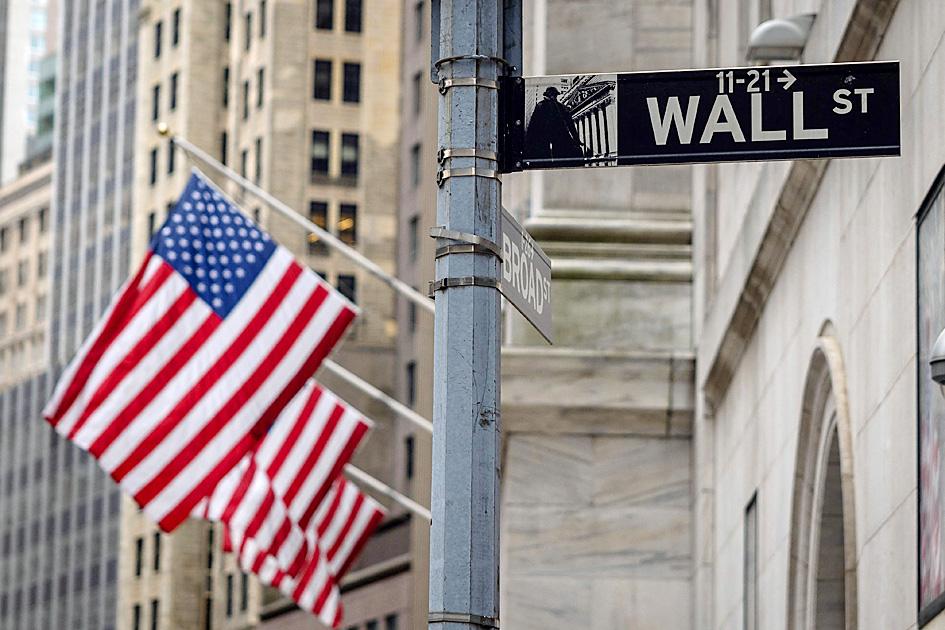
Photo: AFP
China’s exposure to Taiwanese banks was the second-largest, although claims by the local banking sector fell 4.56 percent from a quarter earlier to US$56.77 billion, the central bank said.
COVID-19 lockdowns in several Chinese cities, including Shanghai, Suzhou and Kunshan, made Taiwanese banks more cautious, causing them to reduce exposure to Chinese debtors, Pan said.
As of the end of March, the US and China accounted for 23.71 percent and 10.74 percent of the local banking sector’s exposure respectively, which totaled US$528.7 billion, up 1.26 percent from a quarter earlier, in the wake of an increase in investments in the public sector outside of Taiwan, the central bank said.
After the US and China, Luxembourg remained in third position, with Taiwanese banks’ exposure on a direct risk basis at US$39.72 billion, down 6.11 percent from a quarter earlier and ahead of Hong Kong (US$37.38 billion) and Japan (US$30.86 billion), the data showed.
Australia took the sixth spot with its exposure of Taiwan’s banking sector reaching US$30.81 billion, followed by the Cayman Islands (US$18.62 billion), Singapore (US$17.97 billion), Vietnam (US$16.87 billion) and the UK (US$16.81 billion).
The top 10 debtors accounted for 73.99 percent of Taiwanese banks’ aggregate international claims in the first quarter, the central bank said.
Among the top 10, Australia posted the largest sequential increase in debt of 16.49 percent, while exposure to Japan fell 15.91 percent quarter-on-quarter — the steepest drop, it said.
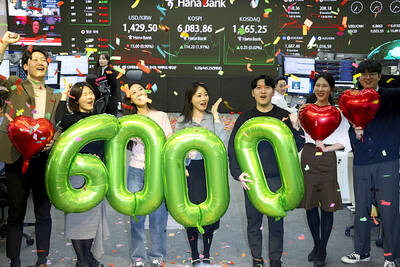
South Korea’s equity benchmark yesterday crossed a new milestone just a month after surpassing the once-unthinkable 5,000 mark as surging global memory demand powers the country’s biggest chipmakers. The KOSPI advanced as much as 2.6 percent to a record 6,123, with Samsung Electronics Co and SK Hynix Inc each gaining more than 2 percent. With the benchmark now up 45 percent this year, South Korea’s stock market capitalization has also moved past France’s, following last month’s overtaking of Germany’s. Long overlooked by foreign funds, despite being undervalued, South Korean stocks have now emerged as clear winners in the global market. The so-called “artificial intelligence

‘SEISMIC SHIFT’: The researcher forecast there would be about 1.1 billion mobile shipments this year, down from 1.26 billion the prior year and erasing years of gains The global smartphone market is expected to contract 12.9 percent this year due to the unprecedented memorychip shortage, marking “a crisis like no other,” researcher International Data Corp (IDC) said. The new forecast, a dramatic revision down from earlier estimates, gives the latest accounting of the ongoing memory crunch that is affecting every corner of the electronics industry. The demand for advanced memory to power artificial intelligence (AI) tasks has drained global supply until well into next year and jeopardizes the business model of many smartphone makers. IDC forecast about 1.1 billion mobile shipments this year, down from 1.26 billion the prior
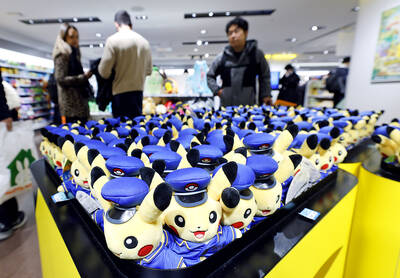
People stand in a Pokemon store in Tokyo on Thursday. One of the world highest-grossing franchises is celebrated its 30th anniversary yesterday.
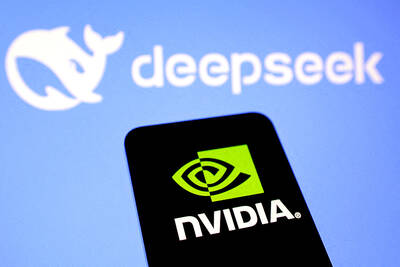
Chinese artificial intelligence (AI) start-up DeepSeek’s (深度求索) latest AI model, set to be released as soon as next week, was trained on Nvidia Corp’s most advanced AI chip, the Blackwell, a senior official of US President Donald Trump’s administration said on Monday, in what could represent a violation of US export controls. The US believes DeepSeek will remove the technical indicators that might reveal its use of American AI chips, the official said, adding that the Blackwells are likely clustered at its data center in Inner Mongolia, an autonomous region of China. The person declined to say how the US government received


 RSS
RSS