


UK retail sales fell last month as soaring food prices and the wider cost of living crisis forced consumer to cut back on spending.
The volume of goods sold in stores and online fell 0.5 percent from April, the Office for National Statistics (ONS) said yesterday.
Economists had expected a decline of 0.7 percent. Sales excluding auto fuel fell 0.7 percent.
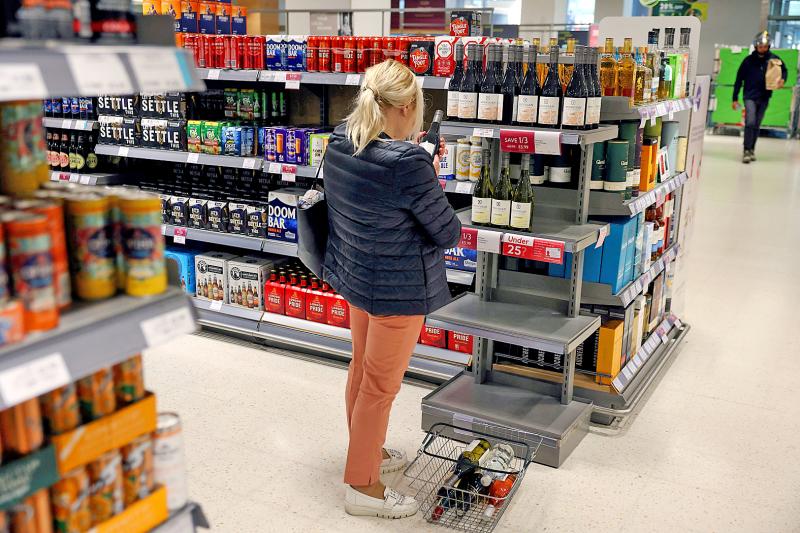
Photo: Reuters
The drop — the third in the past four months — was driven by a 1.6 percent fall in food sales, particularly at large supermarkets, which the ONS linked to soaring prices.
Data earlier this week showed overall inflation hit a four-decade high of 9.1 percent last month.
“Feedback from supermarkets suggested customers were spending less on their food shop, because of the rising cost of living,” said Heather Bovill, ONS deputy director for surveys and economic indicators.
Figures earlier yesterday showed higher prices were also weighing heavy on consumer confidence, which dropped to a record low this month.
BLEAK JULY
The outlook for stores also looks bleak, with the Confederation of British Industry on Thursday saying that retailers were also expecting a poor July.
Taken together, the reports show the deep damage that the fastest inflation rate since the 1980s is having on the economy. With wages failing to keep pace with rising prices, consumer finances are being squeezed and leading to a more gloomy outlook than during the depths of the COVID-19 pandemic.
“Britain faces a stark new economic reality,” said Joe Staton, client strategy director at GfK. “History shows that consumers will not hesitate to retrench and tighten their purse strings when the going gets tough.”
The survey is the first since the government announced a multibillion-dollar package of support for households to help them cope with soaring energy bills and the latest drop suggests even that unprecedented aid is not enough to bolster sentiment.
RETAIL DRAG
Sales at supermarkets fell 1.5 percent last month, while sales of tobacco, alcohol and other drinks dropped 4 percent, the ONS said.
Total sales were 1.3 percent lower in the three months through May than during the December-to-February period, suggesting the retail sector would act as a drag on the economy in the second quarter.
Sales in April rose just 0.4 percent, rather than the 1.4 percent previously estimated.
Meanwhile, GfK yesterday said its measure of consumer sentiment dropped 1 point to minus-41 this month, the lowest reading in the 48 years of the survey.
The risk of recession weighed on consumers’ view of the future outlook both for their own finances and the broader economy.
The prospects of a summer of industrial action and soaring interest rates are also weighing heavily on the mood of the nation, with the Bank of England indicating it is prepared to sacrifice economic growth to lean against higher pices.
RECESSION?
With the economy already on track to shrink in the second quarter, the risk is that ebbing confidence weighs further on spending, delivering a recession later this year.
More pain also lies ahead, with the Bank of England predicting inflation would climb above 11 percent, more than five times its target, as more energy bill hikes kick in come October.

Vincent Wei led fellow Singaporean farmers around an empty Malaysian plot, laying out plans for a greenhouse and rows of leafy vegetables. What he pitched was not just space for crops, but a lifeline for growers struggling to make ends meet in a city-state with high prices and little vacant land. The future agriculture hub is part of a joint special economic zone launched last year by the two neighbors, expected to cost US$123 million and produce 10,000 tonnes of fresh produce annually. It is attracting Singaporean farmers with promises of cheaper land, labor and energy just over the border.

US actor Matthew McConaughey has filed recordings of his image and voice with US patent authorities to protect them from unauthorized usage by artificial intelligence (AI) platforms, a representative said earlier this week. Several video clips and audio recordings were registered by the commercial arm of the Just Keep Livin’ Foundation, a non-profit created by the Oscar-winning actor and his wife, Camila, according to the US Patent and Trademark Office database. Many artists are increasingly concerned about the uncontrolled use of their image via generative AI since the rollout of ChatGPT and other AI-powered tools. Several US states have adopted

KEEPING UP: The acquisition of a cleanroom in Taiwan would enable Micron to increase production in a market where demand continues to outpace supply, a Micron official said Micron Technology Inc has signed a letter of intent to buy a fabrication site in Taiwan from Powerchip Semiconductor Manufacturing Corp (力積電) for US$1.8 billion to expand its production of memory chips. Micron would take control of the P5 site in Miaoli County’s Tongluo Township (銅鑼) and plans to ramp up DRAM production in phases after the transaction closes in the second quarter, the company said in a statement on Saturday. The acquisition includes an existing 12 inch fab cleanroom of 27,871m2 and would further position Micron to address growing global demand for memory solutions, the company said. Micron expects the transaction to

A proposed billionaires’ tax in California has ignited a political uproar in Silicon Valley, with tech titans threatening to leave the state while California Governor Gavin Newsom of the Democratic Party maneuvers to defeat a levy that he fears would lead to an exodus of wealth. A technology mecca, California has more billionaires than any other US state — a few hundred, by some estimates. About half its personal income tax revenue, a financial backbone in the nearly US$350 billion budget, comes from the top 1 percent of earners. A large healthcare union is attempting to place a proposal before


 RSS
RSS