


The risk to South Korea’s economy and global supply chains is growing as a nationwide trucker strike widens, curbing output at top steelmaker POSCO Holdings Inc and causing increasing damage to the petrochemicals sector.
The South Korean Ministry of Trade, Industry and Energy estimates that the auto, petrochemical, steel and other key industries have seen production disruptions worth about 1.6 trillion won (US$1.2 billion) due to the strike.
Disruptions from the stoppage would be more severe this week because many of the companies have reached the storage limits for their products, the ministry said in a statement yesterday.
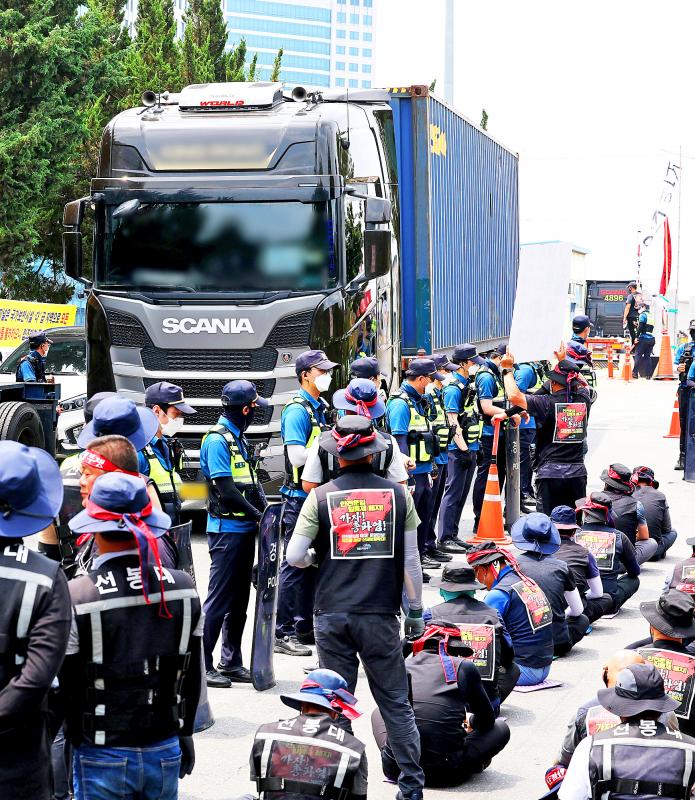
Photo: EPA-EFE
The Korea Petrochemical Industry Association called for a halt to the strike, saying the “damage is snowballing” and would affect the national economy.
Shipments from major ports such as Ulsan, Yeosu and Daesan have been halted, and daily deliveries have fallen to about 10 percent of the average level of 74,000 tonnes, it said in a statement yesterday.
The strike — one of the first economic challenges for newly elected South Korean President Yoon Suk-yeol — is entering its seventh day, as truckers protest the removal of a minimum wage scheme amid soaring fuel prices.
Deliveries of automobiles, fuels, steel and materials for semiconductor chips have been suspended or delayed, exacerbating disruptions to global supply chains after COVID-19 lockdowns in China and Russia’s invasion of Ukraine.
It is uncertain how long the strikes will continue, as talks over the weekend between the union and government officials failed to make progress. A prolonged dispute threatens to have ripple effects across the globe, as South Korea is the largest exporter of memory chips and is home to some of the world’s biggest auto companies.
The daily volume of container boxes transported to and from the nation’s 12 ports dropped 87 percent on Sunday compared with the average for last month, Ministry of Land, Infrastructure and Transport data showed.
Inbound and outbound volumes at Busan, the world’s seventh-most busy port, were less than one-fifth of their usual amount.
Steel, cement and petrochemicals are among the hardest hit industries so far, as drivers move to block deliveries of the Asian country’s most critical export items.
Output by cement companies has fallen significantly, while production by some ready-mixed concrete companies has been suspended, the transport ministry said in a statement.
Ulsan is a major choke point for trade. Not only is it a significant port for petrochemicals, it is also where leading automaker Hyundai Motor Group has its production facilities.
The company on Friday said it experienced partial production disruptions there, with the Chosun Ilbo reporting that about 50 percent of production at Hyundai’s plant was halted.
POSCO yesterday halted output at its four wire-rod factories and a cold-rolled steel plant, after the strike exhausted warehouse space, it said in response to a Bloomberg query.
The daily output of wire rod would be curbed by about 7,500 tonnes, and cold-rolled steel by 4,500 tonnes, the firm said.
While POSCO is working on minimizing the effects from the strike, there is a possibility it might have to further reduce production, a company spokeswoman said.
The firm is piling up products in parking lots and on roads, it said.
Hanwha Totalenergies Petrochemical Co and LG Chem Ltd said that they would most likely have to at least partly suspend production at some plants if the strike continues.
Warehouse space for storing solids is limited, while storage tanks for gas and liquid products are running out, the two companies said.
The South Korean military is operating about 100 cargo trucks consigned by the transport ministry to ship containers in and out of major ports, including Busan, to respond to the strike, the Ministry of Oceans and Fisheries said yesterday.
The military is shipping containers to and from locations primarily within short distances of the ports to free up space, it said.
Additional reporting by Reuters
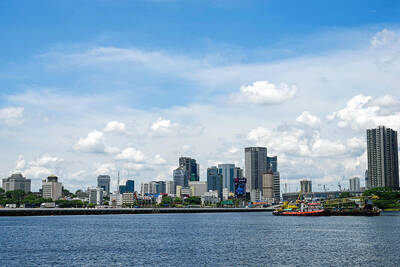
Vincent Wei led fellow Singaporean farmers around an empty Malaysian plot, laying out plans for a greenhouse and rows of leafy vegetables. What he pitched was not just space for crops, but a lifeline for growers struggling to make ends meet in a city-state with high prices and little vacant land. The future agriculture hub is part of a joint special economic zone launched last year by the two neighbors, expected to cost US$123 million and produce 10,000 tonnes of fresh produce annually. It is attracting Singaporean farmers with promises of cheaper land, labor and energy just over the border.

US actor Matthew McConaughey has filed recordings of his image and voice with US patent authorities to protect them from unauthorized usage by artificial intelligence (AI) platforms, a representative said earlier this week. Several video clips and audio recordings were registered by the commercial arm of the Just Keep Livin’ Foundation, a non-profit created by the Oscar-winning actor and his wife, Camila, according to the US Patent and Trademark Office database. Many artists are increasingly concerned about the uncontrolled use of their image via generative AI since the rollout of ChatGPT and other AI-powered tools. Several US states have adopted

KEEPING UP: The acquisition of a cleanroom in Taiwan would enable Micron to increase production in a market where demand continues to outpace supply, a Micron official said Micron Technology Inc has signed a letter of intent to buy a fabrication site in Taiwan from Powerchip Semiconductor Manufacturing Corp (力積電) for US$1.8 billion to expand its production of memory chips. Micron would take control of the P5 site in Miaoli County’s Tongluo Township (銅鑼) and plans to ramp up DRAM production in phases after the transaction closes in the second quarter, the company said in a statement on Saturday. The acquisition includes an existing 12 inch fab cleanroom of 27,871m2 and would further position Micron to address growing global demand for memory solutions, the company said. Micron expects the transaction to

A proposed billionaires’ tax in California has ignited a political uproar in Silicon Valley, with tech titans threatening to leave the state while California Governor Gavin Newsom of the Democratic Party maneuvers to defeat a levy that he fears would lead to an exodus of wealth. A technology mecca, California has more billionaires than any other US state — a few hundred, by some estimates. About half its personal income tax revenue, a financial backbone in the nearly US$350 billion budget, comes from the top 1 percent of earners. A large healthcare union is attempting to place a proposal before


 RSS
RSS