


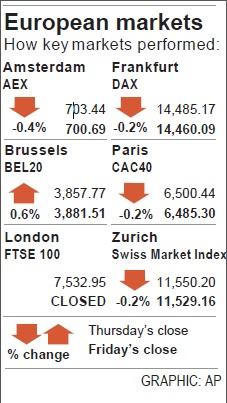
European shares on Friday fell, wiping out earlier gains, after US jobs data supported the case for the US Federal Reserve’s aggressive policy tightening and investors raised their bets on European Central Bank (ECB) rate hikes following robust inflation numbers this week.
The pan-European STOXX 600 index fell 0.26 percent to 440.09, with volumes expected to be subdued due to holidays in the UK and China. It ended the tumultuous week 0.87 percent lower.
The rate-sensitive information technology sector led losses on the STOXX 600, while the auto sector declined 1.6 percent as France’s Faurecia SE slid 6.8 percent.
The auto parts supplier said it launched a 705 million euro (US$755.69 million) capital increase to fund its acquisition of German rival Hella KGaA Hueck & Co.
Investors ramped up their bets on ECB interest rate rises this year, and priced in a bigger, 50 basis-point hike at one of the bank’s policy meetings by October, following data this week showing record high inflation in the eurozone.
“In view of the dramatic inflation trend and the fact that the ECB is so clearly ‘behind the curve,’ compared with the Fed, the ECB’s language should tend to become more hawkish,” Commerzbank AG analysts wrote in a note.
Data on Friday showed US employers hired more workers than expected last month and maintained a fairly strong pace of wage increases, signs of labor market strength that would keep the Fed on an aggressive monetary policy tightening path.
European equity markets started the week on a better footing after China eased some COVID-19 restrictions and revealed more stimulus, but the optimism was swiftly undone by data that pointed to economies tipping into recession.
In France, growth in business activity in the country’s dominant services sector weakened last month compared with April, according to a survey. Germany’s services sector also showed signs of slowing growth.
The EU’s partial ban on Russian oil imports, in retaliation for its invasion of Ukraine, also drove fears of inflation rising further.
“A recession, if any, will not occur this year, but most probably in 2023. That said, we expect the market to discount more properly a lower momentum in the economy,” Generali Investments equity strategists said.
Additional reporting by staff writer

Taichung reported the steepest fall in completed home prices among the six special municipalities in the first quarter of this year, data compiled by Taiwan Realty Co (台灣房屋) showed yesterday. From January through last month, the average transaction price for completed homes in Taichung fell 8 percent from a year earlier to NT$299,000 (US$9,483) per ping (3.3m²), said Taiwan Realty, which compiled the data based on the government’s price registration platform. The decline could be attributed to many home buyers choosing relatively affordable used homes to live in themselves, instead of newly built homes in the city’s prime property market, Taiwan Realty
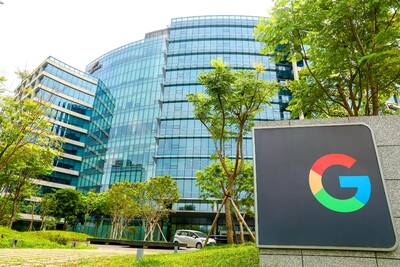
The government yesterday approved applications by Alphabet Inc’s Google to invest NT$27.08 billion (US$859.98 million) in Taiwan, the Ministry of Economic Affairs said in a statement. The Department of Investment Review approved two investments proposed by Google, with much of the funds to be used for data processing and electronic information supply services, as well as inventory procurement businesses in the semiconductor field, the ministry said. It marks the second consecutive year that Google has applied to increase its investment in Taiwan. Google plans to infuse NT$25.34 billion into Charter Investments Ltd (特許投資顧問) through its Singapore-based subsidiary Fructan Holdings Singapore Pte Ltd, and

Micron Technology Inc is a driving force pushing the US Congress to pass legislation that would put new export restrictions on equipment its Chinese competitors use to make their chips, according to people familiar with the matter. A US House of Representatives panel yesterday was to vote on the “MATCH Act,” a bill designed to close gaps in restrictions on chipmaking equipment. It would also pressure foreign companies that sell equipment to Chinese chipmaking facilities to align with export curbs on US companies like Lam Research Corp and Applied Materials Inc. The bill targets facilities operated by China’s ChangXin Memory Technologies Inc

Singapore-based ride-hailing and delivery giant Grab Holdings’ planned acquisition of Foodpanda’s Taiwan operations has yet to enter the formal review stage, as regulators await supplementary documents, the Fair Trade Commission (FTC) said yesterday. Acting FTC Chairman Chen Chih-min (陳志民) told the legislature’s Economics Committee that although Grab submitted its application on March 27, the case has not been officially accepted because required materials remain incomplete. Once the filing is finalized, the FTC would launch a formal probe into the deal, focusing on issues such as cross-shareholding and potential restrictions on market competition, Chen told lawmakers. Grab last month announced that it would acquire


 RSS
RSS