


The official manufacturing purchasing managers’ index (PMI) last month slowed to 53.5 points from 56.3 in April, with all sectors adopting conservative six-month outlooks as uncertainty builds amid rising global inflation, the Chung-Hua Institution for Economic Research (CIER, 中華經濟研究) said yesterday.
The service sector fared the worst, with the non-manufacturing index slipping into the contraction zone, as business at financial institutions, wholesalers, retailers, restaurants and hotels diminished because Taiwanese practiced self-imposed isolation, the Taipei-based think tank said.
The PMI reading last month shed another 2.8 points from April — its slowest pace of expansion in nearly two years as Russia’s invasion of Ukraine and China’s strict COVID-19 controls continued to weigh, it said.
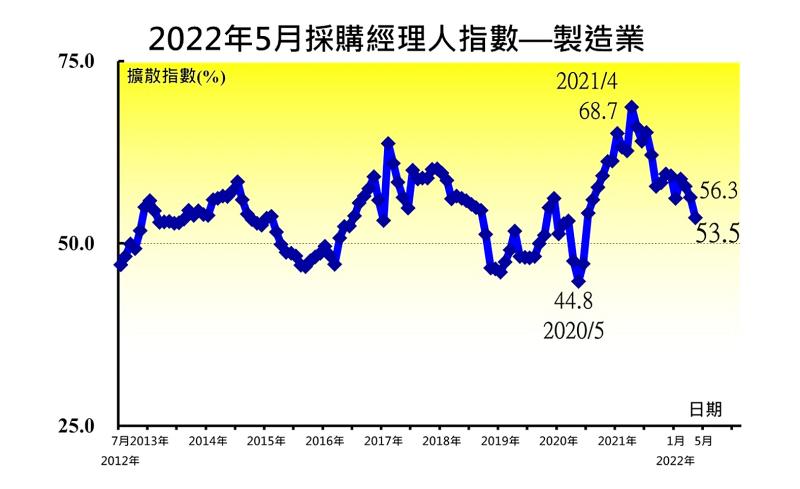
Photo courtesy of the Chung-Hua Institution for Economic Research
The index aims to capture the health of the manufacturing industry, with values above 50 points indicating an expansion and values below 50 indicating a contraction.
The subindices on new orders and industrial output faltered into negative territory, as makers of food products, textiles, raw materials, transportation tools and machinery equipment received fewer orders.
Lockdowns in China’s key industrial and commercial cities hampered economic activity and intensified supply chain disruptions, local companies have said.
Suppliers of electronics and biotechnology products managed to hold firm, thanks to solid demand for digital transformation and innovative technology applications, CIER said.
The situation might improve this month as Shanghai reopens.
However, the survey showed that companies have generally turned pessimistic, with the six-month outlook measure declining by 8.9 points to 44, the first negative reading since June 2020.
The manufacturing industry would experience uneven results in the second half of the year, CIER vice president Wang Jiann-chyuan (王健全) said.
“Companies on the upstream side of the supply chain will fare better than downstream firms,” as companies focused on selling finished goods must tackle cost hikes and softening demand, Wang said, citing the example of notebook computer suppliers.
Non-manufacturing companies generally experienced a downturn in business as most Taiwanese have voluntarily stayed home since April to avoid contracting COVID-19, CIER said.
In a separate survey, the institute said the non-manufacturing index tumbled 10 points to 45.1, the first contraction in 10 months and the worst performance since May 2020.
A surge in locally transmitted COVID-19 infections, which have hovered above 80,000 per day over the past few weeks, also added to human resource issues, Wang said.
Many service-oriented companies are having considerable difficulty maintaining sufficient cash flow, Wang said, urging the government to provide quick relief so that the firms can survive the downturn.
Non-manufacturers expect business to deteriorate, with the six-month outlook measure slumping 9.9 points to 35.8.

Vincent Wei led fellow Singaporean farmers around an empty Malaysian plot, laying out plans for a greenhouse and rows of leafy vegetables. What he pitched was not just space for crops, but a lifeline for growers struggling to make ends meet in a city-state with high prices and little vacant land. The future agriculture hub is part of a joint special economic zone launched last year by the two neighbors, expected to cost US$123 million and produce 10,000 tonnes of fresh produce annually. It is attracting Singaporean farmers with promises of cheaper land, labor and energy just over the border.

US actor Matthew McConaughey has filed recordings of his image and voice with US patent authorities to protect them from unauthorized usage by artificial intelligence (AI) platforms, a representative said earlier this week. Several video clips and audio recordings were registered by the commercial arm of the Just Keep Livin’ Foundation, a non-profit created by the Oscar-winning actor and his wife, Camila, according to the US Patent and Trademark Office database. Many artists are increasingly concerned about the uncontrolled use of their image via generative AI since the rollout of ChatGPT and other AI-powered tools. Several US states have adopted

KEEPING UP: The acquisition of a cleanroom in Taiwan would enable Micron to increase production in a market where demand continues to outpace supply, a Micron official said Micron Technology Inc has signed a letter of intent to buy a fabrication site in Taiwan from Powerchip Semiconductor Manufacturing Corp (力積電) for US$1.8 billion to expand its production of memory chips. Micron would take control of the P5 site in Miaoli County’s Tongluo Township (銅鑼) and plans to ramp up DRAM production in phases after the transaction closes in the second quarter, the company said in a statement on Saturday. The acquisition includes an existing 12 inch fab cleanroom of 27,871m2 and would further position Micron to address growing global demand for memory solutions, the company said. Micron expects the transaction to

A proposed billionaires’ tax in California has ignited a political uproar in Silicon Valley, with tech titans threatening to leave the state while California Governor Gavin Newsom of the Democratic Party maneuvers to defeat a levy that he fears would lead to an exodus of wealth. A technology mecca, California has more billionaires than any other US state — a few hundred, by some estimates. About half its personal income tax revenue, a financial backbone in the nearly US$350 billion budget, comes from the top 1 percent of earners. A large healthcare union is attempting to place a proposal before


 RSS
RSS