


In many respects, Takeshi Magami’s farm is like any other in Japan, growing everything from potatoes to ginger and eggplants, but one major difference sets it apart from its neighbors: the 2,826 solar panels perched above the crops.
The panels, covering much of the one hectare of land in the tranquil countryside east of Tokyo, serve a dual purpose. They supply nearly all the power needed to run the farm, and are a source of extra income by selling surplus renewable energy to the grid.
For Magami, that can mean ¥24 million (US$187,698) of additional revenue a year, eight times more than the maximum ¥3 million generated from his produce. While he benefits from generous tariffs that have since been reduced, it is an indication of the added value available to farms in Japan and globally.
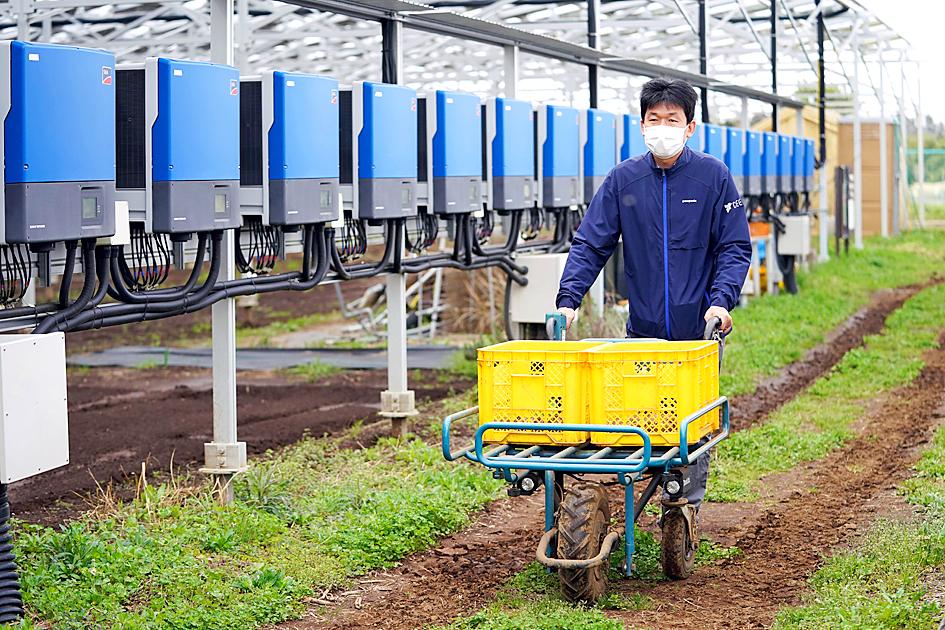
Photo: Bloomberg
“Our goal is to electrify and automate all steps of farming” and create a model for what sustainable agriculture could look like, said the 38-year-old Magami, who has been operating the farm as part of his start-up Chiba Ecological Energy Inc.
All the machinery used on Magami’s farm, minus the tractor and a hand-pushed tiller, are electric, charged by panels set above a small shed. Rows of batteries for the tools are lined up on a shelf.
The farm is part of a global movement called solar sharing — or agrivoltaics — that involves the simultaneous use of farmland for producing crops and generating power. The movement is gaining adherents as the global push to replace fossil fuels is encouraging more innovative approaches to boosting capacity for renewable energy.
Solar sharing is emerging as a viable alternative in places such as Japan with limited space and a heavy reliance on energy imports. It can help stretch home-grown energy production as countries increasingly seek to reduce their exposure to foreign supplies. Solar sharing is also useful in countries with harsh growing environments, protecting crops by absorbing sunlight and acting as a shield.
“We’ve seen many regions with climate change, and agrivoltaics could mitigate and make agriculture more resilient,” said Max Trommsdorff, head of the agrivoltaics group at the Fraunhofer Institute for Solar Energy Systems ISE in Germany. “Small countries in the sun belt with high population is where agrivoltaics are most urgent and promising.”
Japan, which aims to be carbon neutral by 2050, has limited capabilities for renewable energy because of its mountainous terrain. It is aiming for 36 percent to 38 percent of its energy mix to come from renewable sources in 2030, with solar accounting for 14 percent to 16 percent.
While Japan’s solar installations have risen over the past decade, they supplied only 8.9 percent of the country’s power as of fiscal 2020, the Institute for Sustainable Energy Policies in Tokyo said.
That means Japan would need more spots for panels. The government is looking toward rooftops, railway lines and airports, and the country’s wide stretches of agricultural land on the flat plains offer a promising alternative.
However, while Magami has demonstrated the success of solar sharing, the practice has not been widely adopted in Japan.
Only 742 hectares were approved for agrivoltaic use between fiscal 2013 and 2019, out of the country’s total agricultural land of 4.4 million hectares as of 2020, Japanese Ministry of Agriculture, Forestry and Fisheries data showed.
Agrivoltaics is a tough sell for Japan’s older farming population. Many are without successors to take over the business, and are unwilling to make the heavy investment in solar panels that might take decades to pay off. It can also distract from the business of growing crops.
“Some people are against it as it ruins aesthetics, or for getting in the way of farm work,” said Chiho Egashira, a ministry official said.
It can be cumbersome for farm equipment to dodge poles that lift the panels off the ground.
While solar panels can be an alluring prospect for extra income, the ministry wants to ensure food security remains the priority, and so it has put in place rules to ensure production levels.
Despite the hurdles, it is necessary for the country to embrace agrivoltaics to reach carbon neutrality by 2050, Magami said.
Using solar panels on about 5 percent of Japan’s arable farmland, or equivalent to 200,000 hectares, could generate 20 percent of the country’s power generation, he said.
“Things like geothermal and hydropower take decades to start operating,” Magami said. “We’re no longer in an era where the best way is to find unused plots of land available and install it with panels. Those have all been filled.”
Other nations are making progress with solar sharing, especially in countries that face a similar lack of space. South Korea has targeted 10 gigawatt (GW) of agrivoltaics capacity by 2030 under its Renewable Energy 3020 plan.
Taiwan is eyeing the scheme as it seeks available spaces for renewable installation, Magami said.
Italy plans to invest 1.1 billion euros (US$1.16 billion) in agrivoltaics to create about 2GW of capacity.
Larger countries also have a significant presence. China, the world’s top solar panel producer, is home to the biggest agrivoltaic system: a project covering 2,000 hectares of land in the desert in Ningxia.
Of the 2.8GW agrivoltaic systems installed globally, China had roughly 1.9GW of capacity as of 2020, the Fraunhofer Institute said.
Adoption in the US varies, with more progressive states in the Northeast launching projects with government funding, said Mark Uchanski, an associate professor at Colorado State University who specializes in sustainable and organic agriculture.
“People’s appetites are increasing,” he said, adding that agrivoltaics “is a perfect storm for wanting food security, energy and working toward emission goals.”
After several years flying high as Asia’s best Nvidia Corp proxy, Taiwan Semiconductor Manufacturing Co (TSMC, 台積電) is increasingly vying with other artificial intelligence (AI) stocks for investor attention. Stock traders are chasing a wider array of beneficiaries as mainstream usage of AI creates demand for hardware beyond the most-advanced chips TSMC makes for Nvidia. Subthemes from the deepening memory crunch to advances in robotics are also luring bids. At the same time, investment caps on single stocks are pushing funds to diversify, while retail investors long familiar with TSMC through its US depositary receipts are being offered a broader set of

Netherlands-based semiconductor equipment supplier ASML Holding NV yesterday said that it is planning to hire an additional 1,000 people in Taiwan this year in response to growing demand from clients. ASML had previously planned to recruit 600 people this year, but that the plan has been adjusted upward, ASML vice president and ASML Taiwan general manager Grace Wang (汪佳慧) told reporters. ASML has a workforce of more than 4,500 in Taiwan, accounting for about 10 percent of its global total, Wang said. This year’s recruitment campaign would focus on adding people in the customer support, manufacturing and supply chain domains to assist ASML

UNDER MICROSCOPE: Taiwan detained three people who allegedly conspired to buy servers in Taiwan and export them using fraudulent documentation, prosecutors said Nvidia Corp chief executive officer Jensen Huang (黃仁勳) on Saturday urged Super Micro Computer Inc to tighten up on compliance after Taiwan detained three people this week for allegedly making fraudulent declarations about artificial intelligence (AI) servers made by its US partner. The development marked the nation’s first crackdown on semiconductor smuggling, which grew after the US slapped restrictions on exports of high-end chips such as Nvidia AI accelerators to China. Nvidia is “rigorous” in explaining regulations to all of its partners, Huang told reporters after arriving in Taipei. “Ultimately Super Micro has to run their own company,” he said in response to

Nvidia Corp yesterday announced that CEO Jensen Huang (黃仁勳) would attend an employee meeting in Taipei tomorrow to celebrate the launch of the company’s Taiwan headquarters project. Huang would attend a gathering at the site of Nvidia’s planned headquarters in Beitou Shilin Technology Park (北投士林科技園區), the company said in a statement. After arriving in Taiwan on Saturday last week, Huang told reporters that he plans to meet with Quanta Computer Inc (廣達) chairman Barry Lam (林百里) and Taiwan Semiconductor Manufacturing Co (TSMC, 台積電) chairman C.C. Wei (魏哲家), and would attend the groundbreaking ceremony for Nvidia’s Taiwan headquarters tomorrow. Nvidia has not yet applied


 RSS
RSS