


India’s Tata Group is planning a foray into semiconductor manufacturing as the coffee-to-cars conglomerate seeks to mitigate the pain from the global chip crisis as well as reduce dependence on imports.
Besides making chips, plans to manufacture batteries for electric vehicles will also be announced soon, N. Chandrasekaran, chairman of Tata Sons Pvt, the group’s main holding company, said at an event in Mumbai, India, yesterday.
Chandrasekaran in Tata Motors Ltd’s annual report in June last year had spoken about evaluating partnerships with companies in India and Europe to manufacture cells and batteries.
The initiatives by the US$103 billion Tata Group are aligned to Indian Prime Minister Narendra Modi’s attempts to make India a leader in semiconductor production and reduce its reliance on imports amid global chain disruptions.
Besides Tata, several international chip giants, including Intel Corp and Taiwan Semiconductor Manufacturing Co (台積電), are exploring India as a potential manufacturing base.
Automakers around the globe are grappling with a semiconductor shortage, exacerbated by COVID-19 pandemic lockdowns in China, which have hobbled the automobile and the electronics sector by raising input costs for makers.
Volvo Car AB has said it would have a hard time meeting its production forecast for this year due to issues procuring a specific type of semiconductor, while Renault SA earlier this month halted production of its new electric vehicle because of a lack of components.
Tata Group’s foray into semiconductor making will also help its Tata Motors, which makes the Jaguar Land Rover brands and has suffered due to the shortages.
Tata Motors, which has a 70 percent share in India’s nascent electric vehicle market, also announced plans to launch its first-ever pure electric vehicle by 2025.
The five-seater Avinya is to have no gasoline variants, Shailesh Chandra, managing director at Tata Motors Passenger Vehicles told reporters at a briefing yesterday.
Tata Motors currently sells two battery-powered models, the Nexon EV and Tigor EV, but they also have variants that run on fossil fuels.
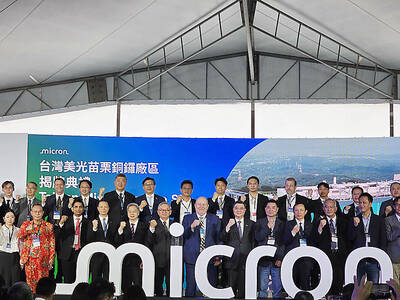
UNPRECEDENTED PACE: Micron Technology has announced plans to expand manufacturing capabilities with the acquisition of a new chip plant in Miaoli Micron Technology Inc unveiled a newly acquired chip plant in Miaoli County yesterday, as the company expands capacity to meet growing demand for advanced DRAM chips, including high-bandwidth memory chips amid the artificial intelligence boom. The plant in Miaoli County’s Tongluo Township (銅鑼), which Micron acquired from Powerchip Semiconductor Manufacturing Corp (力積電) for US$1.8 billion, is expected to make a sizeable capacity contribution to the company from fiscal 2028, the company said in a statement. It would be an extended production site of Micron’s large-scale manufacturing hub in Taichung, the company said. As the global semiconductor industry is racing to reach US$1 trillion

A man walks past real-estate advertisements outside a house in Taipei yesterday. The central bank yesterday said it plans to establish an “Inflation-at-Risk” gauge as a supplementary tool for observing inflation, as policymakers express wish to communicate more effectively with the public when making inflation forecasts.
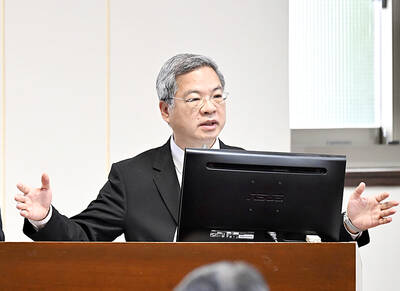
ABOVE LEGAL REQUIREMENT: The Ministry of Economic Affairs is prepared if LNG supply is disrupted, with more than the legal requirement of 11 days of inventory Taiwan has largely secured liquefied natural gas (LNG) supplies through May and arranged about half of June’s supply, Minister of Economic Affairs Kung Ming-hsin (龔明鑫) said yesterday. Since the Middle East conflict began on Feb. 28, Taiwan’s LNG inventories have remained more than 12 days, exceeding the legal requirement of 11 days, indicating no major supply concerns for domestic gas and electricity, Kung said at a meeting of the legislature’s Economics Committee in Taipei. The ministry aims to increase the figure to 14 days by the end of next year, he said. While one or two LNG or crude oil shipments for May

Memory chip stocks extended their losses yesterday after Alphabet Inc’s Google publicized research that could allow more efficient use of the storage needed for artificial intelligence (AI) development. SK Hynix Inc and Samsung Electronics Co, South Korean leaders in the market, fell more than 6 percent and about 5 percent respectively in Seoul. In the US, Micron Technology Inc, Western Digital Corp and Sandisk Corp slid more than 2 percent in pre-market trading, after they all closed lower on Wednesday. Memory companies have been on a tear in recent months as the rapid development of AI infrastructure triggered a spike in chip


 RSS
RSS