


Tesla Inc is extending the production pause at its Shanghai plant to Thursday after the city was placed into a phased lockdown to curb a surge in COVID-19 cases, people familiar with the matter said.
The suspension of production at the Gigafactory near China’s main financial center, originally scheduled for one day, has now been extended to four days and is expected to resume on April 1, said the people, who asked not to be identified.
Shanghai is locking down half of the city in turns to conduct a mass testing blitz to combat a COVID-19 outbreak that has turned it into China’s largest virus hotspot. Areas east of the Huangpu River, where the Tesla plant is located, were locked down starting yesterday for four days.
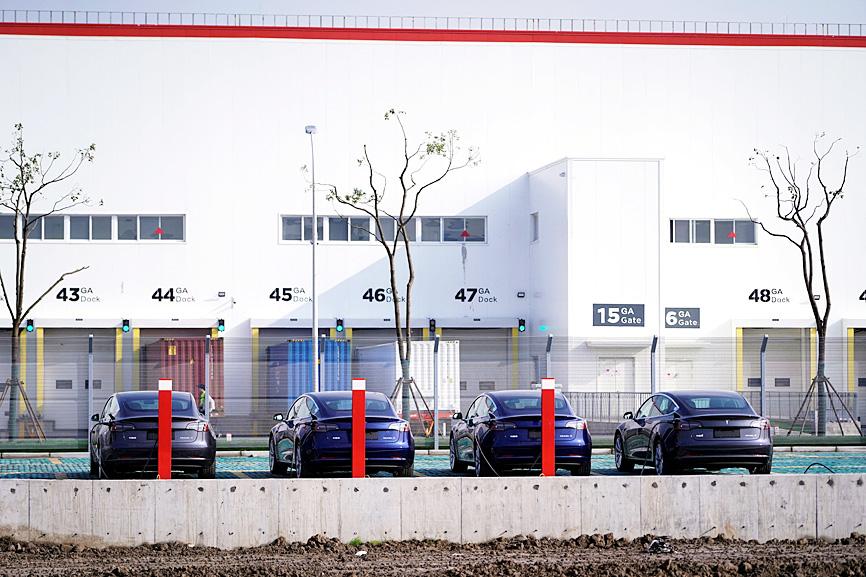
Photo: Reuters
Many Tesla workers are affected, although they might be able to return to work when the lockdown shifts to the other side of the city.
“Tesla always insists on fulfilling the main-body responsibility of pandemic prevention and control, strictly implementing all related requirements, and arranging work according to the government’s policy at any time,” a company spokesperson said.
The first “gigafactory” outside of the US produced half of the electric automaker’s vehicles last year and had to suspend production for two days earlier this month.
The company said at the time that it was making its “best effort” to ensure production could continue at the plant, while “actively cooperating with the government’s order for COVID-19 tests and relevant pandemic prevention measures.”
The Shanghai factory is crucial for Tesla, given that China is the company’s second-largest market and the plant builds vehicles for export to Europe and elsewhere in Asia.
The China Passenger Car Association earlier this month reported that Tesla delivered 56,515 cars from the factory last month alone — 23,200 for the domestic market and 33,315 for export.
Tesla CEO Elon Musk famously resisted California health regulators’ efforts to keep a US factory closed during the early days of the pandemic. After about seven weeks of shutdown, he reopened the Fremont plant — his only US vehicle-production site at the time — on May 11, 2020, flouting county officials’ orders and daring authorities to arrest him.
Musk ultimately cited the dispute as one of the reasons he moved Tesla’s headquarters from Palo Alto, California, to Austin, Texas, late last year.
Tesla has factories on three continents. Musk last week delivered the first German-made Model Y vehicles from a new factory outside Berlin. Tesla has a fourth auto factory scheduled to open in Austin in a few weeks.

SECOND-RATE: Models distilled from US products do not perform the same as the original and undo measures that ensure the systems are neutral, the US’ cable said The US Department of State has ordered a global push to bring attention to what it said are widespread efforts by Chinese companies, including artificial intelligence (AI) start-up DeepSeek (深度求索), to steal intellectual property from US AI labs, according to a diplomatic cable. The cable, dated Friday and sent to diplomatic and consular posts around the world, instructs diplomatic staff to speak to their foreign counterparts about “concerns over adversaries’ extraction and distillation of US AI models.” Distillation is the process of training smaller AI models using output from larger, more expensive ones to lower the costs of training a powerful new
Shares of Taiwan Semiconductor Manufacturing Co (TSMC, 台積電) have repeatedly hit new highs, but an equity analyst said the stock’s valuation remains within a reasonable range and any pullback would likely be technical. The contract chipmaker’s historical price-to-earnings (P/E) ratio has ranged between 20 and 30, Cathay Futures Consultant Co (國泰證期) analyst Tsai Ming-han (蔡明翰) told Central News Agency. With market consensus projecting that TSMC would post earnings per share of about NT$100 (US$3.17) this year, supported by strong global demand for artificial intelligence (AI) applications, and the stock currently trading at a P/E ratio of below 25, Tsai said the valuation
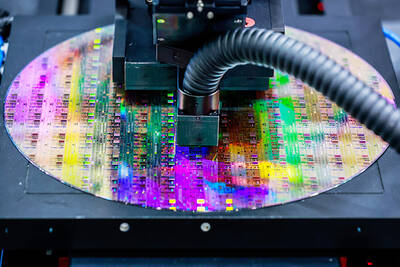
The artificial intelligence (AI) boom has triggered a seismic reshuffling of global equity markets, with Taiwan and South Korea muscling past European nations one by one. With its stock market now valued at nearly US$4.3 trillion, Taiwan surpassed the UK, Europe’s biggest market, earlier this month, data compiled by Bloomberg showed. South Korea is about US$140 billion away from doing the same. The tech-heavy Asian markets have shot past Germany and France in the past seven months. The shift is largely down to massive gains in shares of three companies that provide essential hardware for AI: Taiwan Semiconductor Manufacturing Co (TSMC, 台積電),
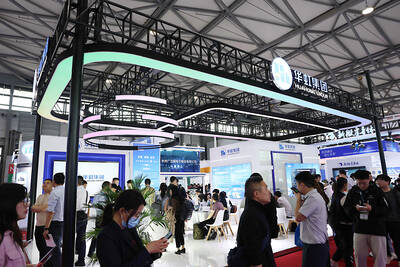
The US Department of Commerce last week ordered multiple chip equipment companies to halt shipments of certain tools to China’s second-largest chipmaker, Hua Hong Semiconductor Ltd (華虹半導體), its latest action to slow the country’s development of advanced chips, two people familiar with the matter said. The department sent letters to at least a handful of companies informing them of restrictions on tools and other materials destined for two Hua Hong facilities US officials believe make China’s most sophisticated chips, the people said. Top US chip equipment companies Lam Research Corp, Applied Materials Inc and KLA Corp, each of which has significant


 RSS
RSS