


Hong Kong carrier Cathay Pacific Airways Ltd (國泰航空) yesterday posted a loss of US$703 million for last year, a massive improvement on the record loss sustained in 2020, even as the airline struggles with tough travel restrictions.
Cathay chairman Patrick Healy said the company “continued to face serious challenges” and the overall loss for the year was “substantial,” despite a considerable improvement in the second half.
Cathay’s result was a vast improvement from its record loss in 2020 of HK$21.6 billion (US$2.76 billion at the current exchange rate), which Healey described as the “most challenging” year in the airline’s seven-decade history.
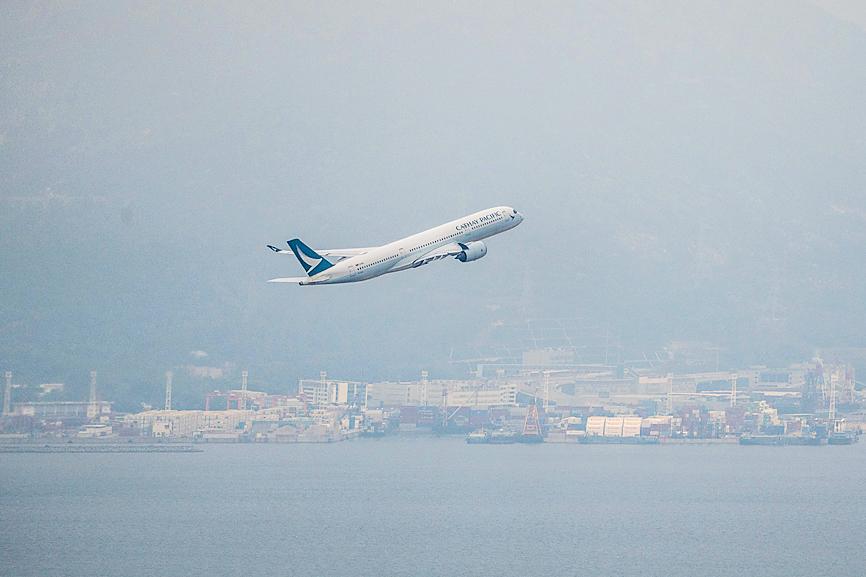
Photo: Bloomberg
Cathay recorded an attributable loss of HK$5.5 billion for the whole of last year, recovering ground in the second half of the year with a HK$2 billion attributable profit.
“The exceptional performance of our cargo business, especially during the second-half peak season, was extremely encouraging,” Healy said.
The average estimate from analysts tracked by Bloomberg was for an annual loss of HK$9.8 billion.
Cathay also surpassed its own forecast in January, when it expected a net loss of HK$5.6 billion to HK$6.1 billion.
Hong Kong has imposed some of the world’s harshest travel restrictions under its “zero COVID” policy, isolating a territory that was once one of the world’s largest logistics and transportation hubs.
Cathay said that passenger numbers were down 85 percent from 2020, with the airline flying just 1,965 passengers per day on average last year, and a far cry from the 35.2 million transported in 2019 before the emergence of COVID-19.
Strict quarantine regulations for aircrew that Hong Kong imposed in February last year were “very demanding” and had a “substantial impact” on Cathay’s travel business, Healy said.
However, cargo was the bright spot, with revenue up 32 percent to HK$32.38 billion.
“Our cargo business performed exceptionally well,” Healy said, with Cathay’s freighter fleet operating at peak capacity toward the end of last year, supplemented by extra cargo-only passenger flight operations.
Hong Kong’s tight travel restrictions, with flights from several countries banned, are expected to continue to affect operations this year as the territory battles a massive outbreak of the Omicron variant of SARS-CoV-2.
“We have had an extremely challenging start to 2022,” Healy said.
For this year, Cathay said that it expects to operate at about 2 percent of its pre-COVID-19 passenger flight capacity, with the figure for cargo flight capacity remaining at less than one-third.
“Although we are still facing many challenges, we have the utmost confidence in the long-term future of Cathay Pacific,” Healy said.
Taiwan’s exports soared 56 percent year-on-year to an all-time high of US$64.05 billion last month, propelled by surging global demand for artificial intelligence (AI), high-performance computing and cloud service infrastructure, the Ministry of Finance said yesterday. Department of Statistics Director-General Beatrice Tsai (蔡美娜) called the figure an unexpected upside surprise, citing a wave of technology orders from overseas customers alongside the usual year-end shopping season for technology products. Growth is likely to remain strong this month, she said, projecting a 40 percent to 45 percent expansion on an annual basis. The outperformance could prompt the Directorate-General of Budget, Accounting and

Two Chinese chipmakers are attracting strong retail investor demand, buoyed by industry peer Moore Threads Technology Co’s (摩爾線程) stellar debut. The retail portion of MetaX Integrated Circuits (Shanghai) Co’s (上海沐曦) upcoming initial public offering (IPO) was 2,986 times oversubscribed on Friday, according to a filing. Meanwhile, Beijing Onmicro Electronics Co (北京昂瑞微), which makes radio frequency chips, was 2,899 times oversubscribed on Friday, its filing showed. The bids coincided with Moore Threads’ trading debut, which surged 425 percent on Friday after raising 8 billion yuan (US$1.13 billion) on bets that the company could emerge as a viable local competitor to Nvidia

BARRIERS: Gudeng’s chairman said it was unlikely that the US could replicate Taiwan’s science parks in Arizona, given its strict immigration policies and cultural differences Gudeng Precision Industrial Co (家登), which supplies wafer pods to the world’s major semiconductor firms, yesterday said it is in no rush to set up production in the US due to high costs. The company supplies its customers through a warehouse in Arizona jointly operated by TSS Holdings Ltd (德鑫控股), a joint holding of Gudeng and 17 Taiwanese firms in the semiconductor supply chain, including specialty plastic compounds producer Nytex Composites Co (耐特) and automated material handling system supplier Symtek Automation Asia Co (迅得). While the company has long been exploring the feasibility of setting up production in the US to address

OPTION: Uber said it could provide higher pay for batch trips, if incentives for batching is not removed entirely, as the latter would force it to pass on the costs to consumers Uber Technologies Inc yesterday warned that proposed restrictions on batching orders and minimum wages could prompt a NT$20 delivery fee increase in Taiwan, as lower efficiency would drive up costs. Uber CEO Dara Khosrowshahi made the remarks yesterday during his visit to Taiwan. He is on a multileg trip to the region, which includes stops in South Korea and Japan. His visit coincided the release last month of the Ministry of Labor’s draft bill on the delivery sector, which aims to safeguard delivery workers’ rights and improve their welfare. The ministry set the minimum pay for local food delivery drivers at


 RSS
RSS