


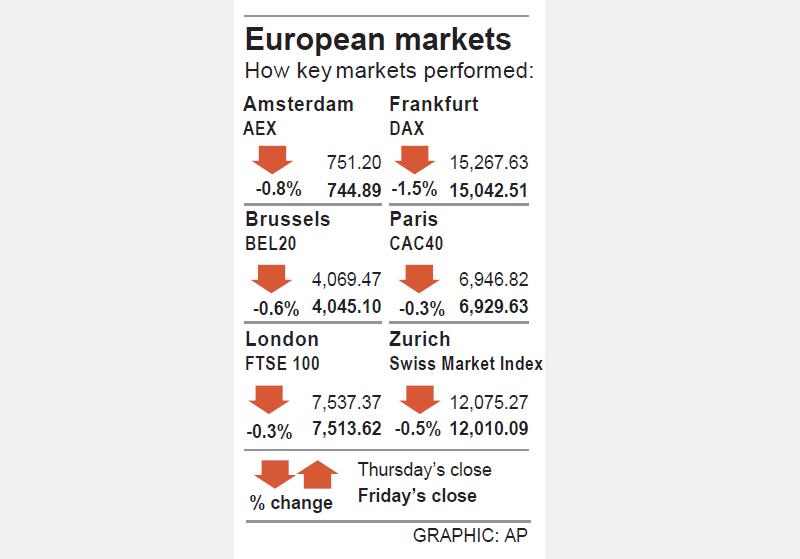
European shares ended lower on Friday and dropped nearly 2 percent this week with travel and banking shares leading the declines over caution around rising tensions between Russia and Ukraine ahead of the weekend.
Caution overtook markets across the globe as Russian-backed separatists in eastern Ukraine said they planned to evacuate their breakaway region’s residents to Russia, a shock turn in a conflict the West believes Moscow plans to use to justify an invasion of Ukraine.
The pan-European STOXX 600 fell 0.8 percent and dropped 1.9 percent for the week with travel and banking shares the top weekly losers.
However, news of US the secretary of state agreeing to a meeting next week with the Russian minister of foreign affairs raised hopes of a diplomatic solution and helped limit losses somewhat.
“There is a higher probability either of a diplomatic solution or some kind of an incursion, but fairly contained,” PineBridge Investments multiasset manager Hani Redha said.
Banking shares have come under pressure this week as rising conflict fears pushed investors toward safer assets, driving short-term European yields lower, which have fallen 12 basis points this week.
Markets have gyrated this week following news of shelling in eastern Ukraine and warnings from Western leaders that an invasion could happen at any time, even though Moscow has denied it.
While earnings continued to be largely supportive, investors also feared aggressive monetary policy tightening measures from the US Federal Reserve and other major central banks to combat surging inflation.
“Since late last year, we began to reduce risk because we saw a lot of policy withdrawal challenges that markets will have to go through,” Redha said.
Allianz SE fell 3.8 percent and was the top drag on the STOXX 600 after it announced big bonus cuts for its CEO and board, and a settlement with a “vast majority” of investors, as it braces for the outcome of US regulatory investigations into a multibillion-dollar trading debacle at its funds arm.
Finnish drug manufacturer Orion Corp jumped 22.2 percent to the top of STOXX 600 following positive trial results for its prostate cancer treatment.
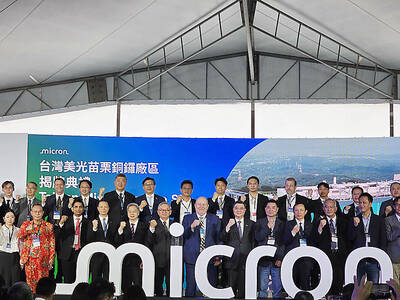
UNPRECEDENTED PACE: Micron Technology has announced plans to expand manufacturing capabilities with the acquisition of a new chip plant in Miaoli Micron Technology Inc unveiled a newly acquired chip plant in Miaoli County yesterday, as the company expands capacity to meet growing demand for advanced DRAM chips, including high-bandwidth memory chips amid the artificial intelligence boom. The plant in Miaoli County’s Tongluo Township (銅鑼), which Micron acquired from Powerchip Semiconductor Manufacturing Corp (力積電) for US$1.8 billion, is expected to make a sizeable capacity contribution to the company from fiscal 2028, the company said in a statement. It would be an extended production site of Micron’s large-scale manufacturing hub in Taichung, the company said. As the global semiconductor industry is racing to reach US$1 trillion

Singapore-based ride-hailing and delivery giant Grab Holdings Ltd has applied for regulatory approval to acquire the Taiwan operations of Germany-based Delivery Hero SE's Foodpanda in a deal valued at about US$600 million. Grab submitted the filing to the Fair Trade Commission on Friday last week, with the transaction subject to regulatory review and approval, the company said in a statement yesterday. Its independent governance structure would help foster a healthy and competitive market in Taiwan if the deal is approved, Grab said. Grab, which is listed on the NASDAQ, said in the filing that US-based Uber Technologies Inc holds about 13 percent of

Taiwan’s food delivery market could undergo a major shift if Singapore-based Grab Holdings Ltd completes its planned acquisition of Delivery Hero SE’s Foodpanda business in Taiwan, industry experts said. Grab on Monday last week announced it would acquire Foodpanda’s Taiwan operations for US$600 million. The deal is expected to be finalized in the second half of this year, with Grab aiming to complete user migration to its platform by the first half of next year. A duopoly between Uber Eats and Foodpanda dominates Taiwan’s delivery market, a structure that has remained intact since the Fair Trade Commission (FTC) blocked Uber Technologies Inc’s

Memory chip stocks extended their losses yesterday after Alphabet Inc’s Google publicized research that could allow more efficient use of the storage needed for artificial intelligence (AI) development. SK Hynix Inc and Samsung Electronics Co, South Korean leaders in the market, fell more than 6 percent and about 5 percent respectively in Seoul. In the US, Micron Technology Inc, Western Digital Corp and Sandisk Corp slid more than 2 percent in pre-market trading, after they all closed lower on Wednesday. Memory companies have been on a tear in recent months as the rapid development of AI infrastructure triggered a spike in chip


 RSS
RSS