


Netflix Inc expects to add just 2.5 million subscribers this quarter, a number that falls short of Wall Street’s estimates and would mark the slowest start to a new year for the company in at least a decade.
Shares of Netflix fell as much as 20 percent to US$404.50 in after-hours trading, erasing about US$45 billion in market value as investors braced for the prospect that the streaming giant is entering a new phase of slower growth. Walt Disney Co and Roku Inc also slumped.
Netflix added just 18.2 million customers in last year, down about 50 percent from the record year before. It is forecasting the slowdown to continue at least for another quarter, with the outlook for the current period missing Wall Street’s projection for 6.26 million new subscribers.
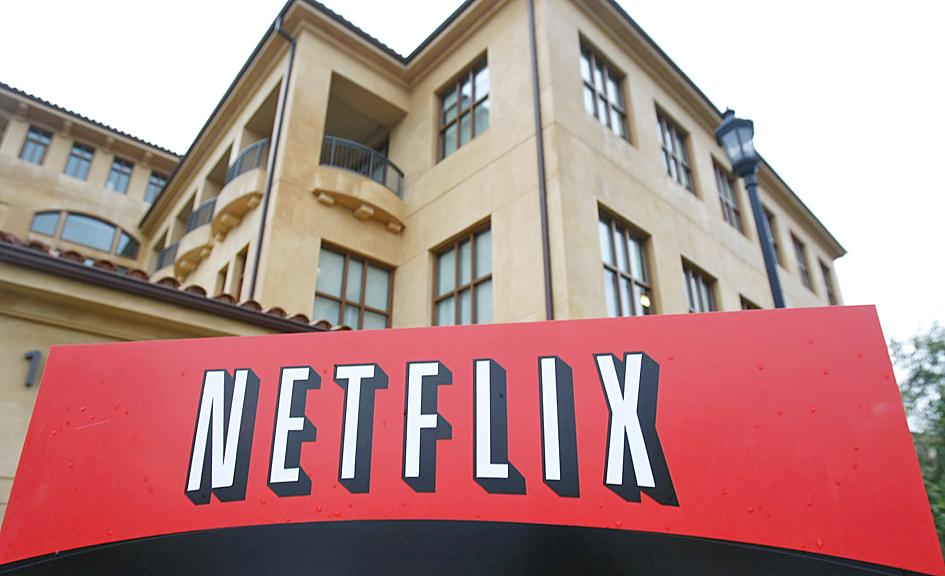
Photo: AP
Company executives struggled to identify why growth has slowed. They blamed a tough economy, especially in Latin America, as well as lingering fallout from the pandemic. Management also acknowledged the potential impact from rival streaming services.
Cofounder Reed Hastings has long dismissed competition as a problem, noting that Netflix grew while many rivals were just entering the business.
However, Netflix is changing its tune slightly.
“It’s tough to pinpoint why [subscriber] acquisition hasn’t recovered to pre-COVID levels,” chief financial officer Spencer Neumann said on Thursday. He said that they have confidence in the long-term prospects for the business.
The ups and downs of the COVID-19 pandemic show the company’s trajectory as less predictable. Netflix posted its best subscriber growth ever in 2020, when billions of people were stuck at home. However, the company said that those numbers pulled from future growth and led to a slow start to last year.
The company ended the year with two strong quarters. Netflix signed up 8.28 million customers in the fourth quarter of last year, the company said in a statement on Thursday, beating Wall Street estimates, though shy of its own forecast of 8.5 million.
The just-ended quarter featured the strongest slate in Netflix history, with more big titles released in the final months of last year than in any previous period. They included new seasons of the popular series The Witcher and Money Heist, the new shows Maid and My Name, and the movies Don’t Look Up and Red Notice.
Those two pictures are Netflix’s two most-viewed original films ever. Red Notice was viewed for more than 364 million hours in its first 28 days, and spent almost 350 million hours with the climate-change satire Don’t Look Up. That is the equivalent of about 180 million people watching Red Notice once, and about 140 million people going to see Don’t Look Up in a theater.
Investors have long seen Netflix as a growth stock, a company that could add tens of millions of customers per year as people transition from pay TV to Internet video. Netflix has delivered on that promise for a decade, growing year after year to more than 200 million subscribers. Its stock climbed almost 6,000 percent over the 10 years than ended last month.
However, now that the company has signed up so many customers in North America and much of Europe, growth becomes challenging. Europe and Asia were the company’s most important markets last year. Netflix added 7.14 million customers in Asia Pacific and 7.34 million in Europe, the Middle East and Africa.

The domestic unit of the Chinese-owned, Dutch-headquartered chipmaker Nexperia BV will soon be able to produce semiconductors locally within China, according to two company sources. Nexperia is at the center of a global tug-of-war over critical semiconductor technology, with a Dutch court in February ordering a probe into alleged mismanagement at the company. The geopolitical tussle has disrupted supply chains, with some carmakers reportedly forced to cut production due to chip shortages. Local production would allow Nexperia’s domestic arm, Nexperia Semiconductors (China) Ltd (安世半導體中國), to bypass restrictions in place since October on the supply of silicon wafers — etched with tiny components to

Singapore-based ride-hailing and delivery giant Grab Holdings Ltd has applied for regulatory approval to acquire the Taiwan operations of Germany-based Delivery Hero SE's Foodpanda in a deal valued at about US$600 million. Grab submitted the filing to the Fair Trade Commission on Friday last week, with the transaction subject to regulatory review and approval, the company said in a statement yesterday. Its independent governance structure would help foster a healthy and competitive market in Taiwan if the deal is approved, Grab said. Grab, which is listed on the NASDAQ, said in the filing that US-based Uber Technologies Inc holds about 13 percent of

Taiwan Semiconductor Manufacturing Co (TSMC, 台積電) yesterday received government approval to deploy its advanced 3-nanometer (3nm) process at its second fab currently under construction in Japan, the Ministry of Economic Affairs said in a news release. The ministry green-lit the plan for the facility in Kumamoto, which is scheduled to start installing equipment and come online in 2028 with a monthly production capacity of 15,000 12-inch wafers, the ministry said. The Department of Investment Review in June 2024 authorized a US$5.26 billion investment for the facility, slated to manufacture 6- to 12nm chips, significantly less advanced than 3nm process. At a meeting with

Taiwan’s food delivery market could undergo a major shift if Singapore-based Grab Holdings Ltd completes its planned acquisition of Delivery Hero SE’s Foodpanda business in Taiwan, industry experts said. Grab on Monday last week announced it would acquire Foodpanda’s Taiwan operations for US$600 million. The deal is expected to be finalized in the second half of this year, with Grab aiming to complete user migration to its platform by the first half of next year. A duopoly between Uber Eats and Foodpanda dominates Taiwan’s delivery market, a structure that has remained intact since the Fair Trade Commission (FTC) blocked Uber Technologies Inc’s


 RSS
RSS