


Hon Hai Precision Industry Co (鴻海精密), a major iPhone assembler, yesterday tightened COVID-19 rules for workers at its factories in Taoyuan’s Jhongli District (中壢) and asked them to work remotely amid a rise in local infections.
The move came after one more worker at Compal Electronics Inc’s (仁寶電腦) factory in Pingjhen District (平鎮) yesterday tested positive for the virus, bringing the firm’s total to four cases.
“To cope with recent surges in local infections, employees residing in Taoyuan’s Jhongli District should stop coming to factories immediately and work from home instead,” Hon Hai, headquartered in New Taipei City’s Tucheng District (土城), said in an internal memo.
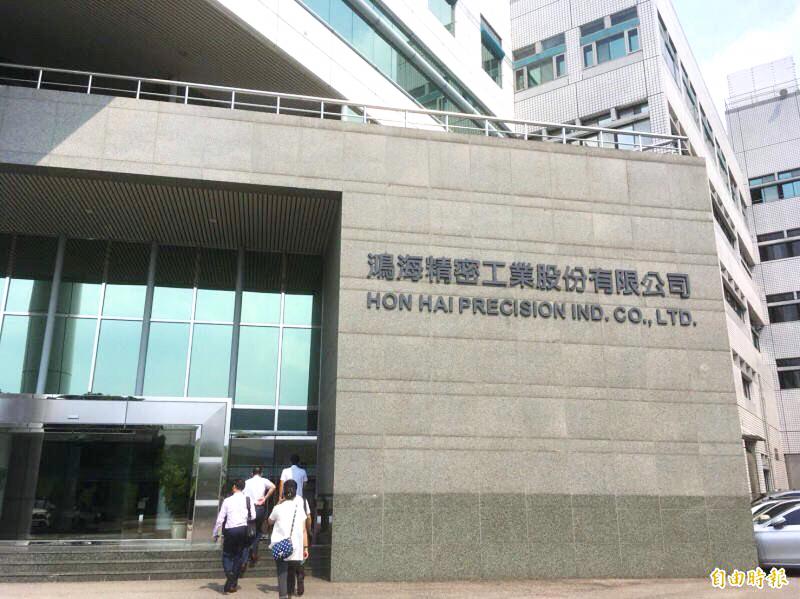
Photo: Chen Jou-chen, Taipei Times
Employees would not be allowed to switch between manufacturing sites, it said in a separate memo.
Shuttle buses running between factories in Taoyuan and municipal Taipei would be suspended, it said, urging on-site workers to practice social distancing.
To reduce in-person contacts and protect its workforce, employee restaurants would only offer boxed lunches and employees would only be allowed to eat in their cubicles rather than in public areas, Hon Hai said.
Separately, Hon Hai chairman Young Liu (劉揚偉) said that the company would develop a platform for companies in its ecosystem to develop metaverse applications, a strategy Hon Hai has adopted for entering the electric vehicle (EV) business.
“Hon Hai has been known for its strength in hardware in the past, but the company has deeply involved itself in software development,” Liu said in an interview with news Web site TechOrange. “What we intend to do in the EV and metaverse areas is to offer a platform, or infrastructure.”
By creating a metaverse platform to integrate hardware and software technologies, Hon Hai aims to help solve problems such as poor voice quality during video conferences, instead using avatars to communicate smoothly, he said.
Aside from the metaverse, Hon Hai has identified quantum computing as a key technology that would significantly affect people’s lives, so the company is seeking to make inroads in that field, too, he said.
Quantum computing would help autonomous vehicles navigate, as traditional technologies would be too slow, Liu said.
“Traditional computing technology is not quick enough to make the calculations,” he said.
Quantum computing could also help find low-risk investments and quickly develop medical solutions, he said.
Hon Hai is striving to transform itself into a technology-oriented company, leaving behind its image as a manufacturing service provider, Liu said.
About two years ago, when Young succeeded Terry Gou (郭台銘) as chairman, the company set up the Hon Hai Research Institute, which aims to identify crucial technologies that would play important roles three to seven years ahead, he said.

The domestic unit of the Chinese-owned, Dutch-headquartered chipmaker Nexperia BV will soon be able to produce semiconductors locally within China, according to two company sources. Nexperia is at the center of a global tug-of-war over critical semiconductor technology, with a Dutch court in February ordering a probe into alleged mismanagement at the company. The geopolitical tussle has disrupted supply chains, with some carmakers reportedly forced to cut production due to chip shortages. Local production would allow Nexperia’s domestic arm, Nexperia Semiconductors (China) Ltd (安世半導體中國), to bypass restrictions in place since October on the supply of silicon wafers — etched with tiny components to

Singapore-based ride-hailing and delivery giant Grab Holdings Ltd has applied for regulatory approval to acquire the Taiwan operations of Germany-based Delivery Hero SE's Foodpanda in a deal valued at about US$600 million. Grab submitted the filing to the Fair Trade Commission on Friday last week, with the transaction subject to regulatory review and approval, the company said in a statement yesterday. Its independent governance structure would help foster a healthy and competitive market in Taiwan if the deal is approved, Grab said. Grab, which is listed on the NASDAQ, said in the filing that US-based Uber Technologies Inc holds about 13 percent of

Taiwan Semiconductor Manufacturing Co (TSMC, 台積電) yesterday received government approval to deploy its advanced 3-nanometer (3nm) process at its second fab currently under construction in Japan, the Ministry of Economic Affairs said in a news release. The ministry green-lit the plan for the facility in Kumamoto, which is scheduled to start installing equipment and come online in 2028 with a monthly production capacity of 15,000 12-inch wafers, the ministry said. The Department of Investment Review in June 2024 authorized a US$5.26 billion investment for the facility, slated to manufacture 6- to 12nm chips, significantly less advanced than 3nm process. At a meeting with

Taiwan’s food delivery market could undergo a major shift if Singapore-based Grab Holdings Ltd completes its planned acquisition of Delivery Hero SE’s Foodpanda business in Taiwan, industry experts said. Grab on Monday last week announced it would acquire Foodpanda’s Taiwan operations for US$600 million. The deal is expected to be finalized in the second half of this year, with Grab aiming to complete user migration to its platform by the first half of next year. A duopoly between Uber Eats and Foodpanda dominates Taiwan’s delivery market, a structure that has remained intact since the Fair Trade Commission (FTC) blocked Uber Technologies Inc’s


 RSS
RSS