


Under pressure from US auto safety regulators, Tesla has agreed to stop allowing video games to be played on center touch screens while its vehicles are moving.
The US National Highway Traffic Safety Administration (NHTSA) said that the company would send out a software update over the Internet so the function called “Passenger Play” would be locked and would not work while vehicles are in motion.
The move comes one day after the agency announced it would open a formal investigation into distracted driving concerns about Tesla’s video games, some of which could be played while vehicles are being driven.
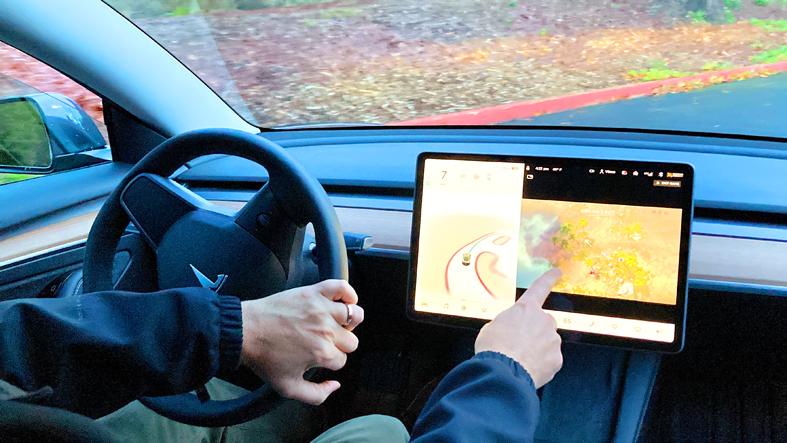
Photo: AP
An agency spokeswoman on Thursday said in a statement that the change came after regulators discussed concerns about the system with Tesla. The first update went out on Wednesday as part of Tesla’s holiday software release, and the rest of the vehicles should get it today.
The statement said that the NHTSA regularly talks about infotainment screens with all automakers.
A message was left on Thursday seeking comment from Tesla, which has disbanded its media relations department.
The agency says its investigation of Tesla’s feature would continue even with the update. It was not clear whether the NHTSA would require Tesla to do a formal recall with the update. In the past the agency has asked Tesla why it should not be required to do recalls with safety-related software updates.
“The Vehicle Safety Act prohibits manufacturers from selling vehicles with defects posing unreasonable risks to safety, including technologies that distract drivers from driving safely,” the NHTSA statement said.
The agency said it assesses how manufacturers identify and guard against distraction hazards due to misuse or intended use of screens, and other convenience technology.
The agency on Wednesday said that it would formally investigate Tesla’s screens after an owner from the Portland, Oregon, area filed a complaint when he discovered that a driver could play games while the vehicle was moving.
The agency said that the “Passenger Play” feature could distract the driver and increase the risk of a crash.
The investigation covers about 580,000 Tesla Models S, X, Y and 3 from the 2017 to 2022 model years.
In documents detailing the investigation, NHTSA said “Passenger Play” has been available since December 2020. Before that, enabling play was only possible when its vehicles were in park.
The NHTSA documents do not list any crashes or injuries caused by the problem.
Tesla owner Vince Patton, 59, filed the complaint last month after discovering the gaming feature could be played by drivers.
Patton, who loves his car and says he has nothing against Tesla, worries that drivers would play games and become dangerously distracted.
“Somebody’s going to get killed,” Patton said. “It’s absolutely insane.”
The NHTSA already is investigating why Tesla’s “Autopilot” partially automated driving system keeps crashing into stopped emergency vehicles. It is also looking into the performance of Tesla’s “Full Self-Driving” software after getting a complaint that it nearly caused a crash.
Tesla says neither system can drive vehicles, and that drivers must pay attention and be ready to intervene at all times.
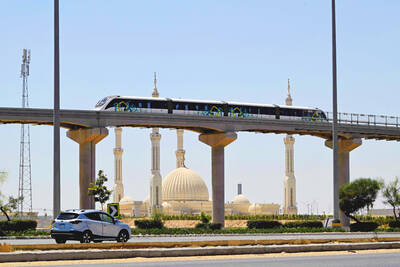
Cairo’s new monorail slices across the city skyline, running above the familiar chaos of blaring horns and aging buses’ exhaust fumes that mark rush hour below. The US$4.5 billion monorail, opened this month, is among Egypt’s most prominent new transport projects, part of a debt-funded infrastructure drive criticized for sapping state finances while bringing limited benefits to most of the country’s 109 million people. “It feels like you’re in a different country,” said Ramy Sayed, a restaurant manager, aboard a driverless Innovia 300 train. “No noise, no traffic, we’re not used to this.” The eastern line runs 56km from the bustling middle-class

Taiwanese firms have increased investment in the Philippines in recent years as Manila’s ties with Washington deepen and global supply chains continue to shift away from China, an expert at the Chung-Hua Institution for Economic Research (CIER, 中華經濟研究院) said yesterday. The Philippines had not been among Taiwanese investors’ top choices in Southeast Asia, CIER Taiwan ASEAN Studies Center director Kristy Hsu (徐遵慈) said at a seminar in Taipei. However, Taiwan’s investment in the country has grown significantly since the COVID-19 pandemic, reaching US $257 million last year, a high in recent years, she said. Although Taiwan’s total investment in the Philippines still lags
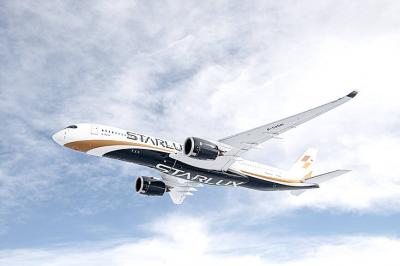
Starlux Airlines Co (星宇航空) today unveiled a long-haul network expansion plan at a shareholders’ meeting in Taipei, including direct flights to Barcelona, Spain, and Zurich, Switzerland, as well as a service connecting Taipei, Sydney and New Zealand. Starlux is to become the first Taiwanese carrier to offer non-stop services to the two European cities, while the inaugural oceanic route is expected to expand transit opportunities within the Australia-New Zealand market, Starlux said. Flight services to Chicago, Dallas, Washington and New York are under evaluation, the airline added. Prior to the shareholders’ meeting, the airline earlier this year announced that it would be

Intel Corp regards Taiwan Semiconductor Manufacturing Co (TSMC, 台積電) as a longstanding partner, as the US chipmaker would continue outsourcing production of advanced chips to TSMC, Intel chief executive officer Lip-Bu Tan (陳立武) said yesterday. “I don’t look at people as competitors. I look at the collaboration... Nvidia is also, you know, a good friend,” Tan told a news conference following his keynote speech at the Computex trade show in Taipei. “It’s a very trusted partnership for us... We are a big, top customer for them, and we’re going to continue doing that,” he said, referring to TSMC, the world’s largest foundry


 RSS
RSS