


Tatung Co (大同) chairman Lu Ming-kuang (盧明光) and president Chaney Ho (何春盛) yesterday announced their resignations, adding further uncertainty at the troubled conglomerate which has undergone several changes to its management team since last year.
When he took the job late last year, 72-year-old Lu had envisioned implementing a five-year plan to turn the company around before retiring again. Yesterday, he said he was proud of what he had achieved since returning to the company.
“I’ve not done wrong by the largest shareholder, the employees or the investors who came in because they believed in my management team,” Lu told a news conference in Taipei.
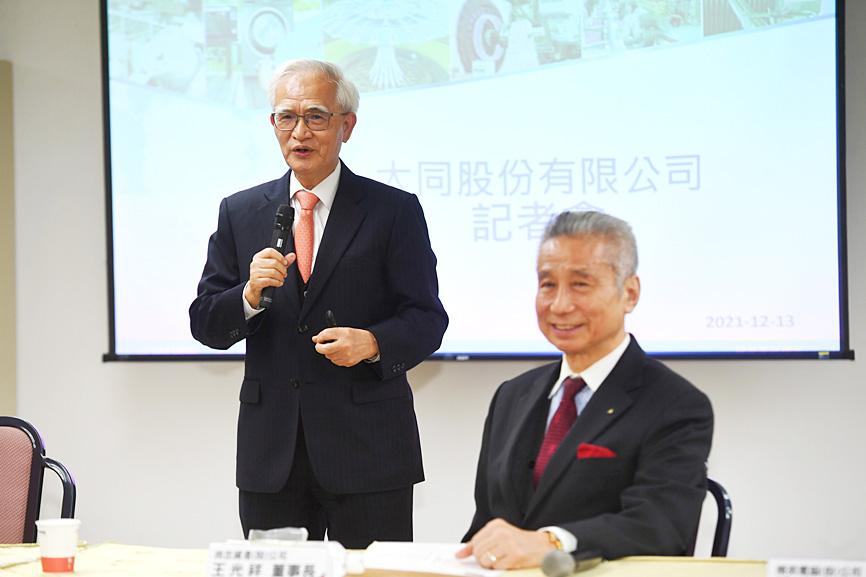
Photo: CNA
Lu came out of retirement to take over as chairman in December last year after his predecessor, Lin Wen-yuan (林文淵), stepped down from the position after 50 days in office amid a disagreement with major shareholder Shanyuan Group (三圓建設) chairman Wang Kuang-hsiang (王光祥).
Under Lu’s leadership, Tatung’s nine business units all returned to profitability, Ho said.
“We did our level best to save Tatung” said Ho, who joined the company in June. “We took a company that was going backward and turned it into a company that was making a slow forward motion.”
However, that was not enough for Wang, who yesterday thanked, praised and bowed to Lu and Ho, before escorting them out of the news conference.
It is time for Tatung to start paying a dividend again and develop its substantial real-estate assets, said Wang, who is a director of Tatung and also chairs the company’s real-estate subsidiary, Shan Chih Asset Development Co (尚志資產開發).
“Tatung shareholders are like paupers sitting in a house made of gold,” Wang said.
There are rumors that Wang is likely to take over as Tatung chairman when the company holds a board meeting on Tuesday next week.
“We will now comprehensively develop our real-estate portfolio, our renewable energy business and our electric bus,” Wang said. “Chairman Lu was hardworking and conscientious, but it’s been 20 years since Tatung paid a dividend, we will not let our investors wait another five.”
Chung Yi-wen (鍾依文), who made way for Ho in June, is expected to return as president.
“The fundamental principle of business is profitability,” Chung said.

The domestic unit of the Chinese-owned, Dutch-headquartered chipmaker Nexperia BV will soon be able to produce semiconductors locally within China, according to two company sources. Nexperia is at the center of a global tug-of-war over critical semiconductor technology, with a Dutch court in February ordering a probe into alleged mismanagement at the company. The geopolitical tussle has disrupted supply chains, with some carmakers reportedly forced to cut production due to chip shortages. Local production would allow Nexperia’s domestic arm, Nexperia Semiconductors (China) Ltd (安世半導體中國), to bypass restrictions in place since October on the supply of silicon wafers — etched with tiny components to

Singapore-based ride-hailing and delivery giant Grab Holdings Ltd has applied for regulatory approval to acquire the Taiwan operations of Germany-based Delivery Hero SE's Foodpanda in a deal valued at about US$600 million. Grab submitted the filing to the Fair Trade Commission on Friday last week, with the transaction subject to regulatory review and approval, the company said in a statement yesterday. Its independent governance structure would help foster a healthy and competitive market in Taiwan if the deal is approved, Grab said. Grab, which is listed on the NASDAQ, said in the filing that US-based Uber Technologies Inc holds about 13 percent of

Taiwan Semiconductor Manufacturing Co (TSMC, 台積電) yesterday received government approval to deploy its advanced 3-nanometer (3nm) process at its second fab currently under construction in Japan, the Ministry of Economic Affairs said in a news release. The ministry green-lit the plan for the facility in Kumamoto, which is scheduled to start installing equipment and come online in 2028 with a monthly production capacity of 15,000 12-inch wafers, the ministry said. The Department of Investment Review in June 2024 authorized a US$5.26 billion investment for the facility, slated to manufacture 6- to 12nm chips, significantly less advanced than 3nm process. At a meeting with

Taiwan’s food delivery market could undergo a major shift if Singapore-based Grab Holdings Ltd completes its planned acquisition of Delivery Hero SE’s Foodpanda business in Taiwan, industry experts said. Grab on Monday last week announced it would acquire Foodpanda’s Taiwan operations for US$600 million. The deal is expected to be finalized in the second half of this year, with Grab aiming to complete user migration to its platform by the first half of next year. A duopoly between Uber Eats and Foodpanda dominates Taiwan’s delivery market, a structure that has remained intact since the Fair Trade Commission (FTC) blocked Uber Technologies Inc’s


 RSS
RSS