


The Sri Lankan government yesterday threatened to freeze the bank accounts of Sri Lankans working overseas who send money back to the country using informal money changers, as depleted foreign exchange reserves drive a thriving black market for US dollars.
The COVID-19 pandemic has wreaked havoc on the island’s economy, and the government has banned imports of food, vehicles and other items in an effort to shore up its stockpile of foreign currency.
These restrictions have led to severe shortages of food, cooking gas and cement, and Sri Lanka was forced to shut its only oil refinery last month, as it ran out of US dollars to import crude.
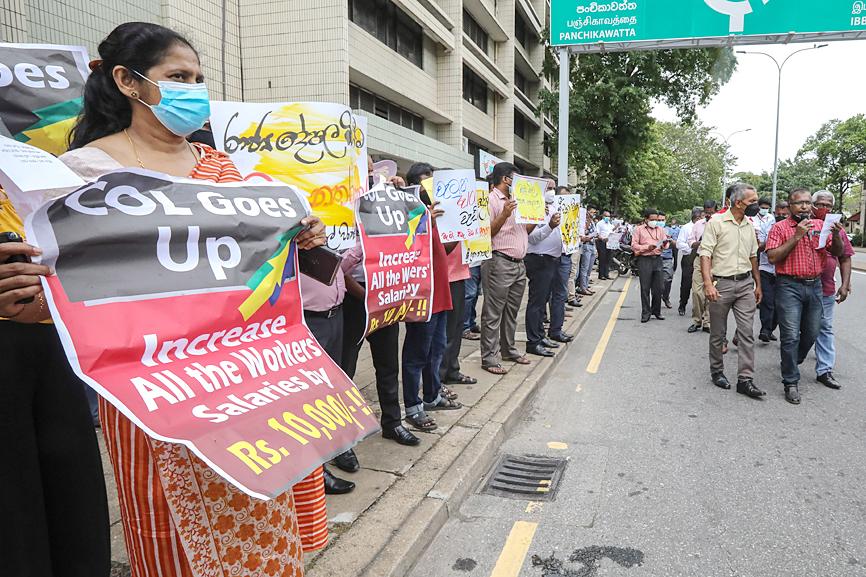
Photo: EPA-EFE
The official exchange rate of 202 rupees to the US dollar, offered by commercial banks that have run out of foreign currency, is well below the 240 rupees to 245 rupees offered by informal money changers now in the Sri Lankan central bank’s crosshairs.
Central Bank of Sri Lanka governor Ajith Nivard Cabraal said that migrant workers and others would face consequences if they sent their earnings home outside of official channels.
“Bank accounts of those who distribute and receive #money through #unlawful money transmission methods will be frozen with immediate effect,” Cabraal wrote on Twitter.
He added that the central bank “urges all #migrant Sri Lankans to use only #legal channels to #repatriate their earnings.”
The bank has also offered to pay a 10 rupee incentive to overseas workers who send money back through official channels, up from 2 rupees before.
Sri Lanka is struggling to service its foreign debt, and foreign exchange reserves had fallen to US$2.26 billion at the end of October, about one-third of the levels when a new administration took office two years ago.
Ratings agency Moody’s Investors Service in October downgraded Sri Lanka’s foreign debt rating, and the government last month unveiled a drastic austerity budget in an attempt to rein in its runaway deficit.
Central bank officials have said that the country is facing its worst foreign exchange crisis since the advent of a free economy and have demanded all exporters turn over their foreign exchange earnings to the government within six months.
Sri Lanka recorded its worst ever economic performance last year with a 3.6 percent contraction, fueled largely by the fallout from the pandemic on tourism.

The domestic unit of the Chinese-owned, Dutch-headquartered chipmaker Nexperia BV will soon be able to produce semiconductors locally within China, according to two company sources. Nexperia is at the center of a global tug-of-war over critical semiconductor technology, with a Dutch court in February ordering a probe into alleged mismanagement at the company. The geopolitical tussle has disrupted supply chains, with some carmakers reportedly forced to cut production due to chip shortages. Local production would allow Nexperia’s domestic arm, Nexperia Semiconductors (China) Ltd (安世半導體中國), to bypass restrictions in place since October on the supply of silicon wafers — etched with tiny components to

Singapore-based ride-hailing and delivery giant Grab Holdings Ltd has applied for regulatory approval to acquire the Taiwan operations of Germany-based Delivery Hero SE's Foodpanda in a deal valued at about US$600 million. Grab submitted the filing to the Fair Trade Commission on Friday last week, with the transaction subject to regulatory review and approval, the company said in a statement yesterday. Its independent governance structure would help foster a healthy and competitive market in Taiwan if the deal is approved, Grab said. Grab, which is listed on the NASDAQ, said in the filing that US-based Uber Technologies Inc holds about 13 percent of

Taiwan Semiconductor Manufacturing Co (TSMC, 台積電) yesterday received government approval to deploy its advanced 3-nanometer (3nm) process at its second fab currently under construction in Japan, the Ministry of Economic Affairs said in a news release. The ministry green-lit the plan for the facility in Kumamoto, which is scheduled to start installing equipment and come online in 2028 with a monthly production capacity of 15,000 12-inch wafers, the ministry said. The Department of Investment Review in June 2024 authorized a US$5.26 billion investment for the facility, slated to manufacture 6- to 12nm chips, significantly less advanced than 3nm process. At a meeting with

Taiwan’s food delivery market could undergo a major shift if Singapore-based Grab Holdings Ltd completes its planned acquisition of Delivery Hero SE’s Foodpanda business in Taiwan, industry experts said. Grab on Monday last week announced it would acquire Foodpanda’s Taiwan operations for US$600 million. The deal is expected to be finalized in the second half of this year, with Grab aiming to complete user migration to its platform by the first half of next year. A duopoly between Uber Eats and Foodpanda dominates Taiwan’s delivery market, a structure that has remained intact since the Fair Trade Commission (FTC) blocked Uber Technologies Inc’s


 RSS
RSS