


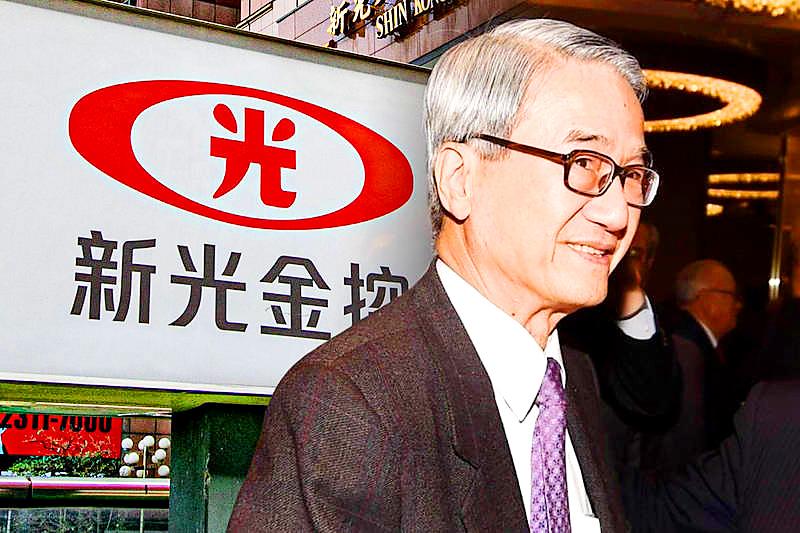
The Financial Supervisory Commission (FSC) has requested Shin Kong Financial Holding Co (新光金控) to investigate whether former chairman Eugene Wu (吳東進) had contravened a commission-imposed ban on his involvement in the firm’s management.
FSC Chairman Thomas Huang (黃天牧) told a meeting of the legislature’s Finance Committee on Thursday that it has tasked the firm’s three independent directors to lead the investigation, after the Banking Bureau was days earlier tipped off about Wu allegedly giving instructions to the management.
The three directors were instructed to submit their findings to the commission as soon as possible, he added.
Taipei Times file photo
Huang’s remarks came after Democratic Progressive Party (DPP) Legislator Michelle Lin (林楚茵) told the meeting that Wu had since last month allegedly attended four meetings with senior Shin Kong Financial managers, instructing them on the firm’s credit card and land development operations.
Citing tips from whistle-blowers, Lin said that the meetings were held at Jasper Villa Banqiao in New Taipei City and Jasper Villa Tianmu in Taipei — two hotels managed by the holding company’s life insurance unit, Shin Kong Life Insurance Co (新光人壽).
The meetings — on Oct. 1 and 2, Oct. 7 and 8, Oct. 22 and 23, and Nov. 7 — show that Wu has substantial command over the company, despite holding no formal position, Lin said.
Huang said that an outside person who has control over or interferes with a company’s business might contravene the Company Act (公司法).
Wu retired from Shin Kong Financial in June last year, but continued to serve as the chairman of the life insurance arm until the commission suspended him in September last year, citing his poor supervision and fining Shin Kong Life Insurance NT$27.6 million (US$992,984).
The commission barred Wu from the firm’s board until his term ends in June 2023 and prohibited him from involvement in the company’s business.
Shin Kong Financial declined to comment on the issue, saying that it awaits the outcome of the investigation.

South Korea’s equity benchmark yesterday crossed a new milestone just a month after surpassing the once-unthinkable 5,000 mark as surging global memory demand powers the country’s biggest chipmakers. The KOSPI advanced as much as 2.6 percent to a record 6,123, with Samsung Electronics Co and SK Hynix Inc each gaining more than 2 percent. With the benchmark now up 45 percent this year, South Korea’s stock market capitalization has also moved past France’s, following last month’s overtaking of Germany’s. Long overlooked by foreign funds, despite being undervalued, South Korean stocks have now emerged as clear winners in the global market. The so-called “artificial intelligence

NEW IDENTITY: Known for its software, India has expanded into hardware, with its semiconductor industry growing from US$38bn in 2023 to US$45bn to US$50bn India on Saturday inaugurated its first semiconductor assembly and test facility, a milestone in the government’s push to reduce dependence on foreign chipmakers and stake a claim in a sector dominated by China. Indian Prime Minister Narendra Modi opened US firm Micron Technology Inc’s semiconductor assembly, test and packaging unit in his home state of Gujarat, hailing the “dawn of a new era” for India’s technology ambitions. “When young Indians look back in the future, they will see this decade as the turning point in our tech future,” Modi told the event, which was broadcast on his YouTube channel. The plant would convert
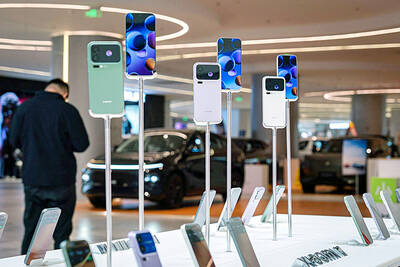
‘SEISMIC SHIFT’: The researcher forecast there would be about 1.1 billion mobile shipments this year, down from 1.26 billion the prior year and erasing years of gains The global smartphone market is expected to contract 12.9 percent this year due to the unprecedented memorychip shortage, marking “a crisis like no other,” researcher International Data Corp (IDC) said. The new forecast, a dramatic revision down from earlier estimates, gives the latest accounting of the ongoing memory crunch that is affecting every corner of the electronics industry. The demand for advanced memory to power artificial intelligence (AI) tasks has drained global supply until well into next year and jeopardizes the business model of many smartphone makers. IDC forecast about 1.1 billion mobile shipments this year, down from 1.26 billion the prior
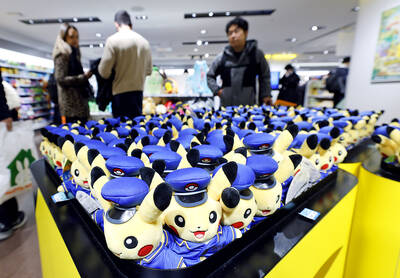
People stand in a Pokemon store in Tokyo on Thursday. One of the world highest-grossing franchises is celebrated its 30th anniversary yesterday.


 RSS
RSS