


China’s energy crisis deepened yesterday as cold weather swept into much of the country and power plants scrambled to stock up on coal, sending prices of the fuel to record highs.
Demand for electricity to heat homes and offices is expected to soar this week as strong cold winds descend from northern China. Forecasters predict average temperatures in some central and eastern regions could fall by as much as 16°C in the next two to three days.
Shortages of coal, high fuel prices and booming post-pandemic industrial demand have sparked widespread power shortages in the world’s second-largest economy. Rationing has already been in place in at least 17 of China’s more than 30 regions since September, forcing some factories to suspend production and disrupting supply chains.
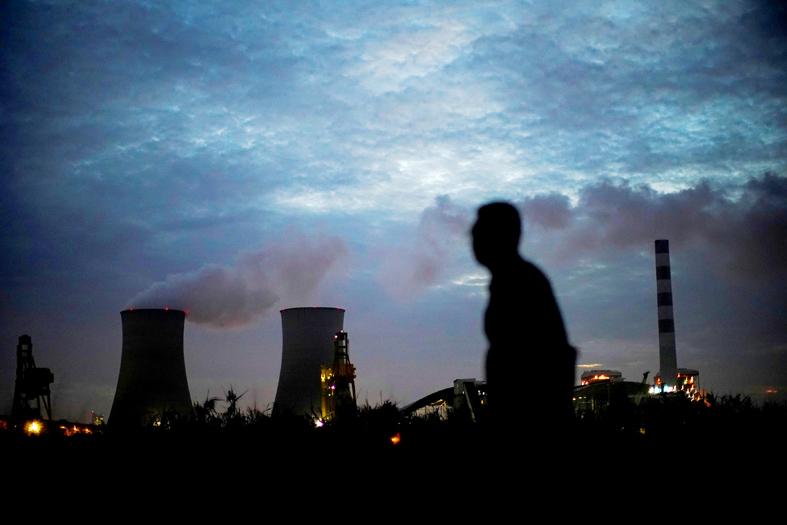
Photo: Reuters
Zhengzhou thermal coal futures hit 1,669.40 yuan (US$259.71) per tonne early yesterday. The contract has risen more than 200 percent in the year to date.
The three northeastern provinces of Jilin, Heilongjiang and Liaoning — among the worst hit by the power shortages last month — and several regions in northern China, including Inner Mongolia and Gansu, have started winter heating, which is mainly fueled by coal, to cope with the early cold weather.
Beijing has taken a slew of measures to contain coal price rises, including raising domestic coal output and cutting power to industries and some factories during periods of peak demand. It has repeatedly assured users that energy supplies have been secured for the winter heating season.
However, power shortages are expected to continue into early next year, with analysts and traders forecasting a 12 percent drop in industrial power consumption in the fourth quarter as coal supplies fall short and local governments give priority to residential users.
Earlier this week, China, in its boldest step in a decades-long power sector reform, said it would allow coal-fired power prices to fluctuate by up to 20 percent from base levels from Oct. 15, enabling power plants to pass on more of the high costs of generation to commercial and industrial end-users.
Steel, aluminum, cement and chemical producers are expected to face higher and more volatile power costs under the new policy, pressuring profit margins. Data on Thursday showed factory-gate inflation last month hit a record high.
China aims to be “carbon neutral” by 2060, and Beijing has been trying to reduce its reliance on polluting coal power in favor of cleaner wind, solar and hydro. But coal is expected to provide the bulk of its electricity needs for some time.
China is not the only nation struggling with power supplies, and the crisis has highlighted the difficulty in cutting the global economy’s dependency on fossil fuels as world leaders seek to tackle climate change at talks next month in Glasgow.

Among the rows of vibrators, rubber torsos and leather harnesses at a Chinese sex toys exhibition in Shanghai this weekend, the beginnings of an artificial intelligence (AI)-driven shift in the industry quietly pulsed. China manufactures about 70 percent of the world’s sex toys, most of it the “hardware” on display at the fair — whether that be technicolor tentacled dildos or hyper-realistic personalized silicone dolls. Yet smart toys have been rising in popularity for some time. Many major European and US brands already offer tech-enhanced products that can enable long-distance love, monitor well-being and even bring people one step closer to

Malaysia’s leader yesterday announced plans to build a massive semiconductor design park, aiming to boost the Southeast Asian nation’s role in the global chip industry. A prominent player in the semiconductor industry for decades, Malaysia accounts for an estimated 13 percent of global back-end manufacturing, according to German tech giant Bosch. Now it wants to go beyond production and emerge as a chip design powerhouse too, Malaysian Prime Minister Anwar Ibrahim said. “I am pleased to announce the largest IC (integrated circuit) Design Park in Southeast Asia, that will house world-class anchor tenants and collaborate with global companies such as Arm [Holdings PLC],”

Sales in the retail, and food and beverage sectors last month continued to rise, increasing 0.7 percent and 13.6 percent respectively from a year earlier, setting record highs for the month of March, the Ministry of Economic Affairs said yesterday. Sales in the wholesale sector also grew last month by 4.6 annually, mainly due to the business opportunities for emerging applications related to artificial intelligence (AI) and high-performance computing technologies, the ministry said in a report. The ministry forecast that retail, and food and beverage sales this month would retain their growth momentum as the former would benefit from Tomb Sweeping Day

Thousands of parents in Singapore are furious after a Cordlife Group Ltd (康盛人生集團), a major operator of cord blood banks in Asia, irreparably damaged their children’s samples through improper handling, with some now pursuing legal action. The ongoing case, one of the worst to hit the largely untested industry, has renewed concerns over companies marketing themselves to anxious parents with mostly unproven assurances. This has implications across the region, given Cordlife’s operations in Hong Kong, Macau, Indonesia, the Philippines and India. The parents paid for years to have their infants’ cord blood stored, with the understanding that the stem cells they contained


 RSS
RSS