


The US Securities and Exchange Commission (SEC) is poised to allow the first US bitcoin futures exchange-traded fund (ETF) to begin trading in a watershed moment for the cryptocurrency industry, people familiar with the matter said.
The regulator is not likely to block the products from starting to trade next week, said the people, who asked not to be named while discussing the decision.
Unlike bitcoin ETF applications that the regulator has previously rejected, the proposals by ProShares and Invesco Ltd are based on futures contracts and were filed under mutual fund rules that SEC Chairman Gary Gensler has said provide “significant investor protections.”
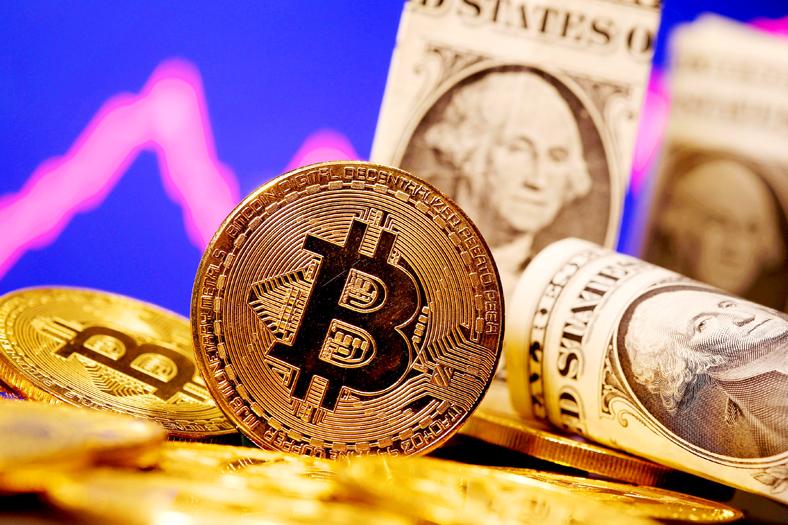
Photo: Reuters
A SEC spokesperson declined to comment, as did an official at ProShares.
Invesco did not immediately respond to a request for comment.
Barring a last-minute reversal, the fund launch would be the culmination of a nearly decade-long campaign by the US$6.7 trillion ETF industry. Advocates have sought approval as a confirmation of mainstream acceptance of cryptocurrencies since Cameron and Tyler Winklevoss, who are best known for their part in the history of Facebook Inc, filed the first application for a bitcoin ETF in 2013.
Approval has for years been out of the grasp of issuers who, amid myriad false signs of progress and outright rejections, have tried to get a variety of different structures cleared for trading.
Over the years, there have been plans for funds that proposed to hold bitcoin via a digital vault or that could use leverage to juice returns. Others sought to mitigate bitcoin’s famous volatility, a key point of contention for the SEC.
The regulator has in the past argued that the crypto space is plagued with investor hazards. The SEC had expressed concern that prices could be manipulated and liquidity might be insufficient, and that bitcoin’s drastic price swings might be too much for individual investors.
Bitcoin’s last three full-year returns were a 74 percent loss followed by gains of 95 percent and 305 percent.
Additionally, the SEC has questioned whether funds would have the information necessary to adequately value cryptocurrencies or related products. There have also been questions about validating ownership of the coins held by funds and the threat from hackers.
Many crypto advocates were heartened when Gensler took the helm at the agency.
They cited his previous interest in the crypto world — he once taught a class at the Massachusetts Institute of Technology called “Blockchain and Money.”
However, Gensler in the past few months also referred to the space as the “Wild West” and has signaled that he wants more robust oversight of the markets.
The mood appeared to shift in August, when Gensler signaled that he would favor funds based on Chicago Mercantile Exchange-traded bitcoin futures filed under a 1940s law.
He reiterated that stance late last month.
That has led to a wave of futures-backed filings and unbridled optimism among issuers that approval could be imminent.
The speculation has fueled a torrential rebound in the price of bitcoin, which surged to its highest level since May this week. The world’s largest cryptocurrency has soared more than 90 percent since breaking below US$30,000 in late July.
Four futures-backed bitcoin ETFs could begin trading on US exchanges this month, with deadlines for applications from VanEck and Valkyrie also approaching.
Meanwhile, dozens of cryptocurrency exchange-traded products have launched in Canada and across Europe.

Among the rows of vibrators, rubber torsos and leather harnesses at a Chinese sex toys exhibition in Shanghai this weekend, the beginnings of an artificial intelligence (AI)-driven shift in the industry quietly pulsed. China manufactures about 70 percent of the world’s sex toys, most of it the “hardware” on display at the fair — whether that be technicolor tentacled dildos or hyper-realistic personalized silicone dolls. Yet smart toys have been rising in popularity for some time. Many major European and US brands already offer tech-enhanced products that can enable long-distance love, monitor well-being and even bring people one step closer to

TRANSFORMATION: Taiwan is now home to the largest Google hardware research and development center outside of the US, thanks to the nation’s economic policies President Tsai Ing-wen (蔡英文) yesterday attended an event marking the opening of Google’s second hardware research and development (R&D) office in Taiwan, which was held at New Taipei City’s Banciao District (板橋). This signals Taiwan’s transformation into the world’s largest Google hardware research and development center outside of the US, validating the nation’s economic policy in the past eight years, she said. The “five plus two” innovative industries policy, “six core strategic industries” initiative and infrastructure projects have grown the national industry and established resilient supply chains that withstood the COVID-19 pandemic, Tsai said. Taiwan has improved investment conditions of the domestic economy

Malaysia’s leader yesterday announced plans to build a massive semiconductor design park, aiming to boost the Southeast Asian nation’s role in the global chip industry. A prominent player in the semiconductor industry for decades, Malaysia accounts for an estimated 13 percent of global back-end manufacturing, according to German tech giant Bosch. Now it wants to go beyond production and emerge as a chip design powerhouse too, Malaysian Prime Minister Anwar Ibrahim said. “I am pleased to announce the largest IC (integrated circuit) Design Park in Southeast Asia, that will house world-class anchor tenants and collaborate with global companies such as Arm [Holdings PLC],”

MAJOR BENEFICIARY: The company benefits from TSMC’s advanced packaging scarcity, given robust demand for Nvidia AI chips, analysts said ASE Technology Holding Co (ASE, 日月光投控), the world’s biggest chip packaging and testing service provider, yesterday said it is raising its equipment capital expenditure budget by 10 percent this year to expand leading-edge and advanced packing and testing capacity amid strong artificial intelligence (AI) and high-performance computing chip demand. This is on top of the 40 to 50 percent annual increase in its capital spending budget to more than the US$1.7 billion to announced in February. About half of the equipment capital expenditure would be spent on leading-edge and advanced packaging and testing technology, the company said. ASE is considered by analysts


 RSS
RSS