


General Motors Co (GM) said it would extend downtime at its Chevy Bolt electric-vehicle plant for another three weeks due to a battery pack shortage, as the company recalls the vehicles over fire risks.
The company is now to idle the plant through the week of Oct. 11 after earlier saying it would stop production through the week of Sept. 20.
GM said it would continue to work with its supplier to “update manufacturing processes” and would evaluate additional production schedule adjustments.
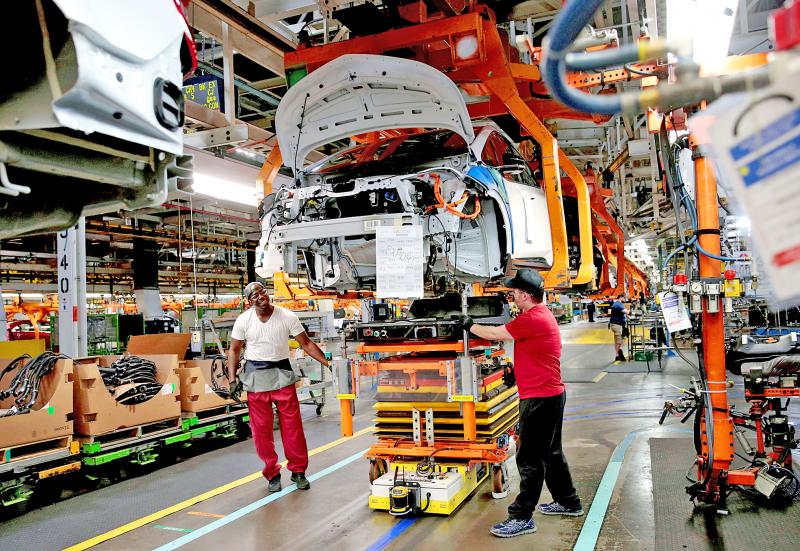
Photo: Reuters
The plant in Lake Orion, Michigan, has been idled since Aug. 23. With the recall under way, GM has urged some owners of Chevy Bolt electric cars to park the vehicles at least 15m away from other cars to reduce the risk that a spontaneous fire could spread.
GM added that it is cutting production at six other North American assembly plants because of an ongoing chip shortage.
The Detroit automaker has recalled almost all of the approximately 142,000 Bolts sold since 2016, because the battery can catch on fire. GM has taken a US$1.8 billion charge so far for the cost of the recall and has been buying cars back from some disgruntled owners. The company expects to recoup much of the cost from battery supplier LG Corp.
The new advice is likely to rankle owners who are already limiting their use of the Bolt to avoid overheating the battery and risking a fire. The parking guidance is especially difficult for owners in urban areas. GM has confirmed 10 fires.
The US National Highway Traffic Safety Administration said it has found 13 fires in Bolts, but the company has not confirmed that the additional three are part of the current recall issue.
The Bolt normally can be driven 417km on one charge, but that has been limited by GM’s guidance to avoid a fire. The automaker told Bolt owners to limit the charge to 90 percent, plug in more frequently and avoid depleting the battery to below about 112km of remaining range. Owners are also advised to park their vehicles outside immediately after charging and not leave them charging indoors overnight.
GM has said the fires are a rare event and are the result of two uncommon defects that stem from a manufacturing problem in LG plants in Michigan and South Korea.

The domestic unit of the Chinese-owned, Dutch-headquartered chipmaker Nexperia BV will soon be able to produce semiconductors locally within China, according to two company sources. Nexperia is at the center of a global tug-of-war over critical semiconductor technology, with a Dutch court in February ordering a probe into alleged mismanagement at the company. The geopolitical tussle has disrupted supply chains, with some carmakers reportedly forced to cut production due to chip shortages. Local production would allow Nexperia’s domestic arm, Nexperia Semiconductors (China) Ltd (安世半導體中國), to bypass restrictions in place since October on the supply of silicon wafers — etched with tiny components to

Singapore-based ride-hailing and delivery giant Grab Holdings Ltd has applied for regulatory approval to acquire the Taiwan operations of Germany-based Delivery Hero SE's Foodpanda in a deal valued at about US$600 million. Grab submitted the filing to the Fair Trade Commission on Friday last week, with the transaction subject to regulatory review and approval, the company said in a statement yesterday. Its independent governance structure would help foster a healthy and competitive market in Taiwan if the deal is approved, Grab said. Grab, which is listed on the NASDAQ, said in the filing that US-based Uber Technologies Inc holds about 13 percent of

Taiwan is open to joining a global liquefied natural gas (LNG) program if one is created, but on the condition that countries provide delivery even in a scenario where there is a conflict with China, an energy department official said yesterday. While Taiwan’s priority is to have enough LNG at home, the nation is open to exploring potential strategic reserves in other countries such as Japan or South Korea, Energy Administration Deputy Director-General Chen Chung-hsien (陳崇憲) said. While the LNG market does not have a global reserve for emergencies like that of oil, the concept has been raised a few times —

Taiwan Semiconductor Manufacturing Co (TSMC, 台積電) yesterday received government approval to deploy its advanced 3-nanometer (3nm) process at its second fab currently under construction in Japan, the Ministry of Economic Affairs said in a news release. The ministry green-lit the plan for the facility in Kumamoto, which is scheduled to start installing equipment and come online in 2028 with a monthly production capacity of 15,000 12-inch wafers, the ministry said. The Department of Investment Review in June 2024 authorized a US$5.26 billion investment for the facility, slated to manufacture 6- to 12nm chips, significantly less advanced than 3nm process. At a meeting with


 RSS
RSS