


Insurance businesses remained the most controversial in the financial services industry, with the Financial Ombudsman Institution receiving 1,710 complaints about insurance policies or insurers in the second quarter, up 5 percent from the first quarter and accounting for 76 percent of all disputes, agency data showed.
The agency received 402 complaints about banks, or 18 percent of the 2,249 complaints received, and 129 about securities firms, or 5.7 percent, the data showed.
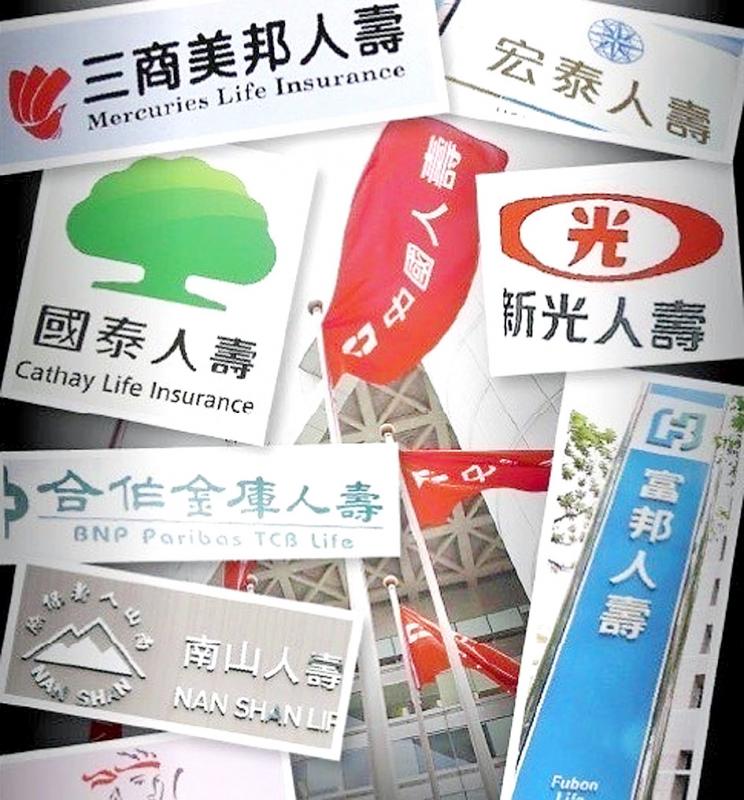
Life insurers and their products accounted for 1,134 of the complaints, or 66 percent of the complaints against the insurance sector, the data showed.
Taipei Times file photo
Most disputes with life insurers were over compensation, the agency said in a report on Aug. 31.
Other common disputes with life insurers were over the types of treatment required, the surgeries covered by policies and pre-existing conditions, as well as delayed payments by insurers, said the Financial Ombudsman Institution, which investigates consumer disputes against financial services firms and facilitates settlements.
Of the 528 complaints against property insurance firms, the two most common were compensation amounts and the identification of disability ratings, the report said.
The agency received the most complaints about products sold by Hontai Life Insurance Co (宏泰人壽), followed by First Life Insurance Co (第一金人壽) and the Taiwan branch of Cardif Assurance Vie (法國巴黎人壽), it said.
The most property insurance complaints were received about the Taiwan branch of Cardif Assurance Risques Divers (法國巴黎產物保險), followed by AIG Taiwan (美國國際產物保險) and Hotai Insurance Co (和泰產險), it added.

The domestic unit of the Chinese-owned, Dutch-headquartered chipmaker Nexperia BV will soon be able to produce semiconductors locally within China, according to two company sources. Nexperia is at the center of a global tug-of-war over critical semiconductor technology, with a Dutch court in February ordering a probe into alleged mismanagement at the company. The geopolitical tussle has disrupted supply chains, with some carmakers reportedly forced to cut production due to chip shortages. Local production would allow Nexperia’s domestic arm, Nexperia Semiconductors (China) Ltd (安世半導體中國), to bypass restrictions in place since October on the supply of silicon wafers — etched with tiny components to

Singapore-based ride-hailing and delivery giant Grab Holdings Ltd has applied for regulatory approval to acquire the Taiwan operations of Germany-based Delivery Hero SE's Foodpanda in a deal valued at about US$600 million. Grab submitted the filing to the Fair Trade Commission on Friday last week, with the transaction subject to regulatory review and approval, the company said in a statement yesterday. Its independent governance structure would help foster a healthy and competitive market in Taiwan if the deal is approved, Grab said. Grab, which is listed on the NASDAQ, said in the filing that US-based Uber Technologies Inc holds about 13 percent of

Taiwan Semiconductor Manufacturing Co (TSMC, 台積電) yesterday received government approval to deploy its advanced 3-nanometer (3nm) process at its second fab currently under construction in Japan, the Ministry of Economic Affairs said in a news release. The ministry green-lit the plan for the facility in Kumamoto, which is scheduled to start installing equipment and come online in 2028 with a monthly production capacity of 15,000 12-inch wafers, the ministry said. The Department of Investment Review in June 2024 authorized a US$5.26 billion investment for the facility, slated to manufacture 6- to 12nm chips, significantly less advanced than 3nm process. At a meeting with

Taiwan’s food delivery market could undergo a major shift if Singapore-based Grab Holdings Ltd completes its planned acquisition of Delivery Hero SE’s Foodpanda business in Taiwan, industry experts said. Grab on Monday last week announced it would acquire Foodpanda’s Taiwan operations for US$600 million. The deal is expected to be finalized in the second half of this year, with Grab aiming to complete user migration to its platform by the first half of next year. A duopoly between Uber Eats and Foodpanda dominates Taiwan’s delivery market, a structure that has remained intact since the Fair Trade Commission (FTC) blocked Uber Technologies Inc’s


 RSS
RSS