


China’s factory gate inflation hit a 13-year high last month driven by roaring raw material prices, despite Beijing’s attempts to cool the market, putting more pressure on manufacturers in the world’s second-largest economy.
The producer price index rose 9.5 percent from a year earlier last month, the National Bureau of Statistics (NBS) said yesterday, faster than the 9.0 percent increase tipped in a Reuters poll and the 9.0 percent reported in July. That was the fastest pace since August 2008.
China’s economy has recovered strongly from last year’s COVID-19 slump, but has been losing steam recently due to domestic COVID-19 outbreaks, high raw material prices, tighter property curbs and a campaign to reduce carbon emissions.
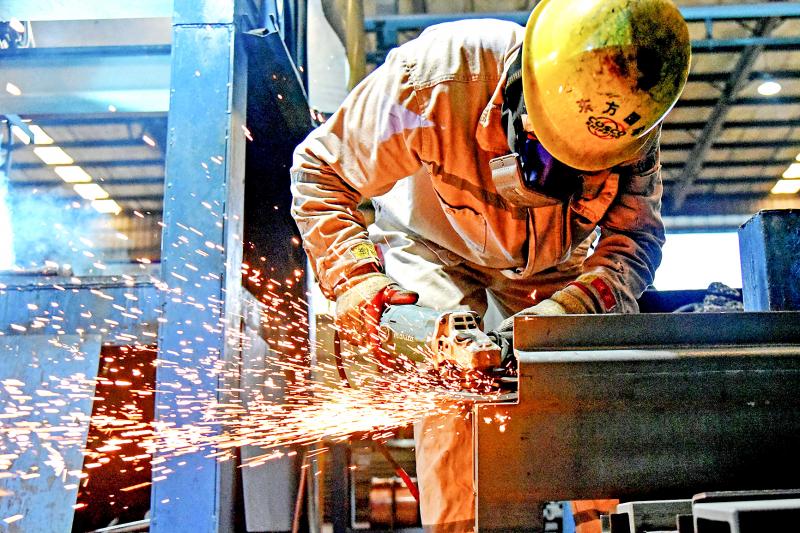
Photo: AFP
Commodity prices have been on a tear in recent months, hurting the bottom lines of many midstream and downstream factories. China’s coal prices soared to a record high on Tuesday over supply concerns as major coal regions began fresh rounds of safety checks.
Earnings at China’s industrial firms have slowed for five straight months.
However, coal and metals prices will likely drop back as construction activity falls amid restrictions on the property sector and slowing credit growth, said Julian Evans-Pritchard, senior China economist at Capital Economics.
The higher comparison base toward the end of last year could also pull down overall inflation.
“We doubt producer price inflation will rise much further,” he said.
The coal, chemicals and metals industries drove much of the price increases last month, according to a statement released alongside the data by Dong Lijuan (董莉娟), an NBS official.
Prices in the coal mining and washing sector grew 57.1 percent last month from a year earlier.
A separate NBS statement showed that the consumer price index (CPI) last month rose 0.8 percent from a year earlier, compared with a 1 percent gain in a Reuters poll and below the government target of about 3 percent this year.
China tightened social restrictions to curb the Delta variant of SARS-CoV-2, including travel limits, which have hampered service-sector demand, although Beijing has largely contained the latest COVID-19 outbreaks.
Declines in airfares, travel and hotel room prices due to the pandemic slowed consumer inflation on a monthly basis, Dong said.
Service-sector activity plunged last month to the lowest level since the pandemic’s first wave in April last year, a recent survey showed, as COVID-19 restrictions threatened to derail the recovery.
Many analysts expect the People’s Bank of China to deliver a further cut to the amount of cash banks must hold as reserves later this year to lift growth, on top of July’s cut, which released about 1 trillion yuan (US$155 billion) in long-term liquidity into the economy.
“We expect monetary policy to remain prudent with a slightly loosening bias for the rest of the year,” HSBC Greater China economist Jing Liu said.
China’s consumer price inflation, which is likely to stay muted, would not constrain a slight loosening stance, she added.
The core consumer price index, which strips out volatile food and energy prices, stood at 1.2 percent year-on-year, versus a 1.3 percent rise in July.

The domestic unit of the Chinese-owned, Dutch-headquartered chipmaker Nexperia BV will soon be able to produce semiconductors locally within China, according to two company sources. Nexperia is at the center of a global tug-of-war over critical semiconductor technology, with a Dutch court in February ordering a probe into alleged mismanagement at the company. The geopolitical tussle has disrupted supply chains, with some carmakers reportedly forced to cut production due to chip shortages. Local production would allow Nexperia’s domestic arm, Nexperia Semiconductors (China) Ltd (安世半導體中國), to bypass restrictions in place since October on the supply of silicon wafers — etched with tiny components to

Singapore-based ride-hailing and delivery giant Grab Holdings Ltd has applied for regulatory approval to acquire the Taiwan operations of Germany-based Delivery Hero SE's Foodpanda in a deal valued at about US$600 million. Grab submitted the filing to the Fair Trade Commission on Friday last week, with the transaction subject to regulatory review and approval, the company said in a statement yesterday. Its independent governance structure would help foster a healthy and competitive market in Taiwan if the deal is approved, Grab said. Grab, which is listed on the NASDAQ, said in the filing that US-based Uber Technologies Inc holds about 13 percent of
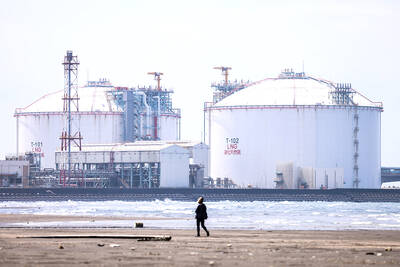
Taiwan is open to joining a global liquefied natural gas (LNG) program if one is created, but on the condition that countries provide delivery even in a scenario where there is a conflict with China, an energy department official said yesterday. While Taiwan’s priority is to have enough LNG at home, the nation is open to exploring potential strategic reserves in other countries such as Japan or South Korea, Energy Administration Deputy Director-General Chen Chung-hsien (陳崇憲) said. While the LNG market does not have a global reserve for emergencies like that of oil, the concept has been raised a few times —

Taiwan Semiconductor Manufacturing Co (TSMC, 台積電) yesterday received government approval to deploy its advanced 3-nanometer (3nm) process at its second fab currently under construction in Japan, the Ministry of Economic Affairs said in a news release. The ministry green-lit the plan for the facility in Kumamoto, which is scheduled to start installing equipment and come online in 2028 with a monthly production capacity of 15,000 12-inch wafers, the ministry said. The Department of Investment Review in June 2024 authorized a US$5.26 billion investment for the facility, slated to manufacture 6- to 12nm chips, significantly less advanced than 3nm process. At a meeting with


 RSS
RSS