


South Korean e-commerce giant Coupang Corp yesterday launched its second outlet in Taipei after opening its first in Zhongshan District (中山) in July.
The new site in Xinyi District (信義) suggests that Coupang, often described as “the Amazon of South Korea,” is to contest the app-based delivery space occupied by Foodpanda Taiwan Co (富胖達) and Uber Eats Taiwan.
Unlike its major rivals, Coupang does not deliver from restaurants, relying instead on warehouses, although Coupang’s delivery drivers use scooters as Uber Eats’ and Foodpanda’s do, zipping along streets after loading orders in a mounted storage box.
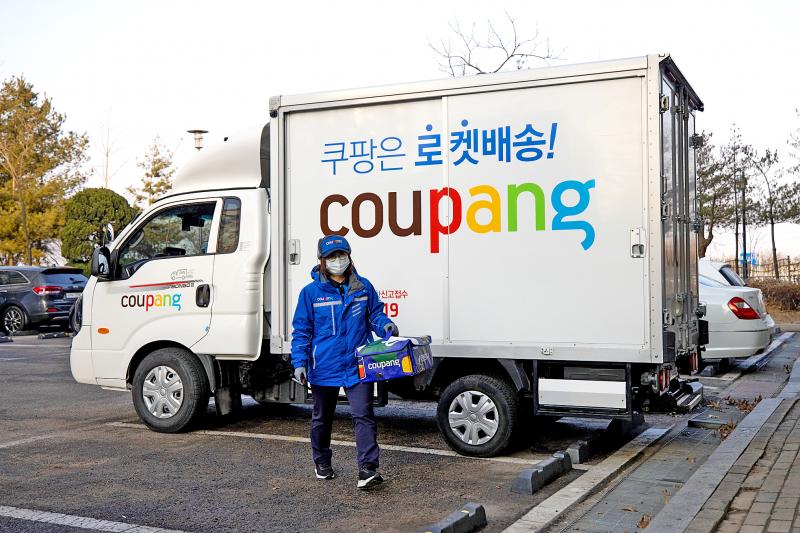
Photographer: SeongJoon Cho/Bloomberg
Coupang says it delivers within 15 minutes for orders to Songshan (松山), Daan (大安), Xinyi, Zhongshan and Datong (大同) districts.
The culture of the e-commerce market in Taiwan is quite mature, Coupang Taiwan general manager Angela Jian (簡心縈) said, adding that the company aims to keep optimizing its product offerings, prices and delivery times.
Coupang founder and chief executive officer Bom Kim said that he is excited by the opportunities in the Taiwanese market.
His focus is on the company’s ventures in Japan and Singapore, Kim said, adding that it plans to enter other regional markets, such as Malaysia.
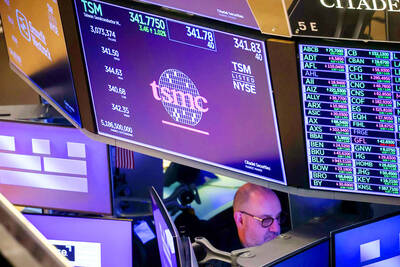
STRONG INTEREST: Analysts have pointed to optimism in TSMC’s growth prospects in the artificial intelligence era as the cause of the rising number of shareholders The number of people holding shares of chipmaker Taiwan Semiconductor Manufacturing Co (TSMC, 台積電) hit a new high last week despite a decline in its stock price, the Taiwan Depository and Clearing Corp (TDCC, 台灣集保) said. The number of TSMC shareholders rose to 2.46 million as of Friday, up 75,536 from a week earlier, TDCC data showed. The stock price fell 1.34 percent during the same week to close at NT$1,840 (US$57.55). The decline in TSMC’s share price resulted from volatility in global tech stocks, driven by rising international crude oil prices as the war against Iran continues. Dealers said
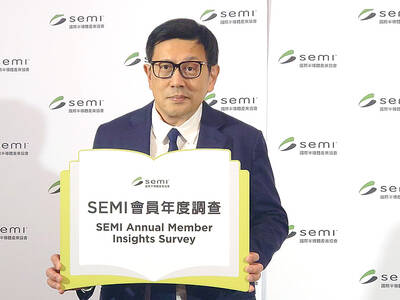
PRICE HIKES: The war in the Middle East would not significantly disrupt supply in the short term, but semiconductor companies are facing price surges for materials Taiwan’s semiconductor companies are not facing imminent supply disruptions of essential chemicals or raw materials due to the war in the Middle East, but surges in material costs loom large, industry association SEMI Taiwan said yesterday. The association’s comments came amid growing concerns that supplies of helium and other key raw materials used in semiconductor production could become a choke point after Qatar shut down its liquefied natural gas (LNG) production and helium output earlier this month due to the conflict. Qatar is the second-largest LNG supplier in the world and accounts for about 33 percent of global helium output. Helium is
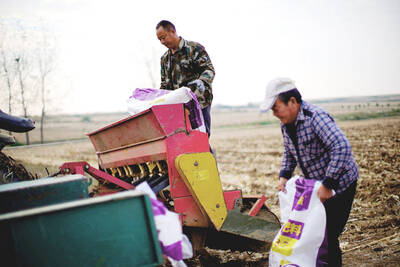
China is clamping down on fertilizer exports to protect its domestic market, industry sources said, putting an additional strain on global markets that were already grappling with shortages caused by the US-Israeli war on Iran. China is among the largest fertilizer exporters — shipping more than US$13 billion of it last year — and it has a history of controlling exports to keep prices low for farmers. Shipments through the war-blocked Strait of Hormuz account for about one-third of the sea-borne supply. This month, Beijing banned exports of nitrogen-potassium fertilizer blends and certain phosphate varieties, sources said. The ban, which has not
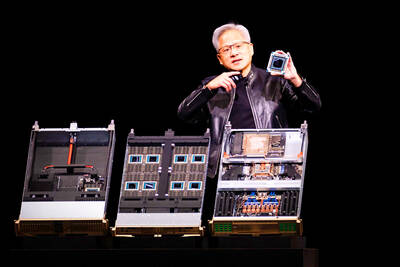
DOMESTIC COMPONENT: Huang identified several Taiwanese partners to be a key part of Nvidia’s Vera Rubin supply chain, including Asustek, Hon Hai and Wistron Nvidia Corp chief executive officer Jensen Huang (黃仁勳), addressing crowds at the company’s biggest annual event, unveiled a variety of new products while predicting that its flagship artificial intelligence (AI) processors would help generate US$1 trillion in sales through next year. During a two-and-a-half-hour keynote address, Huang announced plans to push deeper into central processing units (CPUs) — Intel Corp’s home turf — and introduced semiconductors made with technology acquired from start-up Groq Inc. The company even said it was developing chips for data centers in outer space. At the heart of Huang’s speech was the message that demand for computing power


 RSS
RSS