


US safety officials opened a preliminary investigation into Tesla Inc’s Autopilot after identifying 11 crashes involving the driver assistance system, officials said on Monday.
The incidents dating back to 2018 included one fatal crash and seven that resulted in injuries to 17 people, the US National Highway Traffic Safety Administration (NHTSA) said.
The agency “is committed to ensuring the highest standards of safety on the nation’s roadways” and to “better understand the causes of certain Tesla crashes, NHTSA is opening a preliminary evaluation into Tesla Autopilot systems,” a spokesperson said.
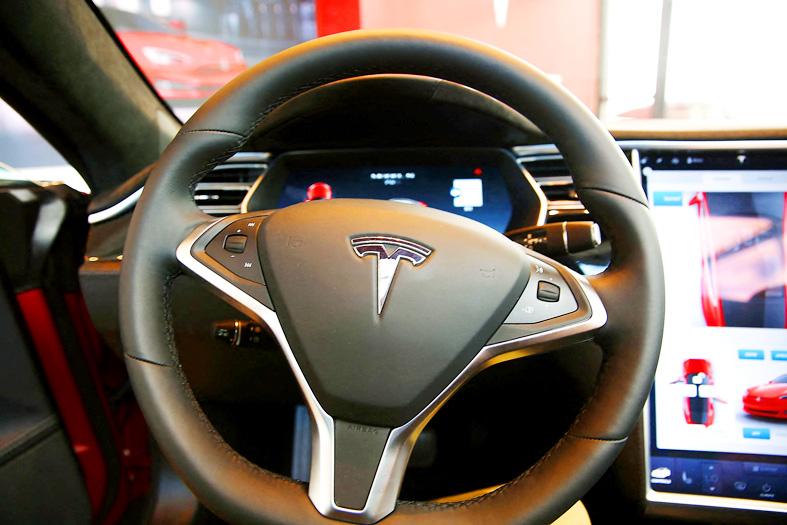
Photo: AFP
Tesla founder Elon Musk has defended the Autopilot system and the electric automaker warns that it requires “active driver supervision” behind the wheel.
However, critics, including in the US Congress, say that the system can be easily fooled and that its name gives drivers a false sense of confidence.
In April, US senators Richard Blumenthal and Ed Markey urged the NHTSA to probe a fatal crash in Texas involving a Tesla after law enforcement said there was no driver behind the wheel.
Tesla did not respond to a request for comment.
The company’s shares dropped 4.3 percent to close at US$686.17.
The crashes cited by the NHTSA involved incidents in which “various Tesla models crashed” in instances where first responders were involved, including “some that crashed directly into the vehicles of first responders,” the NHTSA spokesperson said.
Three of the crashes were in California, while others happened in Florida, Texas, Massachusetts and other states.
The probe covers models S, 3, X and Y, the agency said.
“NHTSA reminds the public that no commercially available motor vehicles today are capable of driving themselves,” the spokesperson said. “Certain advanced driving assistance features can promote safety by helping drivers avoid crashes and mitigate the severity of crashes that occur, but as with all technologies and equipment on motor vehicles, drivers must use them correctly and responsibly.”
In June, Tesla recalled more than 285,000 vehicles in China due to problems with the cruise control system that authorities there said could lead to collisions.
However, analysts said that such a recall could involve a software update rather than a more hardware change that requires costly equipment upgrades.
The Center for Auto Safety, a non-profit group, has pressed US officials since 2018 to bar the name “Autopilot,” viewing the moniker as deceptive.
Center executive director Jason Levine in an e-mail to reporters welcomed news of the NHTSA probe, but said it should go “far beyond” crashes involving first responder vehicles, “because the danger is to all drivers, passengers and pedestrians when Autopilot is engaged.”
“Whether Autopilot needs to be disabled, or be required to use driver monitoring systems to prevent these crashes, is a question for NHTSA, but there’s no question that something needs to be done quickly to prevent more injuries and deaths,” Levine said.
Morningstar analyst Seth Goldstein said that the most likely outcome of the probe would be a requirement for a software update and additional warnings about the limits of Autopilot.
“We think the incidents highlight the need for Tesla to continue to improve its autonomous software before the company is likely to see a large revenue increase from its subscription-based full self-driving software,” Goldstein said in a note.

The domestic unit of the Chinese-owned, Dutch-headquartered chipmaker Nexperia BV will soon be able to produce semiconductors locally within China, according to two company sources. Nexperia is at the center of a global tug-of-war over critical semiconductor technology, with a Dutch court in February ordering a probe into alleged mismanagement at the company. The geopolitical tussle has disrupted supply chains, with some carmakers reportedly forced to cut production due to chip shortages. Local production would allow Nexperia’s domestic arm, Nexperia Semiconductors (China) Ltd (安世半導體中國), to bypass restrictions in place since October on the supply of silicon wafers — etched with tiny components to

Singapore-based ride-hailing and delivery giant Grab Holdings Ltd has applied for regulatory approval to acquire the Taiwan operations of Germany-based Delivery Hero SE's Foodpanda in a deal valued at about US$600 million. Grab submitted the filing to the Fair Trade Commission on Friday last week, with the transaction subject to regulatory review and approval, the company said in a statement yesterday. Its independent governance structure would help foster a healthy and competitive market in Taiwan if the deal is approved, Grab said. Grab, which is listed on the NASDAQ, said in the filing that US-based Uber Technologies Inc holds about 13 percent of

Taiwan is open to joining a global liquefied natural gas (LNG) program if one is created, but on the condition that countries provide delivery even in a scenario where there is a conflict with China, an energy department official said yesterday. While Taiwan’s priority is to have enough LNG at home, the nation is open to exploring potential strategic reserves in other countries such as Japan or South Korea, Energy Administration Deputy Director-General Chen Chung-hsien (陳崇憲) said. While the LNG market does not have a global reserve for emergencies like that of oil, the concept has been raised a few times —

Taiwan Semiconductor Manufacturing Co (TSMC, 台積電) yesterday received government approval to deploy its advanced 3-nanometer (3nm) process at its second fab currently under construction in Japan, the Ministry of Economic Affairs said in a news release. The ministry green-lit the plan for the facility in Kumamoto, which is scheduled to start installing equipment and come online in 2028 with a monthly production capacity of 15,000 12-inch wafers, the ministry said. The Department of Investment Review in June 2024 authorized a US$5.26 billion investment for the facility, slated to manufacture 6- to 12nm chips, significantly less advanced than 3nm process. At a meeting with


 RSS
RSS