


TaiMed Biologics Inc (中裕新藥), an HIV/AIDS drug developer, yesterday gave an upbeat outlook for the next three years, on expectations that its development of two new drugs would bear fruit and its gross margin would improve after a change in manufacturing partner, chairman James Chang (張念原) told an investors’ conference.
TaiMed is analyzing data collected from its phase 3 clinical trial of Trogarzo (TMB-355) by intravenous push for HIV and plans to apply next month to the US Food and Drug Administration (FDA) for marketing approval, Chang said.
The company expects to receive approval for the medication, known generically as ibalizumab-uiyk, by the end of this year, he added.
Unlike its Trogarzo by intravenous infusion that was launched earlier, which is administered to patients after the medication is diluted with saline, Trogarzo by intravenous push can be given to patients undiluted and the administration only takes 30 seconds, compared with 15 minutes by intravenous infusion, he said.
The new medication would be more convenient for patients and doctors alike, he said, adding that TaiMed plans to disclose the results of its phase 3 clinical trial in the next few weeks.
TaiMed also expects to receive the US FDA’s approval for a protocol of the company’s phase 3 clinical test for Trogarzo by intramuscular injection, which would provide an even more convenient administration option for patients, Chang said.
The company expects to receive approval within the next few days, as the regulator had reviewed the protocol and approved it in principle, he said.
TaiMed plans to complete the phase 3 trial within nine months to one year, as the COVID-19 outbreak in the US appears to be under control and is not likely to affect its clinical test, he said, adding that the company expects to obtain marketing approval by next autumn.
All expenses incurred in the phase 3 trial would be covered by TaiMed’s marketing and distribution partner, Theratechnologies Inc, Chang said.
TaiMed has two other HIV drugs — TMB-365 and TMB-380 — under development and plans to conduct phase 2 clinical trials by the end of this year, he said.
An interim analysis of a phase one trial of TMB-365 showed that 800mg of TMB-365 can last as long as 28 days, which is comparable with 2,000mg of TMB-355, and can considerably reduce a patient’s viral load, he said.
These results indicate that TMB-365 would be a medication that last longer and patients would have to take it only once every two months, instead of every two weeks for TMB-355, which should improve their quality of life, he said.
Chang added that TaiMed would change its main contract manufacturer from China-based WuXi Biologics Co (無錫生物製藥) to South Korea-based Samsung Biologics Laboratories.
Although the switch cost the company about NT$400 million (US$14.4 million), the investment should pay off in a few years, as its gross margin is expected to rise from 40 percent to 70 percent with the change in partners, he said.
Sales of Trogarzo by intravenous infusion were affected last year by the COVID-19 pandemic, as many patients could not go to hospitals to receive infusions, but the situation is expected to improve this year, Chang said.
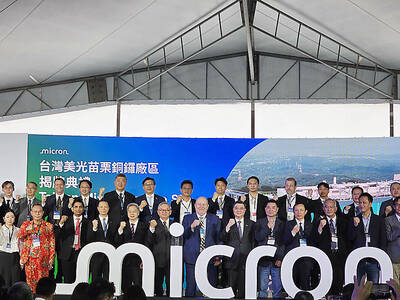
UNPRECEDENTED PACE: Micron Technology has announced plans to expand manufacturing capabilities with the acquisition of a new chip plant in Miaoli Micron Technology Inc unveiled a newly acquired chip plant in Miaoli County yesterday, as the company expands capacity to meet growing demand for advanced DRAM chips, including high-bandwidth memory chips amid the artificial intelligence boom. The plant in Miaoli County’s Tongluo Township (銅鑼), which Micron acquired from Powerchip Semiconductor Manufacturing Corp (力積電) for US$1.8 billion, is expected to make a sizeable capacity contribution to the company from fiscal 2028, the company said in a statement. It would be an extended production site of Micron’s large-scale manufacturing hub in Taichung, the company said. As the global semiconductor industry is racing to reach US$1 trillion

Singapore-based ride-hailing and delivery giant Grab Holdings Ltd has applied for regulatory approval to acquire the Taiwan operations of Germany-based Delivery Hero SE's Foodpanda in a deal valued at about US$600 million. Grab submitted the filing to the Fair Trade Commission on Friday last week, with the transaction subject to regulatory review and approval, the company said in a statement yesterday. Its independent governance structure would help foster a healthy and competitive market in Taiwan if the deal is approved, Grab said. Grab, which is listed on the NASDAQ, said in the filing that US-based Uber Technologies Inc holds about 13 percent of

Taiwan’s food delivery market could undergo a major shift if Singapore-based Grab Holdings Ltd completes its planned acquisition of Delivery Hero SE’s Foodpanda business in Taiwan, industry experts said. Grab on Monday last week announced it would acquire Foodpanda’s Taiwan operations for US$600 million. The deal is expected to be finalized in the second half of this year, with Grab aiming to complete user migration to its platform by the first half of next year. A duopoly between Uber Eats and Foodpanda dominates Taiwan’s delivery market, a structure that has remained intact since the Fair Trade Commission (FTC) blocked Uber Technologies Inc’s

Memory chip stocks extended their losses yesterday after Alphabet Inc’s Google publicized research that could allow more efficient use of the storage needed for artificial intelligence (AI) development. SK Hynix Inc and Samsung Electronics Co, South Korean leaders in the market, fell more than 6 percent and about 5 percent respectively in Seoul. In the US, Micron Technology Inc, Western Digital Corp and Sandisk Corp slid more than 2 percent in pre-market trading, after they all closed lower on Wednesday. Memory companies have been on a tear in recent months as the rapid development of AI infrastructure triggered a spike in chip


 RSS
RSS