


Softbank Group Corp yesterday reported that net profit plunged 39 percent in the first quarter, following gains in the same period last year related to the merger of T-Mobile US Inc and Sprint Corp.
Net profit in the three months to June was ¥761.5 billion (US$6.9 billion), the Japanese conglomerate said, compared with ¥1.26 trillion in the same period in the previous financial year.
The merger of US telecoms T-Mobile and Sprint — formerly controlled by Softbank Group — was completed in April last year, releasing ¥734.5 billion in net income, Softbank said in a statement.
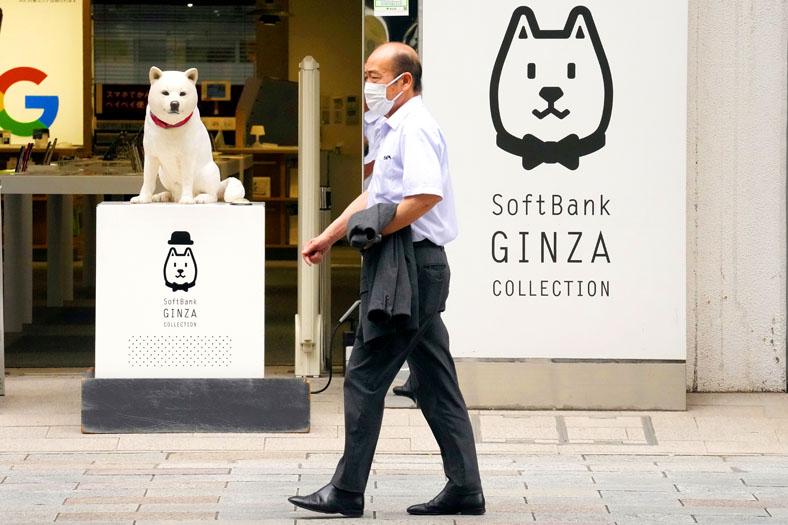
Photo: AP
Softbank Group has poured money into some of Silicon Valley’s biggest names and hottest new ventures, from artificial intelligence to biotechnology through its US$100 billion Vision Fund.
Last financial year, the telecom turned investment behemoth reported Japan’s biggest-ever net profit thanks to rallies in technology shares as people moved their lives online during the COVID-19 pandemic, but Softbank’s investment approach means large transactions can cause unpredictable fluctuations in its results, Moody’s Investors Service vice president and senior credit officer Mariko Semetko said.
“Last year’s record high follows the previous year’s record loss, and signifies the highly volatile nature of the company’s business,” Semetko said. “The company has a very fluid and complex capital structure, and unlisted investments and private financings that have limited transparency and are frequently collateralized.”
“Its investment approach results in high governance risks,” she said.
In the 2019-2020 financial year, Softbank reported a net loss of ¥961.6 billion — its worst ever — as the start of the pandemic compounded woes caused by its investment in troubled office-sharing start-up WeWork, but it quickly returned to profit as the impact of COVID-19 lockdowns worked largely in its favor.
Softbank Group shares closed up 0.90 percent at ¥6,831 in Tokyo trading yesterday.
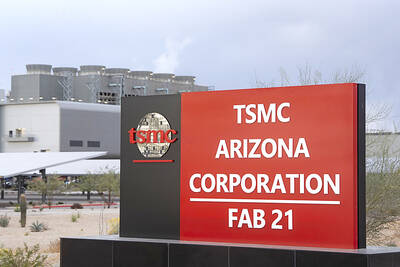
Taiwan Semiconductor Manufacturing Co (TSMC, 台積電), the world’s biggest contract chipmaker, booked its first-ever profit from its Arizona subsidiary in the first half of this year, four years after operations began, a company financial statement showed. Wholly owned by TSMC, the Arizona unit contributed NT$4.52 billion (US$150.1 million) in net profit, compared with a loss of NT$4.34 billion a year earlier, the statement showed. The company attributed the turnaround to strong market demand and high factory utilization. The Arizona unit counts Apple Inc, Nvidia Corp and Advanced Micro Devices Inc among its major customers. The firm’s first fab in Arizona began high-volume production

VOTE OF CONFIDENCE: The Japanese company is adding Intel to an investment portfolio that includes artificial intelligence linchpins Nvidia Corp and TSMC Softbank Group Corp agreed to buy US$2 billion of Intel Corp stock, a surprise deal to shore up a struggling US name while boosting its own chip ambitions. The Japanese company, which is adding Intel to an investment portfolio that includes artificial intelligence (AI) linchpins Nvidia Corp and Taiwan Semiconductor Manufacturing Co (TSMC, 台積電), is to pay US$23 a share — a small discount to Intel’s last close. Shares of the US chipmaker, which would issue new stock to Softbank, surged more than 5 percent in after-hours trading. Softbank’s stock fell as much as 5.4 percent on Tuesday in Tokyo, its
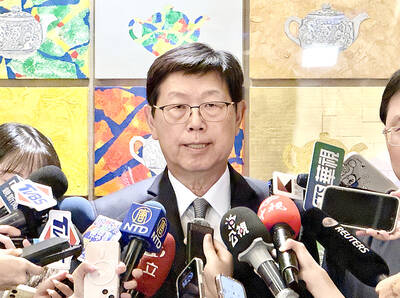
COLLABORATION: Softbank would supply manufacturing gear to the factory, and a joint venture would make AI data center equipment, Young Liu said Hon Hai Precision Industry Co (鴻海精密) would operate a US factory owned by Softbank Group Corp, setting up what is in the running to be the first manufacturing site in the Japanese company’s US$500 billion Stargate venture with OpenAI and Oracle Corp. Softbank is acquiring Hon Hai’s electric-vehicle plant in Ohio, but the Taiwanese company would continue to run the complex after turning it into an artificial intelligence (AI) server production plant, Hon Hai chairman Young Liu (劉揚偉) said yesterday. Softbank would supply manufacturing gear to the factory, and a joint venture between the two companies would make AI data
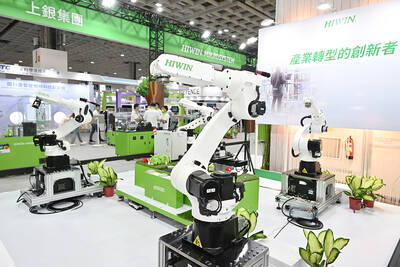
The Taiwan Automation Intelligence and Robot Show, which is to be held from Wednesday to Saturday at the Taipei Nangang Exhibition Center, would showcase the latest in artificial intelligence (AI)-driven robotics and automation technologies, the organizer said yesterday. The event would highlight applications in smart manufacturing, as well as information and communications technology, the Taiwan Automation Intelligence and Robotics Association said. More than 1,000 companies are to display innovations in semiconductors, electromechanics, industrial automation and intelligent manufacturing, it said in a news release. Visitors can explore automated guided vehicles, 3D machine vision systems and AI-powered applications at the show, along


 RSS
RSS