


Global investors are shocked to have discovered that China is run by communists. Shares of online education companies collapsed last week after the Chinese government all but outlawed the industry, and Internet behemoth Tencent Holdings Ltd (騰訊) shed more than US$50 billion of value at one point on Tuesday after state media declared electronic games to be “spiritual opium.”
China’s leaders are making abundantly clear where they stand on the tension between private profits and social well-being. These sudden regulatory shifts have thrown asset managers across the world into a frenzy of effort to understand and explain how prospects for investors in the world’s second-largest economy have changed.
The most lucid and logically coherent explanation also happens to be the simplest: Take the Chinese Communist Party (CCP) at its word. For decades, foreign investors have told themselves a comforting story: China was no longer truly communist, after then-paramount leader Deng Xiaoping (鄧小平) embraced markets in the late 1970s and started the country’s spectacular economic rise. The wealth and growth generated by capitalist techniques had converted the government and people. While the CCP continued to wrap itself in the rhetoric of communism, its members knew they were paying lip service to a bankrupt ideology, or so the thinking ran.
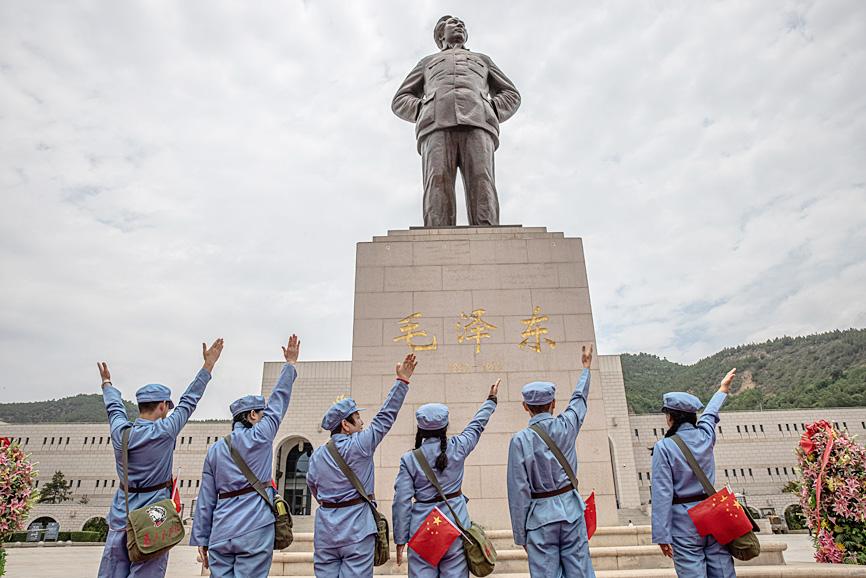
Photo: EPA-EFE
The era of such creative ambiguity is over. With a true believer holding the reins of power, there can be no doubt that China’s rulers mean what they say.
How much does this matter? Communist or not, China has no intention of abandoning capital markets. Having helped to bring the country to the level of a “moderately prosperous” society, markets will play an important role in driving development forward to higher levels of affluence and technological achievement. That inevitably implies opportunities for investors.
The difference will be a greater willingness than in avowedly capitalist countries to intervene to secure socially desirable outcomes, such as steering parents away from a wealth-and-energy-sapping educational rat race or discouraging children from playing Honor of Kings for eight hours a day.
Is this really so dissimilar to market regulation in Western democracies? Capitalism is subject to constraints everywhere. The Chinese government’s declaration that training institutions teaching the school curriculum should be non-profit mirrors a perennial debate in capitalist countries over the appropriate division between the state and private economies. Take healthcare, where commitment to free-market principles has seen the US keep provision mainly in private hands while most developed countries have opted for state-provided universal systems.
Then again, regulators in developed democracies do not generally abolish a US$100 billion industry overnight. The contrast probably seems quite stark to shareholders in US-listed New Oriental Education & Technology Group (新東方教育科技集團) or TAL Education Group (好未來教育集團), which both had lost more than 90 percent of their peak market value by last week’s trough, following the government edict.
Investors might reasonably have considered that companies allowed to sell shares overseas and operate for years unmolested — New Oriental was listed in New York in 2006 — were legitimate businesses in good standing with the state.
Tencent, whose shares pared losses on Tuesday after an online link to the gaming critique was removed, has waved goodbye to almost US$400 billion of value this year amid a wider regulatory crackdown on China’s technology industry.
It is not simply a matter of China’s autocratic system giving officials more sway to enact draconian regulations at short notice — a capacity that some Western consumers might actually envy when it comes to cutting back the overweening dominance of Internet titans — besides Tencent, Alibaba Group Holding Ltd (阿里巴巴) has lost more than US$300 billion of market value from its peak. The distinction exists at a deeper, philosophical level.
Chinese communist ideology declares that capitalism is a stage human society will pass through, to be replaced by socialism and ultimately communism. This idea goes back to the writings of Karl Marx, who claimed to have discovered the universal laws governing human history.
Having been relatively poor and backward prior to Deng’s “reform and opening up” era, the CCP decided it had been wrong to try to leap straight into the stage of communism, and needed to pass through capitalism first.
However, crucially, capitalism is still only a stage. The CCP’s leaders are the architects of the future, there to look beyond this phase.
Markets, viewed through this metaphysical lens, are mere tools to be deployed as needed by the shapers of history. That is a contrast with capitalist countries where markets and the laws that govern them are regarded, often with reverence, as something outside of ourselves, to which participants have no choice but to conform.
“You can’t buck the market,” in the words of the UK’s free-market priestess, former British prime minister Margaret Thatcher.
This dichotomy implies some differences in behavior by China — such as, dare we say, unilaterally declaring that successful industries employing tens of thousands of people should not exist, at least as for-profit entities listed on foreign stock markets, and then hastily convening talks with investment banks and fund managers to try to limit the damage once the fallout has spread to the rest of the market.
The market reaction was entirely rational, and predictable. Equity value can be viewed as a function of dividends (or cash flows), growth and the required rate of return. The higher the return that investors demand, the lower the value. The “equity risk premium” is a nebulous concept to pin down numerically, but the logic is clear. The higher the risk of a company or market, the higher the return that investors should demand to compensate them. A market that suddenly erases an entire industry’s profits is, ipso facto, riskier than one that does not. In that light, investors were right to mark down Chinese equities relative to other markets.
Marx’s universal laws of history might have the last laugh; it is too early to tell, as former Chinese premier Zhou Enlai (周恩來) is reputed (wrongly) to have said about the French Revolution. In the meantime, the laws of mathematics are proving quite immutable, too.
Matthew Brooker is a columnist and editor with Bloomberg Opinion. He previously was a columnist, editor and bureau chief for Bloomberg News. Before joining Bloomberg, he worked for the South China Morning Post.
This column does not necessarily reflect the opinion of the editorial board or Bloomberg LP and its owners.

Starlux Airlines Co (星宇航空) today unveiled a long-haul network expansion plan at a shareholders’ meeting in Taipei, including direct flights to Barcelona, Spain, and Zurich, Switzerland, as well as a service connecting Taipei, Sydney and New Zealand. Starlux is to become the first Taiwanese carrier to offer non-stop services to the two European cities, while the inaugural oceanic route is expected to expand transit opportunities within the Australia-New Zealand market, Starlux said. Flight services to Chicago, Dallas, Washington and New York are under evaluation, the airline added. Prior to the shareholders’ meeting, the airline earlier this year announced that it would be

Netherlands-based semiconductor equipment supplier ASML Holding NV yesterday said that it is planning to hire an additional 1,000 people in Taiwan this year in response to growing demand from clients. ASML had previously planned to recruit 600 people this year, but that the plan has been adjusted upward, ASML vice president and ASML Taiwan general manager Grace Wang (汪佳慧) told reporters. ASML has a workforce of more than 4,500 in Taiwan, accounting for about 10 percent of its global total, Wang said. This year’s recruitment campaign would focus on adding people in the customer support, manufacturing and supply chain domains to assist ASML

UNDER MICROSCOPE: Taiwan detained three people who allegedly conspired to buy servers in Taiwan and export them using fraudulent documentation, prosecutors said Nvidia Corp chief executive officer Jensen Huang (黃仁勳) on Saturday urged Super Micro Computer Inc to tighten up on compliance after Taiwan detained three people this week for allegedly making fraudulent declarations about artificial intelligence (AI) servers made by its US partner. The development marked the nation’s first crackdown on semiconductor smuggling, which grew after the US slapped restrictions on exports of high-end chips such as Nvidia AI accelerators to China. Nvidia is “rigorous” in explaining regulations to all of its partners, Huang told reporters after arriving in Taipei. “Ultimately Super Micro has to run their own company,” he said in response to

Nvidia Corp yesterday announced that CEO Jensen Huang (黃仁勳) would attend an employee meeting in Taipei tomorrow to celebrate the launch of the company’s Taiwan headquarters project. Huang would attend a gathering at the site of Nvidia’s planned headquarters in Beitou Shilin Technology Park (北投士林科技園區), the company said in a statement. After arriving in Taiwan on Saturday last week, Huang told reporters that he plans to meet with Quanta Computer Inc (廣達) chairman Barry Lam (林百里) and Taiwan Semiconductor Manufacturing Co (TSMC, 台積電) chairman C.C. Wei (魏哲家), and would attend the groundbreaking ceremony for Nvidia’s Taiwan headquarters tomorrow. Nvidia has not yet applied


 RSS
RSS