


Department store and shopping mall operators should accelerate their adoption of new sales models in the face of challenges brought by the COVID-19 outbreak, an expert said on Sunday.
Champion Wang (王建彬), vice president of the think tank Commerce Development Research Institute, said that COVID-19 has fundamentally changed the way department stores and shopping malls operate in Taiwan.
That has been especially true after Taiwan imposed a nationwide level 3 COVID-19 alert on May 19, when case numbers surged. The alert led to restrictions on gatherings, barred on-site dining and prompted government warnings about only going out if necessary.
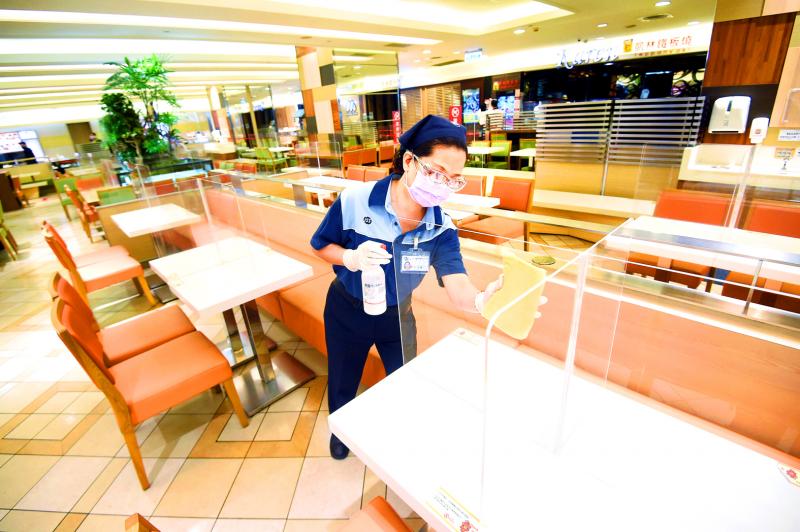
Photo: Fang Pin-chao, Taipei Times
Retail sales grew 18.3 percent year-on-year in April, but only 2.8 percent in May, government statistics showed.
Moreover, food and beverage sales fell 19.1 percent in May from a year earlier.
Department stores and shopping malls were among the retail spaces hardest hit by the COVID-19 restrictions.
Having shortened their business hours or temporarily closed to contain the spread of the disease after the alert was issued, their sales plunged 28.3 percent year-on-year in May.
The nationwide level 3 alert is provisionally set to last until Monday next week.
Local businesses need to do their best to transition to new sales models to meet the challenges brought by the pandemic, even after the level 3 alert is lifted, Wang said.
One of the major changes needed is for department stores to rearrange their spaces so that customers can maintain social distancing, Wang said.
More importantly, they need to develop their digital channels more quickly, which some leading shopping malls and department stores have been doing for some time, he added.
For instance, Global Mall (環球購物中心), one of the largest chain shopping malls with eight outlets, has been pitching its products online in live-streaming sessions on its Facebook page since last year to reach more potential customers, he said.
It is also planning to work closer with Internet influencers to increase its reach, he said.
Taipei 101 Mall, one of the nation’s top international shopping destinations, is also adapting to the new trend by holding its annual jewelry and watch exhibition virtually for the first time this year, Wang said.
Customers can make appointments online to visit the mall during a specific time frame to be able to shop without having contact with other customers, Taipei 101 Mall said.
Another necessary change is for department stores and malls to reallocate their workforce, especially for food and beverage services, Wang said.
For example, more workers should be allocated to making deliveries as indoor dining is banned, he said, adding that food and beverage businesses should come up with more appealing takeout menus.
Retailers should also speed up their membership marketing, which allows them to send tailored and precisely targeted messages and personalized discounts to boost sales, Wang said.

Cairo’s new monorail slices across the city skyline, running above the familiar chaos of blaring horns and aging buses’ exhaust fumes that mark rush hour below. The US$4.5 billion monorail, opened this month, is among Egypt’s most prominent new transport projects, part of a debt-funded infrastructure drive criticized for sapping state finances while bringing limited benefits to most of the country’s 109 million people. “It feels like you’re in a different country,” said Ramy Sayed, a restaurant manager, aboard a driverless Innovia 300 train. “No noise, no traffic, we’re not used to this.” The eastern line runs 56km from the bustling middle-class

Taiwanese firms have increased investment in the Philippines in recent years as Manila’s ties with Washington deepen and global supply chains continue to shift away from China, an expert at the Chung-Hua Institution for Economic Research (CIER, 中華經濟研究院) said yesterday. The Philippines had not been among Taiwanese investors’ top choices in Southeast Asia, CIER Taiwan ASEAN Studies Center director Kristy Hsu (徐遵慈) said at a seminar in Taipei. However, Taiwan’s investment in the country has grown significantly since the COVID-19 pandemic, reaching US $257 million last year, a high in recent years, she said. Although Taiwan’s total investment in the Philippines still lags

Intel Corp regards Taiwan Semiconductor Manufacturing Co (TSMC, 台積電) as a longstanding partner, as the US chipmaker would continue outsourcing production of advanced chips to TSMC, Intel chief executive officer Lip-Bu Tan (陳立武) said yesterday. “I don’t look at people as competitors. I look at the collaboration... Nvidia is also, you know, a good friend,” Tan told a news conference following his keynote speech at the Computex trade show in Taipei. “It’s a very trusted partnership for us... We are a big, top customer for them, and we’re going to continue doing that,” he said, referring to TSMC, the world’s largest foundry

Artificial intelligence (AI) agents would supplant smartphones as the center of people’s digital lives, fundamentally reshaping personal devices and driving a major computing upgrade cycle, Qualcomm Inc CEO Cristiano Amon said yesterday. In his keynote speech for this year’s Computex trade show in Taipei, Amon said that the rise of "agentic AI" — AI systems capable of reasoning, planning and carrying out tasks autonomously — would transform how people interact with technology across phones, PCs, vehicles and wearable devices. Describing the technology as the next major evolution in computing, Amon said that "2026 is the year of agents.” For decades, smartphones have sat


 RSS
RSS