

Contract electronics manufacturer Wistron Corp (緯創) on Thursday reported revenue of NT$71.9 billion (US$2.56 billion) for last month, up 17.92 percent month-on-month, but down 8.98 percent year-on-year, as component shortages limited its ability to fill orders.
Orders far outpaced the company’s ability to produce goods, whether it was laptops, servers, desktops or monitors, Wistron said in a statement, adding that it was uncertain when the shortages would end.
In the first six months of the year, cumulative revenue decreased 4.2 percent from a year earlier to NT$378.24 billion, the company said.
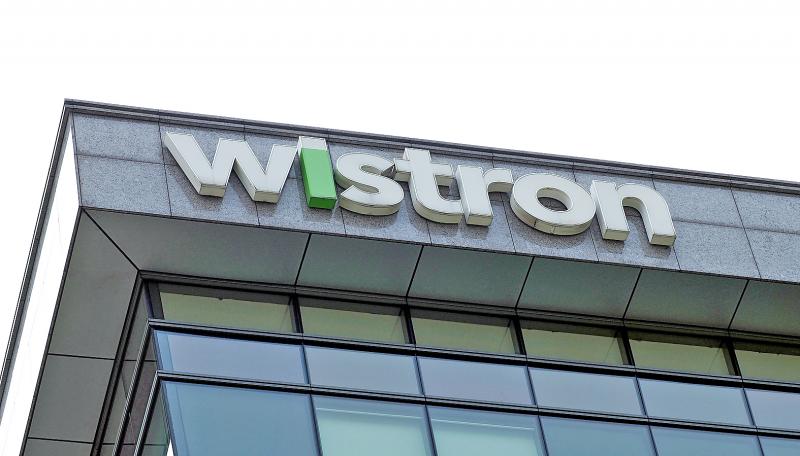
Photo: EPA-EFE
In a separate statement, Wistron said it would acquire 100 percent of Kaohsiung Opto-Electrics Inc (KOE, 高雄晶傑達光電), a wholly-owned subsidiary of JDI Taiwan Inc (台灣晶端顯示), itself a subsidiary of Tokyo-based Japan Display Inc.
The purchase, to be made through Wistron’s Wise Cap Ltd (鼎創) subsidiary, is tentatively set at a transaction value of ¥8 billion (US$72.62 million).
“The final price will be confirmed after the related parties complete due diligence and sign the share purchase agreement,” Wistron said.
The deal is expected to be completed by the end of this quarter.
“Through this acquisition, Wistron will further strengthen its partnership with JDI, and continue to expand the capacity and product portfolio of KOE,” it said.
Fellow contract electronics maker Inventec Corp (英業達) reported revenue of NT$41.27 billion for last month, up 16.79 percent month-on-month, but down 22.72 percent year-on-year.
In the first six months, revenue totaled NT$226.65 billion, down 4.5 percent from a year earlier, the company said.
Inventec’s product lineup includes notebook computers, smart devices and servers, but component shortages remain an issue and affect its ability to fulfill orders, it said.
Bigger rivals Quanta Computer Inc (廣達), Compal Electronics Inc (仁寶) and Pegatron Corp (和碩) posted mixed revenue results for last month and the first half of the year.
Quanta’s sales last month decreased 3.3 percent year-on-year to NT$90.39 billion, but sales in the first half of the year increased 14.9 percent to NT$529.23 billion.
Compal’s sales increased 11.92 percent to NT$91.44 billion last month and rose 19.13 percent to NT$530.98 billion in the first half of the year, while Pegatron’s sales declined 19.17 percent year-on-year to NT$88.87 billion last month and also fell 19.4 percent to NT$488.82 billion in the first six months.

Silicon photonics would play a dominant role next year and make chip-level co-packaged optics (CPO) packaging possible, Taiwan Semiconductor Manufacturing Co (TSMC, 台積電) said yesterday. “For years, critics questioned the reliability of CPO. The doubts are being thoroughly dismantled by real-world data and market validation,” TSMC vice president of advanced packaging technology development K.C. Hsu (徐國晉) said at a SEMI forum in Taipei. The company is on track to enter production of CPO later this year, Hsu said in another forum arranged by Imec in Taipei yesterday, about four months after TSMC announced its progress in CPO development in May.

In China’s hilly Guizhou Province, a cluster of European-style buildings complete with clock tower and multi-arched bridge emits a low, permanent hum — a clue to its unexpected identity as tech giant Huawei’s largest data center. The town-like complex is unique in design, but not in its placement. Dozens of data centers have been constructed in the southwestern province in the past few years. They are part of a government strategy that has seen much of the digital infrastructure for breakneck artificial intelligence (AI) development across China’s eastern seaboard established in the country’s less populated, rural west. The build-out is ongoing. China
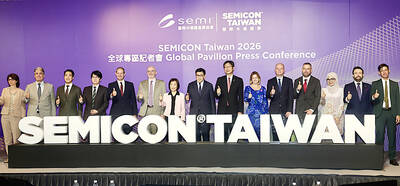
EXPANDING: Firms are accelerating commercialization of the technologies as the industry moves beyond chip-level speeds to upgrading rack-to-rack links, SEMI said Silicon photonics and copackaged optics (CPO), technologies seen as critical to meeting the surging bandwidth demands of artificial intelligence (AI) infrastructure, would be among the main themes at the Semicon Taiwan trade show, which opens on Wednesday, event organizer SEMI said yesterday. The forum runs until Friday at the Taipei Nangang Exhibition Center, with technical forums beginning today. The event is expected to set a record in terms of the number of participants, SEMI said, projecting more than 1,300 exhibitors from 65 countries across 4,300 booths and more than 100,000 attendees. Optical interconnects underpinning AI infrastructure would be one of the highlights, with
Taiwan Semiconductor Manufacturing Co (TSMC, 台積電) has increased its second-quarter employee bonuses by more than 50 percent from a year earlier, as the world’s largest contract chipmaker posted record earnings in the three-month period. TSMC distributed its second-quarter bonuses to employees on Friday. Employee bonuses for the April-to-June period totaled NT$36 billion (US$1.14 billion), the chipmaker’s financial data showed. During the period, TSMC posted NT$706.56 billion in net profit, up 77.4 percent from a year earlier and 23.4 percent from a quarter earlier. Second-quarter earnings per share (EPS) rose to NT$27.25, compared with NT$15.36 a year earlier and NT$22.08 in the first


 RSS
RSS