


The Financial Supervisory Commission (FSC) yesterday enhanced disclosure requirements for environmental, social and governance (ESG)-themed funds to prevent “greenwashing” in the asset management sector.
The commission has requested that asset management firms set at least one sustainability goal for each of their ESG-themed funds and explain how their investment would help achieve that goal, Securities and Futures Bureau Deputy Director Kuo Chia-chun (郭佳君) told a videoconference in Taipei.
Companies operating 21 ESG-themed funds that have been launched, or five funds that have been approved, but have not been launched, must disclose the information in the next six months, or the funds would not be officially recognized as ESG funds, Kuo said.
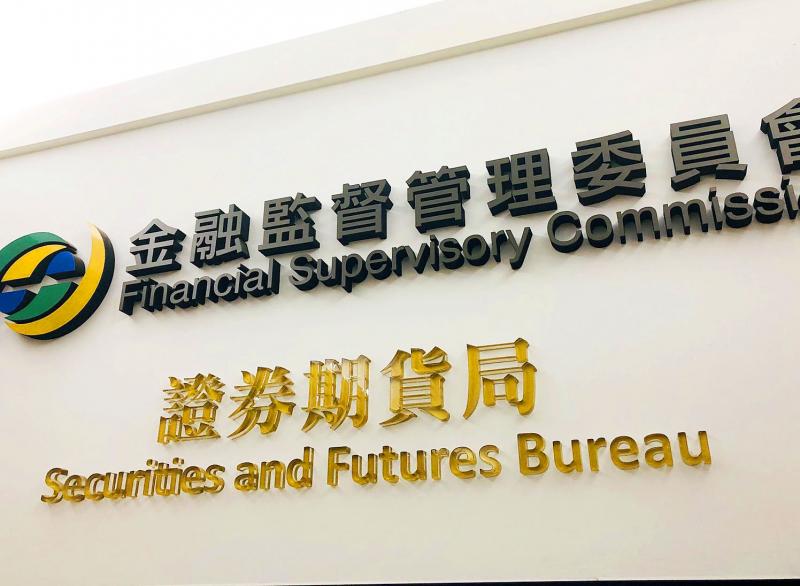
Photo: Kelson Wang, Taipei Times
“In Taiwan, more securities investment and consulting firms have been offering products whose largest selling point is sustainable investment, but we noticed that many failed to provide sufficient information as to how their funds address sustainability issues,” Kuo said.
The firms should set at least one sustainability goal, and each goal should tackle environmental, social and governance issues at the same time, she said.
Once the firms set their goals, they need to ensure that 60 percent of the money under management is allocated for investment in companies whose operations are in line with their goals, Kuo said, adding that 70 percent would be a better ratio.
For example, if an ESG fund focuses on energy transition, the fund’s portfolio should include companies operating in green energy, electric vehicles or other renewable energy technology, Kuo said.
The commission would not intervene in or regulate the sustainability goals that can be set by asset management firms, she said.
However, it urges asset management firms to refer to the Paris Climate Agreement or the UN’s Sustainable Development Goals, such as gender equality, affordable and clean energy, clean water and industry innovation, Kuo said.
Asked if firms need to target net-zero carbon emissions like some financial conglomerates, Kuo said that it would be an ambitious goal, as asset management firms targeting net-zero emissions must convince the commission that the companies their funds invest in have net-zero carbon emissions.
If a recipient of an ESG fund were to be embroiled in a corporate scandal, the asset management firm supplying the fund would not be asked to withdraw its investment, she said.
However, it must review the attribution of the scandal, the date when the alleged malpractice took place and whether the company invested in has resolved its governance issues, Kuo said.
The commission referred to tightened regulations released last month by the Hong Kong Securities and Futures Commission, and the Sustainable Finance Disclosure Regulations released by the EU in March.

Among the rows of vibrators, rubber torsos and leather harnesses at a Chinese sex toys exhibition in Shanghai this weekend, the beginnings of an artificial intelligence (AI)-driven shift in the industry quietly pulsed. China manufactures about 70 percent of the world’s sex toys, most of it the “hardware” on display at the fair — whether that be technicolor tentacled dildos or hyper-realistic personalized silicone dolls. Yet smart toys have been rising in popularity for some time. Many major European and US brands already offer tech-enhanced products that can enable long-distance love, monitor well-being and even bring people one step closer to

Malaysia’s leader yesterday announced plans to build a massive semiconductor design park, aiming to boost the Southeast Asian nation’s role in the global chip industry. A prominent player in the semiconductor industry for decades, Malaysia accounts for an estimated 13 percent of global back-end manufacturing, according to German tech giant Bosch. Now it wants to go beyond production and emerge as a chip design powerhouse too, Malaysian Prime Minister Anwar Ibrahim said. “I am pleased to announce the largest IC (integrated circuit) Design Park in Southeast Asia, that will house world-class anchor tenants and collaborate with global companies such as Arm [Holdings PLC],”

Sales in the retail, and food and beverage sectors last month continued to rise, increasing 0.7 percent and 13.6 percent respectively from a year earlier, setting record highs for the month of March, the Ministry of Economic Affairs said yesterday. Sales in the wholesale sector also grew last month by 4.6 annually, mainly due to the business opportunities for emerging applications related to artificial intelligence (AI) and high-performance computing technologies, the ministry said in a report. The ministry forecast that retail, and food and beverage sales this month would retain their growth momentum as the former would benefit from Tomb Sweeping Day

Thousands of parents in Singapore are furious after a Cordlife Group Ltd (康盛人生集團), a major operator of cord blood banks in Asia, irreparably damaged their children’s samples through improper handling, with some now pursuing legal action. The ongoing case, one of the worst to hit the largely untested industry, has renewed concerns over companies marketing themselves to anxious parents with mostly unproven assurances. This has implications across the region, given Cordlife’s operations in Hong Kong, Macau, Indonesia, the Philippines and India. The parents paid for years to have their infants’ cord blood stored, with the understanding that the stem cells they contained


 RSS
RSS