


PX Mart Co (全聯) and Taiwan FamilyMart Co (全家便利商店) yesterday gained Financial Supervisory Commission (FSC) approval to provide electronic payment services through subsidiaries, the FSC said yesterday.
PXPay Co Ltd (全支付) and All Win Co Ltd (全盈支付金融科技), which is 67 percent owned by Taiwan FamilyMart, 18 percent owned by E.Sun Commercial Bank (玉山銀行) and 15 percent owned by Pi Mobile Technology Inc (拍付國際), were granted approval to establish the services, the commission said.
The two firms fulfilled the requirements, including at least NT$500 million (US$17.86 million) in paid-in capital, and would be allowed to offer a payment tool, as well as to take deposits from service users and offer fund transfers between them, the commission said.
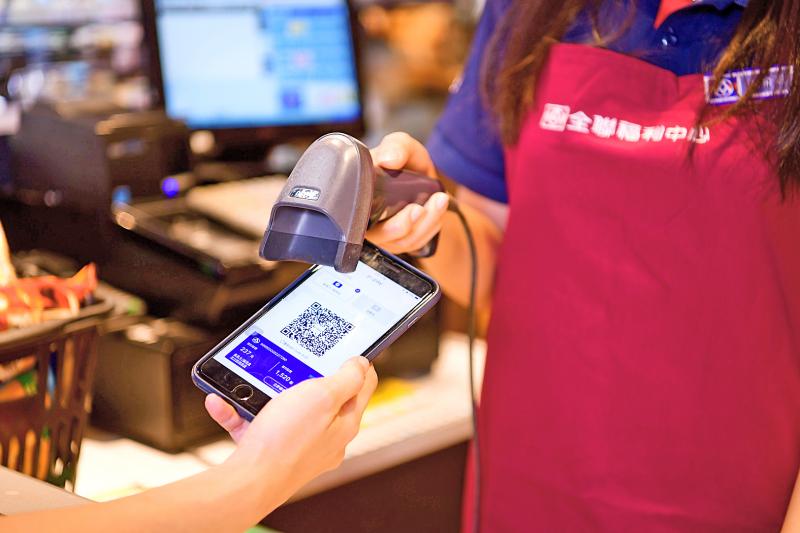
Photo: Yang Ya-min, Taipei Times
However, licenses for additional services, such as foreign currency accounts and vouchers, would require additional applications, the commission said.
Twenty-eight companies offer e-payment services in Taiwan, with 13 million users as of the end of April, FSC data showed.
The addition of PxPay and All Win would intensify competition in the sector, as their parent companies have a large customer base, the commission said.
PxPay has 7 million members, while 13 million Taiwanese have a FamilyMart membership, it added.
The commission has asked the two companies to define stable and solid marketing and pricing strategies, Banking Bureau Deputy Director-General Huang Kuang-hsi (黃光熙) told a videoconference, adding that curbs are in place to prevent players in the sector from engaging in price wars.
Asked if the two e-payment provider could offer exclusive rewards for customers at their parent companies, Huang said that the FSC would decide on a case-by-case basis whether this would have an adverse effect on market discipline.
In related news, a MasterCard Taiwan (萬事達) survey found that more than 75 percent of respondents used mobile payment tools more often than they did before a surge of COVID-19 cases last month.
Half of the respondents used the tools every day, up 30 percentage points from before the outbreak, the company said.
Forty-five percent said they preferred mobile payment tools as they were safer than cash amid the COVID-19 outbreak, while 70 percent said they were attracted by rewards offered through the platforms and 60 percent said that they wanted to save time, the survey showed.

The domestic unit of the Chinese-owned, Dutch-headquartered chipmaker Nexperia BV will soon be able to produce semiconductors locally within China, according to two company sources. Nexperia is at the center of a global tug-of-war over critical semiconductor technology, with a Dutch court in February ordering a probe into alleged mismanagement at the company. The geopolitical tussle has disrupted supply chains, with some carmakers reportedly forced to cut production due to chip shortages. Local production would allow Nexperia’s domestic arm, Nexperia Semiconductors (China) Ltd (安世半導體中國), to bypass restrictions in place since October on the supply of silicon wafers — etched with tiny components to

Singapore-based ride-hailing and delivery giant Grab Holdings Ltd has applied for regulatory approval to acquire the Taiwan operations of Germany-based Delivery Hero SE's Foodpanda in a deal valued at about US$600 million. Grab submitted the filing to the Fair Trade Commission on Friday last week, with the transaction subject to regulatory review and approval, the company said in a statement yesterday. Its independent governance structure would help foster a healthy and competitive market in Taiwan if the deal is approved, Grab said. Grab, which is listed on the NASDAQ, said in the filing that US-based Uber Technologies Inc holds about 13 percent of

Taiwan is open to joining a global liquefied natural gas (LNG) program if one is created, but on the condition that countries provide delivery even in a scenario where there is a conflict with China, an energy department official said yesterday. While Taiwan’s priority is to have enough LNG at home, the nation is open to exploring potential strategic reserves in other countries such as Japan or South Korea, Energy Administration Deputy Director-General Chen Chung-hsien (陳崇憲) said. While the LNG market does not have a global reserve for emergencies like that of oil, the concept has been raised a few times —

Taiwan Semiconductor Manufacturing Co (TSMC, 台積電) yesterday received government approval to deploy its advanced 3-nanometer (3nm) process at its second fab currently under construction in Japan, the Ministry of Economic Affairs said in a news release. The ministry green-lit the plan for the facility in Kumamoto, which is scheduled to start installing equipment and come online in 2028 with a monthly production capacity of 15,000 12-inch wafers, the ministry said. The Department of Investment Review in June 2024 authorized a US$5.26 billion investment for the facility, slated to manufacture 6- to 12nm chips, significantly less advanced than 3nm process. At a meeting with


 RSS
RSS