


Average monthly take-home wages in April gained 2.77 percent from a year earlier to NT$43,190, while total wages — including overtime and performance-based compensation — grew 4.27 percent to NT$49,930, the Directorate-General of Budget, Accounting and Statistics (DGBAS) said yesterday, attributing the trend to an improving economy.
The pay increase came as Taiwan’s exports benefited from strong demand for tech and non-tech products, and before the COVID-19 outbreak chilled consumer activity from the middle of last month.
“The job market in April almost emerged from the negative impact of the COVID-19 pandemic,” DGBAS Deputy Director Chen Hui-hsin (陳惠欣) told an online news conference.

Photo: Clare Cheng, Taipei Times
The public health crisis knocked out 115,000 jobs in the first five months of last year, and the situation started to improve in June last year after the government lifted most social distancing measures, Chen said.
The job market was only 4,000 jobs away from its pre-pandemic level, but things took a drastic turn following an outbreak of the virus last month, Chen said, adding that the situation this year is much worse than last year, as a level 3 COVID-19 alert impedes non-essential consumer activity.
Tourism-related sectors are again bearing the brunt, to a much larger extent this time, after authorities banned dine-in services and urged people to stay home, Chen said.
In April, restaurants and hotels raised headcounts by 5,000, outpacing the manufacturing industry with a gain of 2,000 jobs, the agency said.
Hotels across Taiwan have announced temporary closures to save operating costs, it added.
The DGBAS earlier said that it would postpone the release of unemployment data for last month to July 6, as it needs more time to collect data and process statistics.
So far, the outbreak appears to have little effect on manufacturing, Chen said.
Major listed companies from different sectors posted record revenues last month, lending support to steady advances in monthly wages.
Employees at airline companies enjoyed the highest average take-home pay of NT$74,981 per month, followed by workers at electricity and gas suppliers at NT$65,192, and employees in the financial and insurance industries at NT$63,884, DGBAS data showed.
For the first four months of this year, regular monthly wages on average increased 2.16 percent year-on-year to NT$43,085, while total compensations gained 2.69 percent to NT$62,628, the agency said.
The pace of increases shrank to 1.03 percent and 1.54 percent respectively after factoring in inflation rates, it added.

The domestic unit of the Chinese-owned, Dutch-headquartered chipmaker Nexperia BV will soon be able to produce semiconductors locally within China, according to two company sources. Nexperia is at the center of a global tug-of-war over critical semiconductor technology, with a Dutch court in February ordering a probe into alleged mismanagement at the company. The geopolitical tussle has disrupted supply chains, with some carmakers reportedly forced to cut production due to chip shortages. Local production would allow Nexperia’s domestic arm, Nexperia Semiconductors (China) Ltd (安世半導體中國), to bypass restrictions in place since October on the supply of silicon wafers — etched with tiny components to

Singapore-based ride-hailing and delivery giant Grab Holdings Ltd has applied for regulatory approval to acquire the Taiwan operations of Germany-based Delivery Hero SE's Foodpanda in a deal valued at about US$600 million. Grab submitted the filing to the Fair Trade Commission on Friday last week, with the transaction subject to regulatory review and approval, the company said in a statement yesterday. Its independent governance structure would help foster a healthy and competitive market in Taiwan if the deal is approved, Grab said. Grab, which is listed on the NASDAQ, said in the filing that US-based Uber Technologies Inc holds about 13 percent of
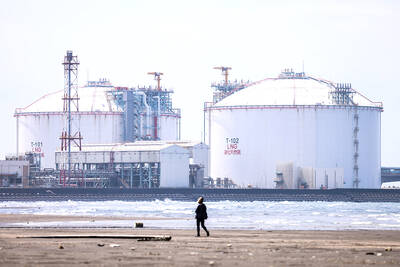
Taiwan is open to joining a global liquefied natural gas (LNG) program if one is created, but on the condition that countries provide delivery even in a scenario where there is a conflict with China, an energy department official said yesterday. While Taiwan’s priority is to have enough LNG at home, the nation is open to exploring potential strategic reserves in other countries such as Japan or South Korea, Energy Administration Deputy Director-General Chen Chung-hsien (陳崇憲) said. While the LNG market does not have a global reserve for emergencies like that of oil, the concept has been raised a few times —

Taiwan Semiconductor Manufacturing Co (TSMC, 台積電) yesterday received government approval to deploy its advanced 3-nanometer (3nm) process at its second fab currently under construction in Japan, the Ministry of Economic Affairs said in a news release. The ministry green-lit the plan for the facility in Kumamoto, which is scheduled to start installing equipment and come online in 2028 with a monthly production capacity of 15,000 12-inch wafers, the ministry said. The Department of Investment Review in June 2024 authorized a US$5.26 billion investment for the facility, slated to manufacture 6- to 12nm chips, significantly less advanced than 3nm process. At a meeting with


 RSS
RSS