


Taiwanese hotel and restaurant operator FDC International Hotels Corp (雲品國際) has signed a management contract with tea vendor Po Yuen Ji (寶元紀) to launch a new 100-table banquet facility in Taichung next year, unfazed by the current business freeze caused by the domestic COVID-19 outbreak.
FDC runs the Palais de Chine (君品酒店) near Taipei Railway Station, the Fleur de Chine Hotel (雲品溫泉酒店) overlooking Sun Moon Lake (日月潭) in Nantou County and several independent banquet facilities.
As FDC is eyeing banquet facilities, which generate higher margins than restaurants, the upcoming venture would be its second after Taoyuan’s Royal Wedding (皇家薇庭).

Photo courtesy of FDC International Hotels Corp
The Taichung venue would be built on a plot of 1,674 ping (5533.9m2), which Po Yuen Ji acquired in June last year, FDC general manager David Ting (丁原偉) said in a statement.
The two businesses agreed to target high-end banquet needs in the hopes of attaining NT$100 million (US$3.6 million) in revenue per year, Ting said, adding that the goal can be reached by setting a price of NT$19,990 per table and a 10 percent service charge.
FDC is to begin accepting bookings for the venue from next month via its banquet arm Palais de Chine Collection (君品Collection), Ting said.
The banquet market is going through a structural shakeup since the COVID-19 pandemic began last year, a process that is gaining traction this year, he added.
Palais de Chine Collection is one of the few banquet operators in Taiwan that managed to remain profitable last year, Ting said, adding that FDC is in talks to arrange two to three more management contracts to increase its market share.
The company’s other banquet sites include a 60-year-old mansion in New Taipei City’s Tamsui District (淡水), the Red House Theater (西門紅樓) in Taipei’s Ximending (西門町) area and a vintage restaurant near Yangmingshan National Park (陽明山國家公園).
Le Palais (頤宮), the Michelin-starred Cantonese restaurant of Palais de Chine (君品酒店), has joined peers in offering takeout after the Taipei City Government banned dining-in at all restaurants.
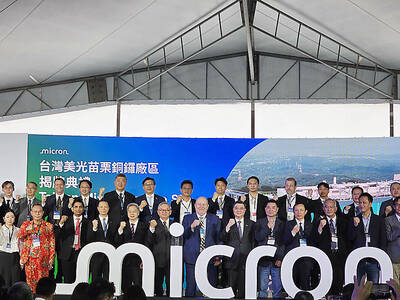
UNPRECEDENTED PACE: Micron Technology has announced plans to expand manufacturing capabilities with the acquisition of a new chip plant in Miaoli Micron Technology Inc unveiled a newly acquired chip plant in Miaoli County yesterday, as the company expands capacity to meet growing demand for advanced DRAM chips, including high-bandwidth memory chips amid the artificial intelligence boom. The plant in Miaoli County’s Tongluo Township (銅鑼), which Micron acquired from Powerchip Semiconductor Manufacturing Corp (力積電) for US$1.8 billion, is expected to make a sizeable capacity contribution to the company from fiscal 2028, the company said in a statement. It would be an extended production site of Micron’s large-scale manufacturing hub in Taichung, the company said. As the global semiconductor industry is racing to reach US$1 trillion

Singapore-based ride-hailing and delivery giant Grab Holdings Ltd has applied for regulatory approval to acquire the Taiwan operations of Germany-based Delivery Hero SE's Foodpanda in a deal valued at about US$600 million. Grab submitted the filing to the Fair Trade Commission on Friday last week, with the transaction subject to regulatory review and approval, the company said in a statement yesterday. Its independent governance structure would help foster a healthy and competitive market in Taiwan if the deal is approved, Grab said. Grab, which is listed on the NASDAQ, said in the filing that US-based Uber Technologies Inc holds about 13 percent of

Taiwan’s food delivery market could undergo a major shift if Singapore-based Grab Holdings Ltd completes its planned acquisition of Delivery Hero SE’s Foodpanda business in Taiwan, industry experts said. Grab on Monday last week announced it would acquire Foodpanda’s Taiwan operations for US$600 million. The deal is expected to be finalized in the second half of this year, with Grab aiming to complete user migration to its platform by the first half of next year. A duopoly between Uber Eats and Foodpanda dominates Taiwan’s delivery market, a structure that has remained intact since the Fair Trade Commission (FTC) blocked Uber Technologies Inc’s

Memory chip stocks extended their losses yesterday after Alphabet Inc’s Google publicized research that could allow more efficient use of the storage needed for artificial intelligence (AI) development. SK Hynix Inc and Samsung Electronics Co, South Korean leaders in the market, fell more than 6 percent and about 5 percent respectively in Seoul. In the US, Micron Technology Inc, Western Digital Corp and Sandisk Corp slid more than 2 percent in pre-market trading, after they all closed lower on Wednesday. Memory companies have been on a tear in recent months as the rapid development of AI infrastructure triggered a spike in chip


 RSS
RSS