


Taiwan’s stock market has been attracting an increasing number of investors, particularly people aged 30 or younger, as the local main board has jumped by more than 20 percent on average over the past two years, Taiwan Stock Exchange (TWSE) data showed.
Last year, the number of stock account owners on the TWSE increased by 670,000 to 11.24 million, while the TAIEX registered a 22.8 percent rise, the data showed.
Among the 11.24 million stock investors last year, 42.9 percent were aged 30 or younger, an increase of 12 percent in that age category from 2015.
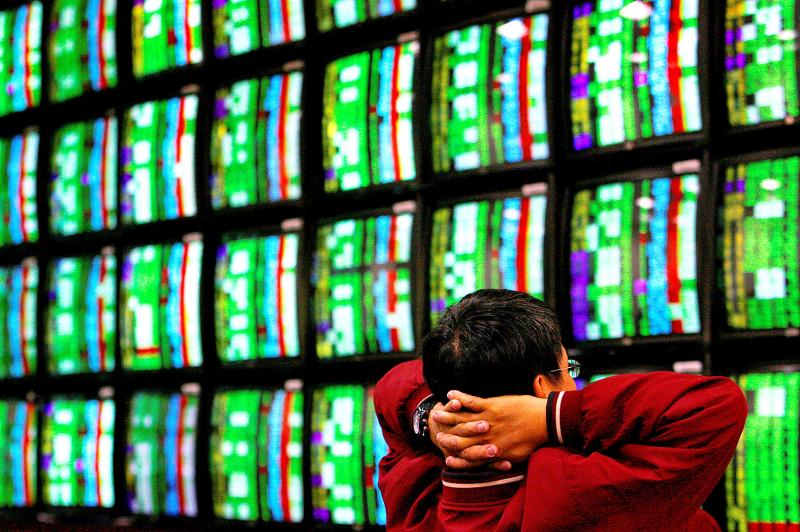
Photo: Reuters
Apart from the stellar performance of the weighted index, the introduction of odd-lot trading — orders of fewer than 1,000 shares — in October last year gave investors the means to buy more expensive stocks, brokerages said.
For example, shares of Taiwan Semiconductor Manufacturing Co (台積電), which were priced at NT$590 as of Friday, would have been too costly for the average retail investor had it not been for odd-lot trading, they said.
Another factor is online trading, which allows investors to buy and sell stocks using mobile phones and has drawn more young people to the market, they said.
Many new investors entered the market to pick up stocks at a lower price after the TAIEX plunged in March last year because of the COVID-19 outbreak, Mega International Investment Services Corp (兆豐國際投顧) analyst Alex Huang (黃國偉) said.
Stock market commentary on platforms such as YouTube and Clubhouse, as well as on podcasts, also helped attract younger investors, he added.
However, it has created a new challenge in regulating online market activities, Financial Supervisory Commission Chairman Thomas Huang (黃天牧) said.
While foreign investors sold Taiwanese stocks this month, average daily turnover was US$17.9 billion, more than 30 percent above the daily average this year, data compiled by Bloomberg showed.
Another boost could be on the way, with the TWSE and Taipei Exchange planning to ease work-from-home rules for stock and bond trading to facilitate market activity, people familiar with the matter said.
Taiwan, South Korea and Vietnam have been three of Asia’s best-performing stock markets this year and also where individual investors are playing outsized roles, underscoring the growing influence of retail traders around the world.
Retail traders are responsible for about 70 percent of the turnover in Taiwan, about 75 percent of transactions in South Korea and about 90 percent of turnover in Vietnam, Bloomberg data showed.
The global retail-investing boom that has taken hold during the COVID-19 pandemic is continuing amid new outbreaks in Asia, with fresh curbs on movement forcing more people into the market to supplement lost income or make up for the meager interest they can earn on savings from bank accounts. The proliferation of cheap trading apps on mobile devices remains a key catalyst for the trend.
“Retail traders will continue to be an important market force as they pick up knowledge and skills in trading and investing,” said Margaret Yang (楊燕), a strategist at DailyFX in Singapore.
They might also bring bouts of “higher market volatility due to ‘herd effect,’” she added.
That is somewhat evident from the recent market activity in Taiwan, where a flare-up in virus cases saw the TAIEX plunge earlier this month to cap its worst weekly drop since March last year, only to reverse most of those losses over the next two weeks.
Retail trading is not the only force driving these better-performing markets in Asia.
Taiwan, South Korea and Vietnam have also benefited from the export outlooks for their economies as global vaccine rollouts buoy confidence around the world.
Taiwan’s exports beat estimates last month amid rising sales of semiconductors and other electronic components, while shipments from South Korea soared 53.3 percent in the first 20 days of this month from a year earlier. Vietnam, which is also battling a nationwide virus outbreak, has benefited the most in Asia from a rebound in the US economy on the back of massive stimulus.
Some analysts caution that retail traders might not be able to maintain the frenetic pace of the past few months.
“The volumes were running three, four, five or even — the case in Taiwan it was six times — the trading volumes we saw in 2016,” said Jonathan Garner, Morgan Stanley’s chief Asia emerging market strategist in Hong Kong. “When you have that degree of volume increase, it’s unlikely to be sustainable.”

SECOND-RATE: Models distilled from US products do not perform the same as the original and undo measures that ensure the systems are neutral, the US’ cable said The US Department of State has ordered a global push to bring attention to what it said are widespread efforts by Chinese companies, including artificial intelligence (AI) start-up DeepSeek (深度求索), to steal intellectual property from US AI labs, according to a diplomatic cable. The cable, dated Friday and sent to diplomatic and consular posts around the world, instructs diplomatic staff to speak to their foreign counterparts about “concerns over adversaries’ extraction and distillation of US AI models.” Distillation is the process of training smaller AI models using output from larger, more expensive ones to lower the costs of training a powerful new
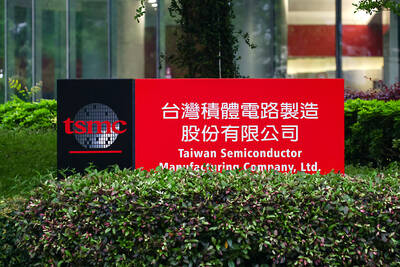
Shares of Taiwan Semiconductor Manufacturing Co (TSMC, 台積電) have repeatedly hit new highs, but an equity analyst said the stock’s valuation remains within a reasonable range and any pullback would likely be technical. The contract chipmaker’s historical price-to-earnings (P/E) ratio has ranged between 20 and 30, Cathay Futures Consultant Co (國泰證期) analyst Tsai Ming-han (蔡明翰) told Central News Agency. With market consensus projecting that TSMC would post earnings per share of about NT$100 (US$3.17) this year, supported by strong global demand for artificial intelligence (AI) applications, and the stock currently trading at a P/E ratio of below 25, Tsai said the valuation
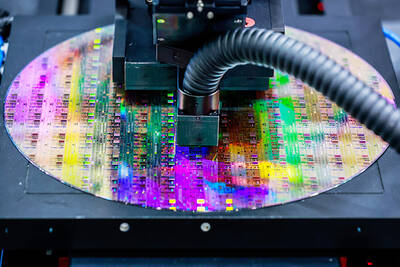
The artificial intelligence (AI) boom has triggered a seismic reshuffling of global equity markets, with Taiwan and South Korea muscling past European nations one by one. With its stock market now valued at nearly US$4.3 trillion, Taiwan surpassed the UK, Europe’s biggest market, earlier this month, data compiled by Bloomberg showed. South Korea is about US$140 billion away from doing the same. The tech-heavy Asian markets have shot past Germany and France in the past seven months. The shift is largely down to massive gains in shares of three companies that provide essential hardware for AI: Taiwan Semiconductor Manufacturing Co (TSMC, 台積電),

The US Department of Commerce last week ordered multiple chip equipment companies to halt shipments of certain tools to China’s second-largest chipmaker, Hua Hong Semiconductor Ltd (華虹半導體), its latest action to slow the country’s development of advanced chips, two people familiar with the matter said. The department sent letters to at least a handful of companies informing them of restrictions on tools and other materials destined for two Hua Hong facilities US officials believe make China’s most sophisticated chips, the people said. Top US chip equipment companies Lam Research Corp, Applied Materials Inc and KLA Corp, each of which has significant


 RSS
RSS