


E Ink Holdings Inc (元太科技), the world’s sole supplier of e-paper displays, yesterday said it was optimistic about revenue growth this year, but tight supplies of display driver ICs and flat-panel displays might cap its sales.
“For the whole of this year, we are positive about the business outlook. However, it will largely hinge on how much key components we can secure,” E Ink chairman Johnson Lee (李政昊) told investors via a teleconference in Taipei.
“So far, it looks like this year will be better than last year,” Lee said. “The second quarter [performance] will be very similar to the first quarter.”
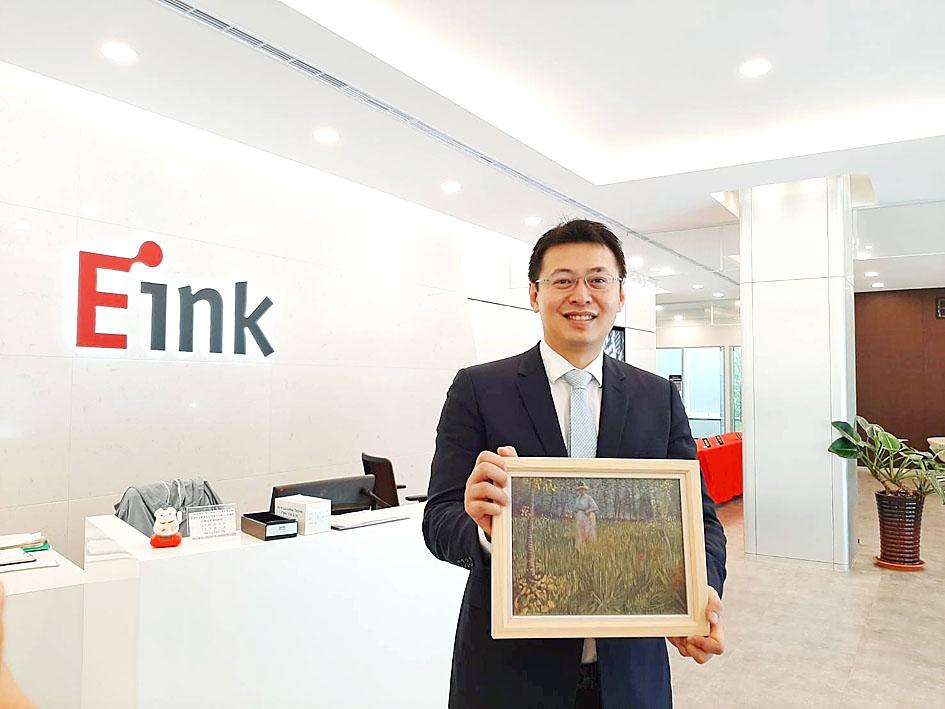
Photo: Chen Mei-ying, Taipei Times
Customer demand is not an issue for E Ink, as demand has greatly exceeded what the company can supply. E-paper is used in e-readers, e-notes and retailers’ electronic shelf labels, replacing traditional paper.
“Many clients have started talks with us about next year’s capacity arrangements as most deals for this year have been settled,” Lee said.
To catch up with customers’ rising demand, E Ink said it plans to add four new production lines to expand capacity, mainly for electronic shelf labels, as well as invest in a new office building that would also include a production line.
The new office building would cost NT$1.91 billion (US$68.26 million), the company said.
The company expects capacity to grow multiple-fold after the new expansion plan is completed next year at the earliest.
The company raised its capital spending for this year to about NT$2 billion from the NT$1.5 billion it estimated in March.
E Ink’s net income soared 48 percent to NT$1.17 billion during the quarter ending March 31, compared with NT$787.26 million a year earlier.
Earnings per share increased to NT$1.03 from NT$0.69 in the same period last year, making last quarter the best first quarter in about eight years.
Gross margin climbed to 49.78 percent, compared with 46.23 percent in the first quarter last year.
E Ink expects its gross margin to trend down in the following quarters, eroded by price increases in key components.
“Our strategy is not to pass on the rising costs to customers, as the e-paper market is still in the nascent stage of expansion. Besides, we are the single source. We should not do this,” Lee said.
To boost e-paper’s penetration of the education market, E Ink has formed an e-paper industry alliance in Shanghai to promote e-readers and e-notes for students.
The company expects the alliance’s membership to double to 200 companies next year.
MediaTek Inc (聯發科), Inventec Co (英業達) and Innolux Corp (群創), as well as China’s Xiaomi Corp (小米), Lenovo Group Ltd (聯想) and Hisense Electric Co (海信), plan to join the alliance, E Ink said.

DAMAGE REPORT: Global central banks are assessing war-driven inflation risks as the law of unintended consequences careens around the world, spiking oil prices Central banks from Washington to London and from Jakarta to Taipei are about to make their first assessments of economic damage after more than two weeks of conflict between the US and Iran. Decisions this week encompassing every member of the G7 and eight of the world’s 10 most-traded currency jurisdictions are likely to confirm to investors that the specter of a new inflation shock is already worrying enough to prompt heightened caution. The US Federal Reserve is widely expected to do exactly what everyone anticipated weeks ahead of its March 17-18 policy gathering: hold rates steady. The narrative surrounding that
Taiwan Semiconductor Manufacturing Co’s (TSMC, 台積電) share of the global foundry market rose to almost 70 percent last year amid booming demand for artificial intelligence (AI), market information advisory firm TrendForce Corp (集邦科技) said on Thursday. The contract chipmaker posted US$122.54 billion in revenue, up 36.1 percent from a year earlier, accounting for 69.9 percent of the global market, TrendForce said. Its share was up from 64.4 percent in 2024, it said. TSMC’s closest rival, Samsung Electronics, was a distant second, posting US$12.63 billion in sales, down 3.9 percent from a year earlier, for a 7.2 percent share of the global market. In the
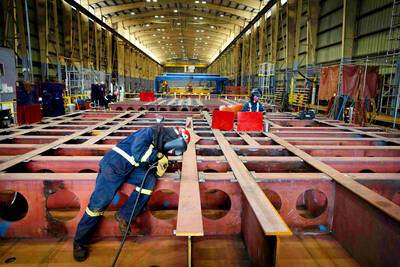
At a massive shipyard in North Vancouver, Canadian workers grind metal beams for a powerful new icebreaker crucial to cementing the country’s presence in the increasingly contested arctic. Icebreakers are specialized, expensive vessels able to navigate in the frozen far north. And “this is the crown jewel,” said Eddie Schehr, vice president of production at the Seaspan shipyard. For Canadian Prime Minister Mark Carney, who heads to Norway next Friday to observe arctic defense drills involving troops from 14 NATO states, Canada’s extreme north has emerged as a strategic priority. “Canada is and forever will be an Arctic nation,” he said ahead of

Chinese entrepreneur Frank Gao used to spend long hours running his social media accounts but now outsources the chore to artificial intelligence (AI) agent tool OpenClaw, which is taking China by storm despite official warnings over cybersecurity. OpenClaw, created in November by an Austrian coder, differs from bots such as ChatGPT because it can execute real-life tasks such as sending e-mails, organizing files or even booking flight tickets. “Since January, I’ve spent hours on the lobster every day,” Gao said in an interview, referring to OpenClaw’s red crustacean mascot. “We’re family.” After downloading OpenClaw, users connect it to artificial intelligence models of their


 RSS
RSS