


Policymakers must continue to spend money to shore up the global economy and ensure that no one is left behind, the IMF said on Thursday, warning that the recovery from the COVID-19 pandemic is not yet over.
Without that aid, and additional financing from the IMF and the World Bank, developing nations and poor people in many countries could struggle to rebound from the downturn, the IMF said at the conclusion of its spring meeting.
Continued support is needed to “mitigate and heal economic scars,” IMF managing director Kristalina Georgieva told reporters. “We want to make sure everybody has a fair shot to a better life.”
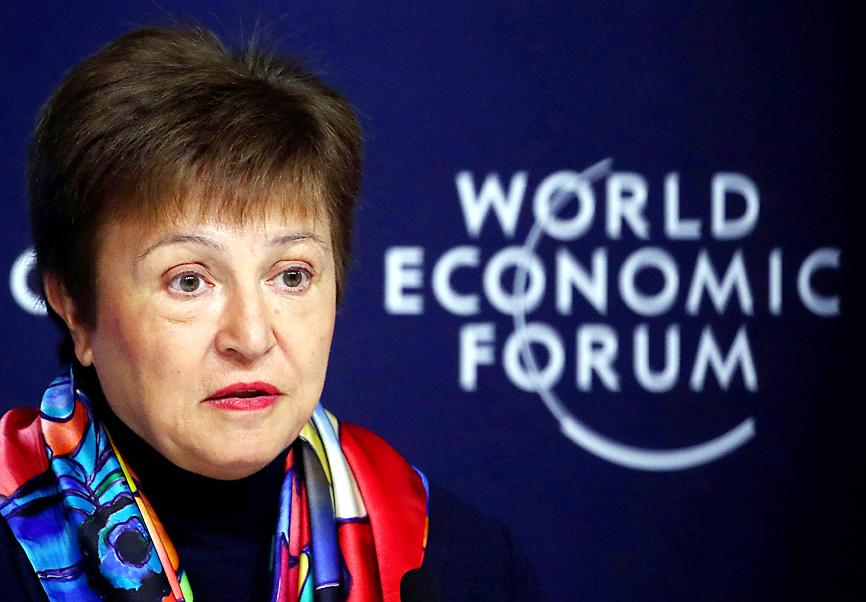
Photo: Reuters
That means accelerating access to vaccines and taking advantage of the opportunity presented by the pandemic to invest in green technology, which can create good paying jobs and address climate change, she said.
US Secretary of the Treasury Janet Yellen joined the call, urging “significant” new spending to ensure a solid rebound.
While the economic outlook has “improved significantly,” especially due to substantial government support, “the job is not yet done, given high uncertainty and the risk of permanent scarring,” Yellen said.
“I urge major economies to not just avoid removing support too early, but to strive to provide significant amounts of new fiscal support to secure a robust recovery,” she said.
The IMF now projects global growth of 6 percent this year after a 3.3 percent contraction last year, and credited the US$16 trillion in global public spending during the pandemic with keeping the worst peacetime recession in a century from being three times as severe.
However, Georgieva warned about a “dangerous divergence” in low-income countries’ prospects compared with rich nations, which could worsen if advanced economies such as the US raise interest rates sooner than expected.
She praised the IMF members who agreed to allow the fund to issue US$650 billion in new Special Drawing Rights, an additional pool of IMF currency that would add to nations’ reserves and boost their ability to access financing.
The IMF is expected to present a proposal to its board in June, and Georgieva said that it is working with rich nations to shift some of their share of those reserves to help aid developing nations, which “face a crucial policy transition from crisis to recovery.”
The officials again stressed that ending the pandemic remains central to the economic recovery, and the closing statement from the IMF Committee lamented “uneven access to vaccines.”
The committee said that “strong international cooperation to accelerate vaccine production and support affordable and equitable distribution to all” was needed.
The pandemic offers policymakers a vehicle to capitalize on the need for investments to accelerate green projects that can provide good-paying jobs, officials said.
“Government efforts to support the recovery need to take advantage of the opportunity to accelerate the transition towards a low-carbon economy and limit the long-term threat from climate change,” Organisation for Economic Co-operation and Development Secretary-General Angel Gurria said.
Georgieva said that those investments could create jobs in growing industries to replace those lost in sectors that are shrinking.
“Climate risks are growing, and they are substantial for macroeconomic and financial stability, climate action can generate green growth and green jobs,” she said.
The IMF and the World Bank have also announced plans to intensify the focus on green investment and climate-friendly aspects of their lending programs.

Among the rows of vibrators, rubber torsos and leather harnesses at a Chinese sex toys exhibition in Shanghai this weekend, the beginnings of an artificial intelligence (AI)-driven shift in the industry quietly pulsed. China manufactures about 70 percent of the world’s sex toys, most of it the “hardware” on display at the fair — whether that be technicolor tentacled dildos or hyper-realistic personalized silicone dolls. Yet smart toys have been rising in popularity for some time. Many major European and US brands already offer tech-enhanced products that can enable long-distance love, monitor well-being and even bring people one step closer to

Malaysia’s leader yesterday announced plans to build a massive semiconductor design park, aiming to boost the Southeast Asian nation’s role in the global chip industry. A prominent player in the semiconductor industry for decades, Malaysia accounts for an estimated 13 percent of global back-end manufacturing, according to German tech giant Bosch. Now it wants to go beyond production and emerge as a chip design powerhouse too, Malaysian Prime Minister Anwar Ibrahim said. “I am pleased to announce the largest IC (integrated circuit) Design Park in Southeast Asia, that will house world-class anchor tenants and collaborate with global companies such as Arm [Holdings PLC],”

Sales in the retail, and food and beverage sectors last month continued to rise, increasing 0.7 percent and 13.6 percent respectively from a year earlier, setting record highs for the month of March, the Ministry of Economic Affairs said yesterday. Sales in the wholesale sector also grew last month by 4.6 annually, mainly due to the business opportunities for emerging applications related to artificial intelligence (AI) and high-performance computing technologies, the ministry said in a report. The ministry forecast that retail, and food and beverage sales this month would retain their growth momentum as the former would benefit from Tomb Sweeping Day

Thousands of parents in Singapore are furious after a Cordlife Group Ltd (康盛人生集團), a major operator of cord blood banks in Asia, irreparably damaged their children’s samples through improper handling, with some now pursuing legal action. The ongoing case, one of the worst to hit the largely untested industry, has renewed concerns over companies marketing themselves to anxious parents with mostly unproven assurances. This has implications across the region, given Cordlife’s operations in Hong Kong, Macau, Indonesia, the Philippines and India. The parents paid for years to have their infants’ cord blood stored, with the understanding that the stem cells they contained


 RSS
RSS