


European stocks ended the week close to all-time highs, with miners prominent as investors shrugged off worries about a third wave of COVID-19 infections and focused on prospects of a solid global economic recovery.
The pan-European STOXX 600 index rose 0.91 percent to 426.93 on Friday, seven points short of a record high.
It increased 0.85 percent from a week earlier to record its fourth straight weekly rise.
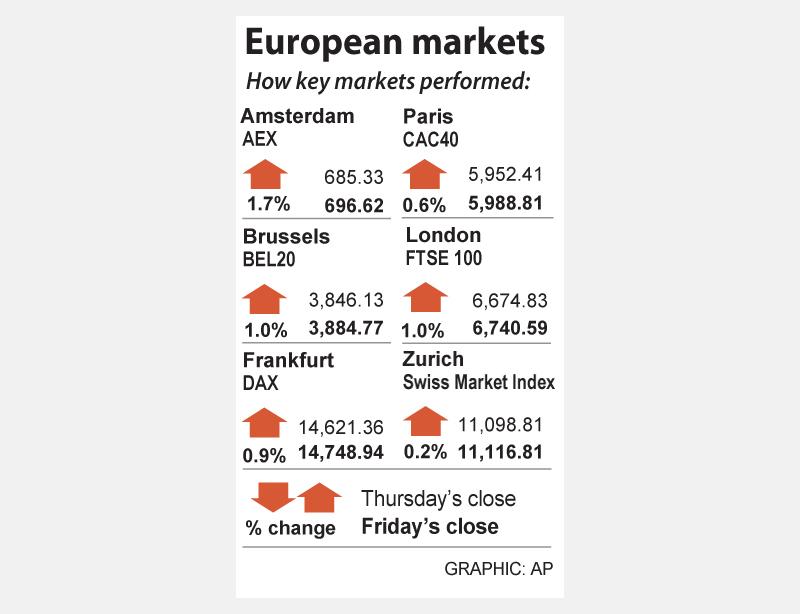
Mining, and oil and gas stocks gave the biggest boost to the index, while defensive sectors including healthcare and utilities were slightly down.
Led by chipmakers, notably ASML and ASM International, the STOXX 600 tech index rose 2.72 percent to 670.81, posting a weekly gain of 4.49 percent, its biggest since early November.
Trading earlier in the week was subdued by worries about new lockdowns and a slow vaccination pace in the eurozone, but optimism about a stimulus-driven recovery in the US brightened the outlook for global growth.
“Ultimately — you still have abundant fiscal and monetary support as the economies open up,” said Ankit Gheedia, BNP Paribas’ head of equity and derivative strategy for Europe.
Although the market has been driven mainly by concerns of a third wave of COVID-19 and slower vaccinations in continental Europe over the past week, Gheedia said that supply is likely to pick up sharply over the next few weeks.
“It’s the best time to be long equities ... with value as a longer-term trade,” Gheedia said.
With rising hopes of a strong economic recovery, the world’s largest steelmaker, ArcelorMittal SA, rose 7.4 percent, while shares in Rio Tinto Group, Glencore PLC and BHP Group were up between 3.7 percent and 5 percent.
Morgan Stanley said global equities should slow down but Europe was poised to outperform relative to other markets, as it expects the region’s relative economic momentum to improve over the next three to six months.
Mining and oil stocks also helped London’s FTSE 100 index end a subdued week on a positive note, and higher retail sales last month underpinned optimism over a swifter global economic recovery.
The blue chip FTSE 100 index ended 0.99 percent higher at 6,740.59, and rose 0.48 percent from a week earlier.
“I don’t think investors are looking at anything other than single stocks scenarios, and you can tell by today’s market action there’s not a lot of real conviction out there apart from the metal and oil-related,” said Keith Temperton, an equity sales trader at Forte Securities.
The FTSE 100 has rebounded more than 36 percent from a COVID-19-driven crash last year.

The domestic unit of the Chinese-owned, Dutch-headquartered chipmaker Nexperia BV will soon be able to produce semiconductors locally within China, according to two company sources. Nexperia is at the center of a global tug-of-war over critical semiconductor technology, with a Dutch court in February ordering a probe into alleged mismanagement at the company. The geopolitical tussle has disrupted supply chains, with some carmakers reportedly forced to cut production due to chip shortages. Local production would allow Nexperia’s domestic arm, Nexperia Semiconductors (China) Ltd (安世半導體中國), to bypass restrictions in place since October on the supply of silicon wafers — etched with tiny components to

Singapore-based ride-hailing and delivery giant Grab Holdings Ltd has applied for regulatory approval to acquire the Taiwan operations of Germany-based Delivery Hero SE's Foodpanda in a deal valued at about US$600 million. Grab submitted the filing to the Fair Trade Commission on Friday last week, with the transaction subject to regulatory review and approval, the company said in a statement yesterday. Its independent governance structure would help foster a healthy and competitive market in Taiwan if the deal is approved, Grab said. Grab, which is listed on the NASDAQ, said in the filing that US-based Uber Technologies Inc holds about 13 percent of

Taiwan Semiconductor Manufacturing Co (TSMC, 台積電) yesterday received government approval to deploy its advanced 3-nanometer (3nm) process at its second fab currently under construction in Japan, the Ministry of Economic Affairs said in a news release. The ministry green-lit the plan for the facility in Kumamoto, which is scheduled to start installing equipment and come online in 2028 with a monthly production capacity of 15,000 12-inch wafers, the ministry said. The Department of Investment Review in June 2024 authorized a US$5.26 billion investment for the facility, slated to manufacture 6- to 12nm chips, significantly less advanced than 3nm process. At a meeting with

Taiwan is open to joining a global liquefied natural gas (LNG) program if one is created, but on the condition that countries provide delivery even in a scenario where there is a conflict with China, an energy department official said yesterday. While Taiwan’s priority is to have enough LNG at home, the nation is open to exploring potential strategic reserves in other countries such as Japan or South Korea, Energy Administration Deputy Director-General Chen Chung-hsien (陳崇憲) said. While the LNG market does not have a global reserve for emergencies like that of oil, the concept has been raised a few times —


 RSS
RSS