


Contract laptop computer maker Compal Electronics Inc (仁寶) yesterday forecast year-on-year double-digit percentage growth for its laptop computer shipments, thanks to strong demand.
Compal president Martin Wong (翁宗斌) told an investors’ conference that he predicted double-digit percentage growth year-on-year “without too many difficulties.”
Even with uncertainty over component shortages, Compal’s PC and non-PC businesses should grow by double-digit percentage points this year, with overall growth of 20 to 25 percent, Wong said.
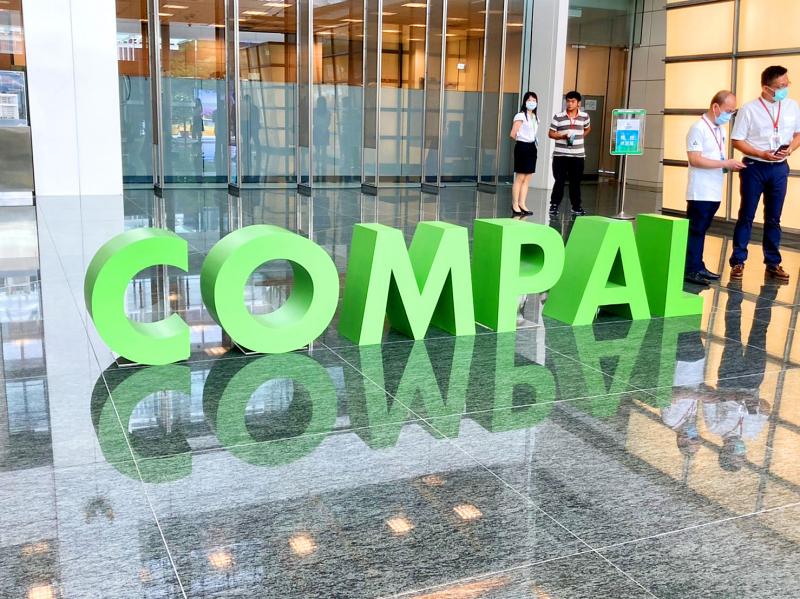
Photo: Chen Rou-chen, Taipei Times
Despite high demand for laptop computers, Compal’s sales in the first quarter had been constrained by component shortages, he said.
“The boom in laptop demand caused a shortage in semiconductor packaging materials. This is a problem that is hard to solve in the short term,” he said.
Wong said that he anticipates a “strong rebound” by the second quarter.
Net profit last year jumped 35 percent to NT$9.36 billion (US$327.25 million) from a year earlier, benefiting from strong demand for laptops related to work-from-home and remote-learning trends due to the COVID-19 pandemic.
That translated into earnings per share of NT$2.15 last year, an eight-year high.
Last year, consolidated revenue rose 7 percent year-on-year to NT$1.04 trillion, the first time Compal’s consolidated revenue has broken the trillion-dollar mark.
Compal’s consolidated fourth-quarter revenue was NT$334.0 billion, up 24.0 quarter-on-quarter and 24.8 percent year-on-year. Gross margin was 3.67 percent, up 0.1 percent year-on-year. Net profit was NT$4.58 billion, up 109.4 percent quarter-on-quarter and 127.5 percent year-on-year. Earnings per share for the fourth quarter were NT$1.05.
About 35 percent of the world’s No. 2 contract laptop maker’s operations are non-PC businesses, including automotive electronics, 5G and medical electronics.
Having invested in electric vehicles (EVs) over the past eight or nine years, Compal counts major European and US automakers among its customers. Its EV-related business is growing at about 30 to 40 percent per year.
“The EV market is very demanding and it takes a long time for each product to mature,” Wong said. “It’s not instant gratification.”


The domestic unit of the Chinese-owned, Dutch-headquartered chipmaker Nexperia BV will soon be able to produce semiconductors locally within China, according to two company sources. Nexperia is at the center of a global tug-of-war over critical semiconductor technology, with a Dutch court in February ordering a probe into alleged mismanagement at the company. The geopolitical tussle has disrupted supply chains, with some carmakers reportedly forced to cut production due to chip shortages. Local production would allow Nexperia’s domestic arm, Nexperia Semiconductors (China) Ltd (安世半導體中國), to bypass restrictions in place since October on the supply of silicon wafers — etched with tiny components to

Taiwan’s foreign exchange reserves fell below the US$600 billion mark at the end of last month, with the central bank reporting a total of US$596.89 billion — a decline of US$8.6 billion from February — ending a three-month streak of increases. The central bank attributed the drop to a combination of factors such as outflows by foreign institutional investors, currency fluctuations and its own market interventions. “The large-scale outflows disrupted the balance of supply and demand in the foreign exchange market, prompting the central bank to intervene repeatedly by selling US dollars to stabilize the local currency,” Department of Foreign

Taiwan is open to joining a global liquefied natural gas (LNG) program if one is created, but on the condition that countries provide delivery even in a scenario where there is a conflict with China, an energy department official said yesterday. While Taiwan’s priority is to have enough LNG at home, the nation is open to exploring potential strategic reserves in other countries such as Japan or South Korea, Energy Administration Deputy Director-General Chen Chung-hsien (陳崇憲) said. While the LNG market does not have a global reserve for emergencies like that of oil, the concept has been raised a few times —
AI-FUELED DEMAND: The company has been benefiting from the skyrocketing prices for DRAM chips amid the AI frenzy, especially its core product — DDR4 DRAM chips DRAM chipmaker Nanya Technology Corp (南亞科技) yesterday reported that its revenue for the first quarter surged 582.91 percent to NT$49.09 billion (US$1.54 billion) from NT$7.19 billion a year earlier, as the supply crunch caused chip price spikes. Last quarter’s figure is the highest on record. On a quarterly basis, revenue jumped 63.14 percent from NT$30.09 billion, the company said. In January, Nanya Technology expected global DRAM supply scarcity to continue through the first half of 2028, thanks to strong demand for artificial intelligence (AI) applications. Market researcher TrendForce Corp (集邦科技) forecast prices of standard DRAM chips would rise between 58 percent and 63


 RSS
RSS