


Marks & Spencer Group PLC (M&S) is to launch Web sites in 46 new overseas markets to try to revive an international business that has languished for years in spite of multiple turnaround efforts.
The British seller of food, clothing and housewares said the expansion into nations from Nepal to Bolivia and Uzbekistan would extend its online reach to more than 100 countries in a cost-effective way.
Paul Friston, the international director at M&S, said online sales to customers abroad are soaring since the start of the COVID-19 pandemic, jumping by 75 percent in the first half alone as more people worldwide favor shopping from home.
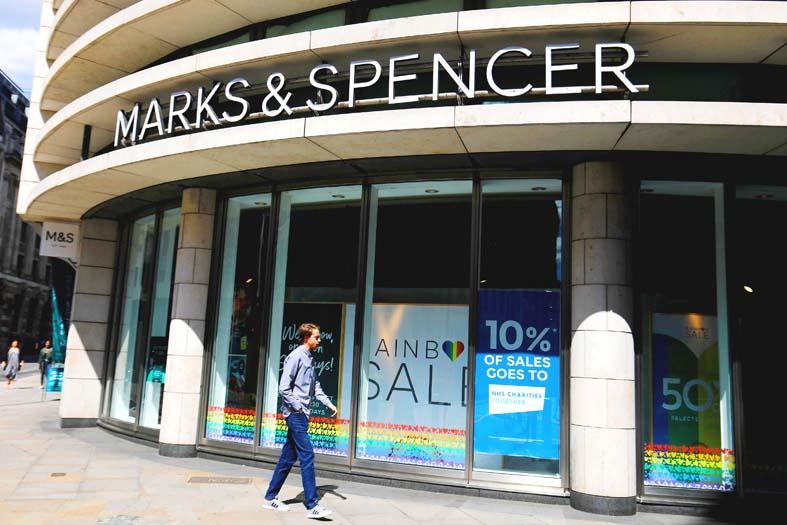
Photo: Tolga Akmen, AFP
The new Web sites would offer a range of clothing and home products, with orders fulfilled through the company’s existing distribution network.
The push would allow the retailer to “explore underlying demand in these markets without significant upfront investment,” Friston said in a statement.
A household name in the UK, Marks & Spencer sells both online and through hundreds of stores across the country.
However, profitability has been falling for years, hurt by a long-struggling clothing and home division, and wider structural changes in the highly competitive UK market.
The international business has also had a mixed record over the past decade, with the brand’s franchise arm generally performing better than wholly owned stores.
In 2011, under then-chief executive officer Marc Bolland, Marks & Spencer returned to France with much fanfare after a 10-year absence. It opened a flagship store on the Champs-Elysees in Paris, which Bolland heralded as a symbol of its success abroad.
However, within several years the retailer was in retreat. It shut that store, along with scores more unprofitable outlets across Europe.
In the past decade, operating profit in M&S’ international division has fallen from £147 million (US$203 million) to just more than £110 million on revenue that has largely hovered around £1 billion.
Steve Rowe, the chief executive officer leading the latest turnaround effort, in May last year said the retailer had completed the first phase of transforming the international business by moving away from direct ownership to a franchise and joint-venture model.
Now the focus is on “localizing ranges, reducing prices and developing sales online globally,” he said.

The domestic unit of the Chinese-owned, Dutch-headquartered chipmaker Nexperia BV will soon be able to produce semiconductors locally within China, according to two company sources. Nexperia is at the center of a global tug-of-war over critical semiconductor technology, with a Dutch court in February ordering a probe into alleged mismanagement at the company. The geopolitical tussle has disrupted supply chains, with some carmakers reportedly forced to cut production due to chip shortages. Local production would allow Nexperia’s domestic arm, Nexperia Semiconductors (China) Ltd (安世半導體中國), to bypass restrictions in place since October on the supply of silicon wafers — etched with tiny components to

Singapore-based ride-hailing and delivery giant Grab Holdings Ltd has applied for regulatory approval to acquire the Taiwan operations of Germany-based Delivery Hero SE's Foodpanda in a deal valued at about US$600 million. Grab submitted the filing to the Fair Trade Commission on Friday last week, with the transaction subject to regulatory review and approval, the company said in a statement yesterday. Its independent governance structure would help foster a healthy and competitive market in Taiwan if the deal is approved, Grab said. Grab, which is listed on the NASDAQ, said in the filing that US-based Uber Technologies Inc holds about 13 percent of

Taiwan Semiconductor Manufacturing Co (TSMC, 台積電) yesterday received government approval to deploy its advanced 3-nanometer (3nm) process at its second fab currently under construction in Japan, the Ministry of Economic Affairs said in a news release. The ministry green-lit the plan for the facility in Kumamoto, which is scheduled to start installing equipment and come online in 2028 with a monthly production capacity of 15,000 12-inch wafers, the ministry said. The Department of Investment Review in June 2024 authorized a US$5.26 billion investment for the facility, slated to manufacture 6- to 12nm chips, significantly less advanced than 3nm process. At a meeting with

Taiwan’s food delivery market could undergo a major shift if Singapore-based Grab Holdings Ltd completes its planned acquisition of Delivery Hero SE’s Foodpanda business in Taiwan, industry experts said. Grab on Monday last week announced it would acquire Foodpanda’s Taiwan operations for US$600 million. The deal is expected to be finalized in the second half of this year, with Grab aiming to complete user migration to its platform by the first half of next year. A duopoly between Uber Eats and Foodpanda dominates Taiwan’s delivery market, a structure that has remained intact since the Fair Trade Commission (FTC) blocked Uber Technologies Inc’s


 RSS
RSS