


Starlux Airlines Co (星宇航空) is considering delaying plans to fly from Taiwan to North America and Guam until the end of next year due to uncertainty over border restrictions, the company said yesterday.
“We are thinking of pushing back our plan to expand routes to North America to the end of next year,” Starlux spokesman Nieh Kuo-wei (聶國維) told the Taipei Times by telephone.
It had earlier proposed starting the flights in the middle of next year.
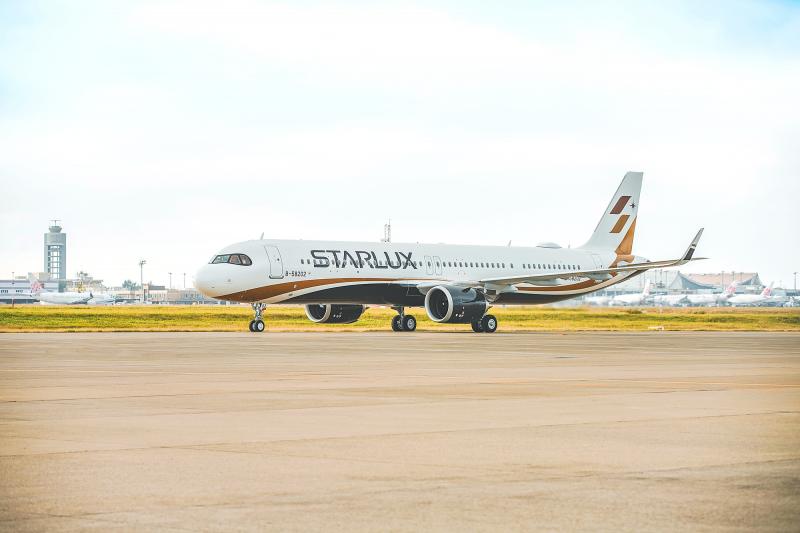
Photo courtesy of StarLux Airlines Co
“The outlook remains clouded,” Nieh said. “Although some have predicted that border controls would be eased with the US administering COVID-19 jabs, the situation is still uncertain.”
The International Air Transport Association has launched a travel pass system for governments and airlines that requires travelers to either provide a negative COVID-19 test or proof of vaccination, but it remains to be seen whether the system would be accepted in Taiwan, he said.
Starlux has applied to the Civil Aeronautics Administration (CAA) to operate 15 new routes from Taiwan to destinations including Boston, Chicago, Guam, Houston, Los Angeles, Miami, New York, San Francisco, Seattle and Washington.
If it defers launching the flights to the end of next year, it would not need to reapply to the CAA, Nieh said.
However, it still needs approval from US regulators before launching the routes, he said.
Starlux would evaluate which destinations are most suitable to operate first, based on passenger demand and air cargo business potential, he said.
The airline might pick three or four destinations to begin flights next year, and another five to six destinations in 2023, Nieh said.
The airline in 2019 inked a deal with Airbus SE to purchase 17 A350s, and would start to take delivery of five A350-900s this year and 12 A350-1000s next year, he said.
Delivery of the first jets has been rescheduled to next year, as the pandemic has disrupted Airbus’ global supply chain, Nieh said.
Starlux has not finalized how many A350 jets it would receive next year, he said.
Starlux, which began operations in January last year, had a 2.13 percent market share in terms of passenger numbers and a 0.08 percent market share in terms of cargo volume in December last year, CAA statistics showed.

UNPRECEDENTED PACE: Micron Technology has announced plans to expand manufacturing capabilities with the acquisition of a new chip plant in Miaoli Micron Technology Inc unveiled a newly acquired chip plant in Miaoli County yesterday, as the company expands capacity to meet growing demand for advanced DRAM chips, including high-bandwidth memory chips amid the artificial intelligence boom. The plant in Miaoli County’s Tongluo Township (銅鑼), which Micron acquired from Powerchip Semiconductor Manufacturing Corp (力積電) for US$1.8 billion, is expected to make a sizeable capacity contribution to the company from fiscal 2028, the company said in a statement. It would be an extended production site of Micron’s large-scale manufacturing hub in Taichung, the company said. As the global semiconductor industry is racing to reach US$1 trillion

Singapore-based ride-hailing and delivery giant Grab Holdings Ltd has applied for regulatory approval to acquire the Taiwan operations of Germany-based Delivery Hero SE's Foodpanda in a deal valued at about US$600 million. Grab submitted the filing to the Fair Trade Commission on Friday last week, with the transaction subject to regulatory review and approval, the company said in a statement yesterday. Its independent governance structure would help foster a healthy and competitive market in Taiwan if the deal is approved, Grab said. Grab, which is listed on the NASDAQ, said in the filing that US-based Uber Technologies Inc holds about 13 percent of

Taiwan’s food delivery market could undergo a major shift if Singapore-based Grab Holdings Ltd completes its planned acquisition of Delivery Hero SE’s Foodpanda business in Taiwan, industry experts said. Grab on Monday last week announced it would acquire Foodpanda’s Taiwan operations for US$600 million. The deal is expected to be finalized in the second half of this year, with Grab aiming to complete user migration to its platform by the first half of next year. A duopoly between Uber Eats and Foodpanda dominates Taiwan’s delivery market, a structure that has remained intact since the Fair Trade Commission (FTC) blocked Uber Technologies Inc’s

Memory chip stocks extended their losses yesterday after Alphabet Inc’s Google publicized research that could allow more efficient use of the storage needed for artificial intelligence (AI) development. SK Hynix Inc and Samsung Electronics Co, South Korean leaders in the market, fell more than 6 percent and about 5 percent respectively in Seoul. In the US, Micron Technology Inc, Western Digital Corp and Sandisk Corp slid more than 2 percent in pre-market trading, after they all closed lower on Wednesday. Memory companies have been on a tear in recent months as the rapid development of AI infrastructure triggered a spike in chip


 RSS
RSS