


Conventional wisdom holds that tax revenue increases amid a growing economy. However, Taiwan’s lower-than-expected tax revenue last year is contrary to this widely held view.
Government statistics show that GDP expanded 3.11 percent year-on-year last year, but tax revenue fell 2.9 percent, following a 3.5 percent increase in the previous year.
“In 2020, tax revenue totaled NT$2.398 trillion [US$84.62 billion at the current exchange rate], a decrease of NT$71.9 billion, or 2.9 percent, from 2019. It was the first decline in 11 years, mainly due to decreased corporate income tax revenue and commodity tax revenue,” the Ministry of Finance said in a report on Saturday.
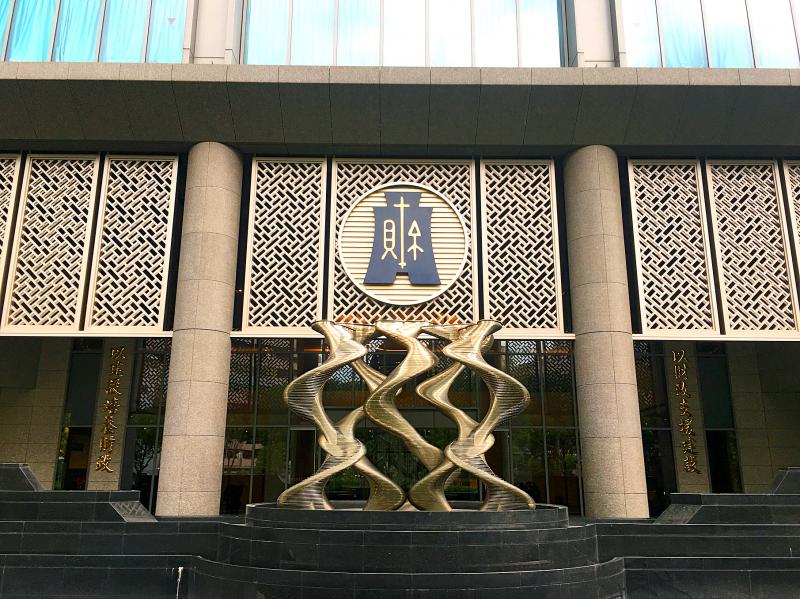
Photo: Clare Cheng, Taipei Times
Even though revenue from the securities transaction tax soared to a record high last year, while land value increment tax revenue and revenue from gift and inheritance taxes also increased sharply, total tax revenue last year was NT$22.3 billion below the government’s target, the ministry said.
“It is the first time in seven years that the government has failed to meet its revenue goal,” the ministry’s report said.
The ministry reported preliminary tax revenue data for last year on Jan. 12, and it offered more accurate and detailed statistics on Saturday, including tax data from other government agencies and deferred tax revenue from December last year.
Based on its report, corporate income tax revenue decreased by NT$170.9 billion, or 26.4 percent, from the previous year, the largest fall among all tax items and a record drop for the income tax.
The ministry attributed the decline to lackluster earnings in 2018 of listed companies, tax cuts on companies’ undistributed earnings and the preferential tax rates for industrial innovation.
Last year, firms affected by the COVID-19 pandemic could apply for deferred tax payment or extension of tax payment in installments, and companies that met certain conditions were exempt from temporary payment, also affecting tax revenue, the ministry said.
Commodity tax revenue fell NT$6.7 billion, or 3.8 percent, which the ministry said was mainly due to government policies including tax rebates for the purchase of new vehicles and energy-saving home appliances.
Among all tax items, the securities transaction tax, business tax, tobacco and alcohol tax, and vehicle license tax generated the highest revenue on record last year, while the personal income tax, inheritance tax, customs duty and house tax reported the second-highest level on record, the report said.
Regarding the correlation between tax revenue and economic growth, the ministry said that the two have in the past few years often deviated, suggesting that they do not necessarily maintain “a symmetrical relationship” in the long run.
“There are three factors behind this deviation,” it said.
First is the price factor: The ministry said that the economic growth rate refers to the change in real GDP excluding the effect of prices, but tax revenue changes are affected by price and trade volume, the ministry said.
Second, to measure GDP, the total output of all industries, the input of intermediates is deducted, but taxes are levied on all of them, it said.
Thus, GDP and taxation are not immediately connected, the ministry added.
Third, changes in the tax system and taxation rates, as well as new inspecting and auditing measures would have an effect in the longer term, the ministry said.

Taiwan’s foreign exchange reserves fell below the US$600 billion mark at the end of last month, with the central bank reporting a total of US$596.89 billion — a decline of US$8.6 billion from February — ending a three-month streak of increases. The central bank attributed the drop to a combination of factors such as outflows by foreign institutional investors, currency fluctuations and its own market interventions. “The large-scale outflows disrupted the balance of supply and demand in the foreign exchange market, prompting the central bank to intervene repeatedly by selling US dollars to stabilize the local currency,” Department of Foreign

Intel Corp is joining Elon Musk’s long-shot effort to develop semiconductors for Tesla Inc, Space Exploration Technologies Corp and xAI, marking a surprising twist in the chipmaker’s comeback bid. Intel would help the Terafab project “refactor” the technology in a chip factory, the company said on Tuesday in a post on X, Musk’s social media platform. That is a stage in the development process that typically helps make chips more powerful or reliable. The chipmaker’s shares jumped 4.2 percent to US$52.91 in New York trading on Tuesday. The Terafab project is a grand plan by Musk to eventually manufacture his own chips for
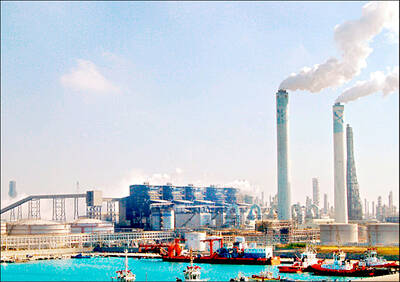
Taiwan Power Co (Taipower, 台電) yesterday said it plans to resume operations at two coal-fired power generators for three months to boost security of electricity supply as liquefied natural gas (LNG) supply risks are running high due to the Middle East conflict. The two coal-fired power generators are at Mailiao Power Plant in Yunlin County’s Mailiao Township (麥寮). The plant, operated by Formosa Plastics Group (台塑集團), supplied electricity to Taipower’s power grid until the end of last year. Taipower’s decision came about one month after Minister of Economic Affairs Kung Ming-hsin (龔明鑫) on March 10 said that the nation had no imminent

Some robotaxi passengers were left stranded in the middle of fast-moving traffic in a major Chinese city after their driverless vehicles stopped running, according to police and media reports on Wednesday. A preliminary investigation indicates more than 100 robotaxis came to a halt because of a “system malfunction,” police in the city of Wuhan said in a statement, without elaborating. No injuries were reported. One passenger told Chinese media that their robotaxi stopped after turning a corner. An instruction on a screen read: “Driving system malfunction. Staff are expected to arrive in 5 minutes.” After no one showed up, the passenger pushed


 RSS
RSS